
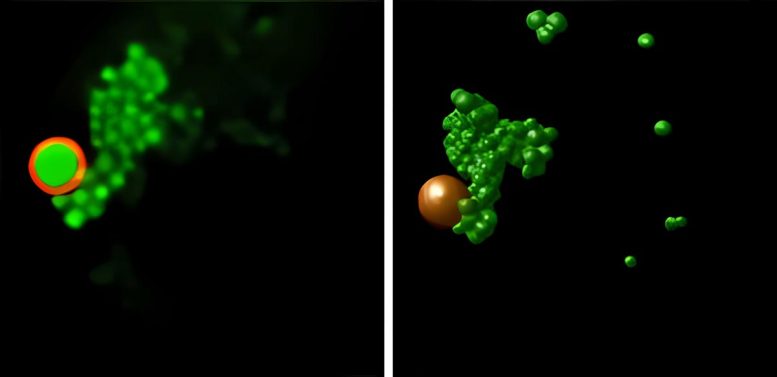
A newly published study suggests that fat is stored in the body in two distinct ways and may lead to ways to prevent cells from storing excess fat and possibly to new approaches for treating obesity.
Fat is stored in the body in two distinct ways, Yale researchers have discovered. While the finding may not help people shed excess pounds, it may shed light on how to prevent health problems associated with weight gain.
“We need a better understanding of how cells actually package fat,” said Tobias Walther, associate professor of cell biology at Yale and senior author of the study published online on February 14 in the journal Developmental Cell. “The cell’s inability to process all the excess energy — not the fat itself — is what causes most health problems.”
Unused metabolic energy triggers the production of triacylglycerol and the creation of fat in the form of lipid droplets. Mammals have developed specialized fat cells called adipose tissue to store this energy. It is the rapid expansion of these lipid droplets while storing excess calories that cause the bulging waists and thighs that plague dieters. Health problems occur when cells become overwhelmed with lipids and lose their ability to store energy. The result is inflammation, insulin resistance, fatty liver, and other health problems associated with obesity.
The Yale researchers working with Robert Farese at the University of California-San Francisco found that not all lipid droplets are the same. One type of lipid droplet was small and did not expand. A second type of lipid droplet, however, has triacylglycerol enzymes on its surface that allows it to expand.
“Dr. Walther’s exciting finding that some lipid droplets can grow while others do not should lead to ways to prevent cells from storing excess fat and possibly to new approaches for treating obesity,” said Jean Chin of the National Institutes of Health’s National Institute of General Medical Sciences, which partly funded the work.
Walther said that exploring ways to prevent failure of cells’ ability to accommodate excess energy may be a more an effective way to tackle the health problems associated with obesity than simply trying to get rid of fat itself.
“Historically, concentrating on just burning fat cells has not worked too well,” he said.
Reference: “Triacylglycerol Synthesis Enzymes Mediate Lipid Droplet Growth by Relocalizing from the ER to Lipid Droplets” by Florian Wilfling, Huajin Wang, Joel T. Haas, Natalie Krahmer, Travis J. Gould, Aki Uchida, Ji-Xin Cheng, Morven Graham, Romain Christiano, Florian Fröhlich, Xinran Liu, Kimberly K. Buhman, Rosalind A. Coleman, Joerg Bewersdorf, Robert V. Farese Jr. and Tobias C. Walther, 14 February 2013, Developmental Cell.
DOI; 10.1016/j.devcel.2013.01.013
Florian Wilfling of Yale is first author of the paper.
Never miss a breakthrough: Join the SciTechDaily newsletter.
Follow us on Google and Google News.
1 Comment
We know that many people do not become obese, in spite of normal taking of food and calories. They represent a class of people who are genetically designed to metabolize rather vigorously by using more calories for their day to day work. In obese people, our cells are unnecessarily efficient in using the calories to minimize their spending for day to day work and hence the adipose cells store fat with unused lipids in the system, which otherwise should be spent rather liberally.They are like great savers of energy which is required only in very cold pole region, to store as fat as in the case of polar bear, to compensate the hibernation in winter months. This genetic make up is not required for tropical people who always live in warm weather, and such people tend to get belly fat if not exercised properly. This follows a viscious circle to store more and more fat and become more and more lethargic in activities, when economising the calories also increases in their cells unnecessarily. Thus obesity should be attacked in the genetic pathway and it is really a long way to go, because our genes won’t listen to the reality as they are tutored by their heredity make up and environmental make up of their ancestors.