
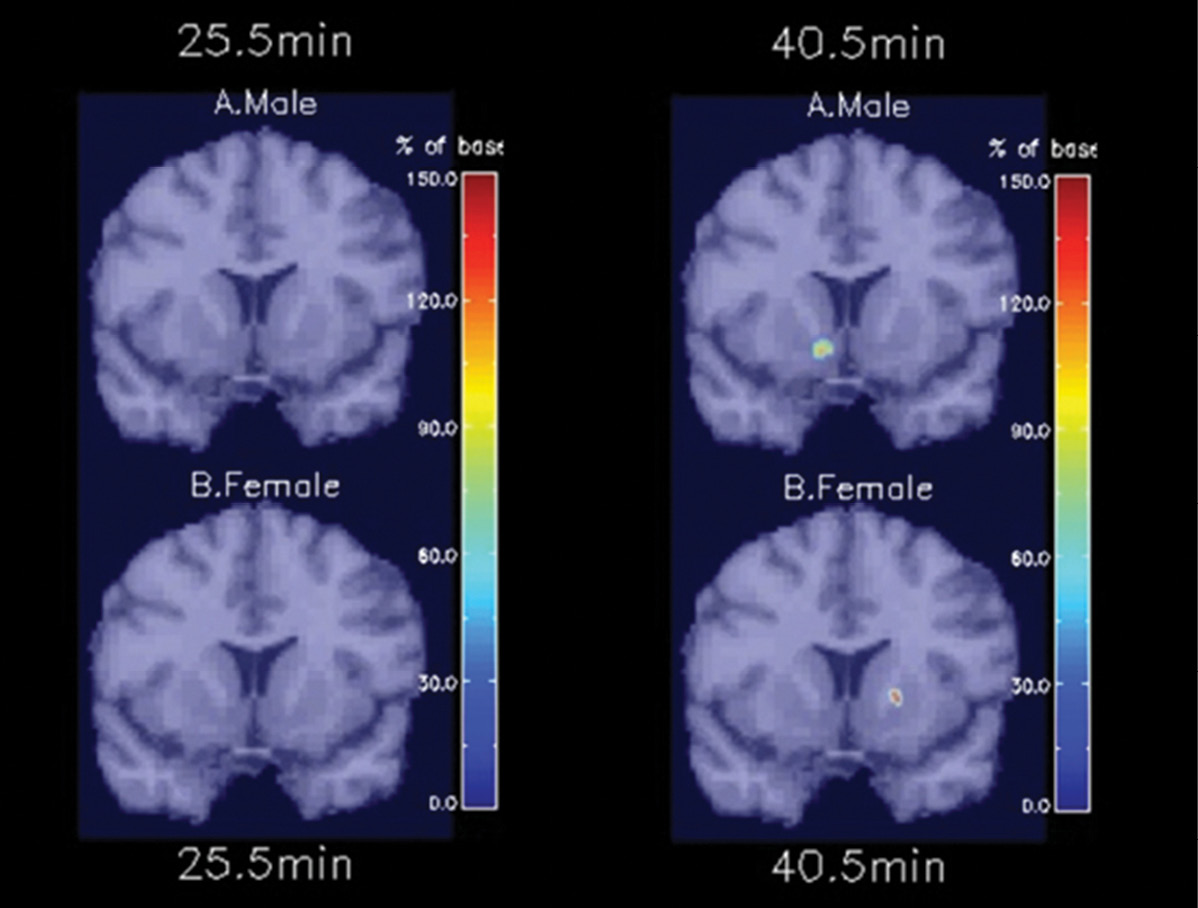
New research from Yale University shows that men and women respond to cigarettes differently, demonstrating for the first time that smoking-induced dopamine activation occurs in a different brain region and much faster in nicotine-dependent men than women.
Yale researchers using a new brain imaging analysis method have confirmed that smoking cigarettes activates a dopamine-driven pleasure and satisfaction response differently in men compared to women.
The study, to be published in The Journal of Neuroscience, used a new way of analyzing PET (positron emission tomography) scans to create “movies” of the dopamine response during smoking to demonstrate for the first time that smoking-induced dopamine activation occurs in a different brain region and much faster in nicotine-dependent men than women.
In practical terms, identifying and understanding the neurobiological underpinnings of the sex differences in smoking behavior, by identifying unique “dopamine signatures” of nicotine dependence in men and women could provide paths for developing and testing gender-sensitive medications and other approaches for quitting smoking.
“By way of analogy, think of an EKG,” explained Evan D. Morris, associate professor of diagnostic radiology, biomedical engineering, and psychiatry, researcher at the Yale Cancer Center, and the senior author on the study. “It shows you a pattern of electrical activity in the heart over the whole cardiac cycle. You can’t identify tachycardia from a single moment in the EKG. Similarly, our dopamine movies show patterns of dopamine activation in the brain over time. This was not possible previously. We hope to find patterns that indicate addiction and patterns that indicate the effectiveness of treatment for addiction.”
In the new study, 16 nicotine-dependent smokers — eight men and eight women — underwent PET brain scanning during smoking sessions. A novel method of analyzing the results allowed the research team to create dynamic images, “dopamine activation movies,” to visualize rapidly changing levels of the neurotransmitter. Brief bursts of dopamine activity — such as one gets from smoking a cigarette — were previously unmeasurable with PET imaging.
The Yale team found that dopamine release in nicotine-dependent men during smoking was consistent and rapid in the right ventral striatum, a region of the brain central to the reinforcement effect of drugs such as nicotine. A similarly rapid dopamine response was found only in women in a part of the dorsal striatum, a brain region that also happens to be critical for habit formation.
These findings are consistent with the established notion that men smoke for the reinforcing drug effect of nicotine and that they are sensitive to the nicotine level, while women tend to smoke for other reasons, such as to alleviate negative mood and stress or from habit. However, the neurobiological bases for these sex differences have eluded researchers, making it difficult to design gender-specific smoking cessation treatments.
“We might expect nicotine replacement to change the dopamine movie of a typical male smoking but not a female,” said Kelly Cosgrove, associate professor of psychiatry, diagnostic radiology, and neurobiology, and the lead author. “If our hypothesis pans out, then dopamine movies may help explain why nicotine-replacement therapies, such as nicotine patches, appear to be more effective for male smokers than for women.”
Reference: “Sex Differences in the Brain’s Dopamine Signature of Cigarette Smoking” by Kelly P. Cosgrove, Shuo Wang, Su-Jin Kim, Erin McGovern, Nabeel Nabulsi, Hong Gao, David Labaree, Hemant D. Tagare, Jenna M. Sullivan and Evan D. Morris, 10 December 2014, The Journal of Neuroscience.
DOI: 10.1523/JNEUROSCI.3661-14.2014
The study was supported by the National Institute on Drug Abuse and the National Institutes of Health Office of Research on Women’s Health, through the Yale Translational Center to Develop Gender-Sensitive Treatment for Tobacco Dependence.
Other authors from Yale on the study were Shuo Wang, Su-Jin Kim, Erin McGovern, Nabeel Nabulsi, Hong Gao, David Labaree, Hemant D. Tagare, and Jenna M. Sullivan.
Never miss a breakthrough: Join the SciTechDaily newsletter.
Follow us on Google and Google News.