
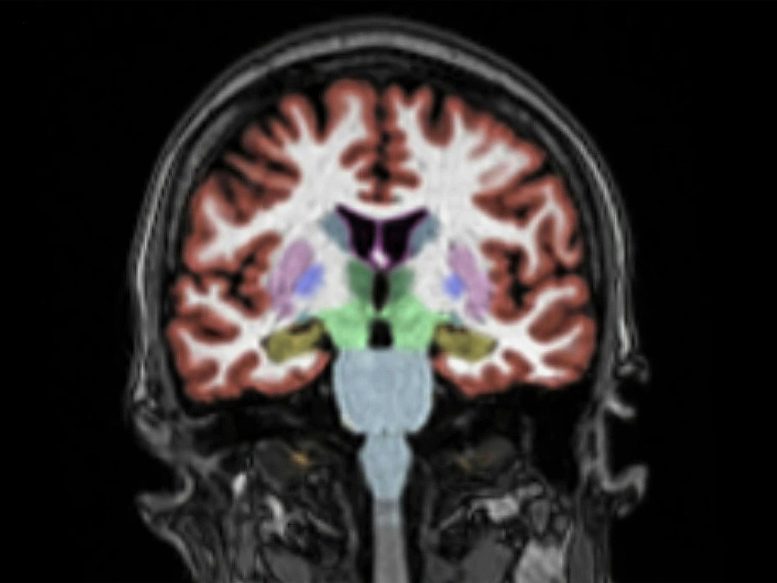
New research from UC Berkeley suggests that sleep disruption in the elderly, mediated by structural brain changes, represents a contributing factor to age-related cognitive decline.
The connection between poor sleep, memory loss and brain deterioration as we grow older has been elusive. But for the first time, scientists at the University of California, Berkeley, have found a link between these hallmark maladies of old age. Their discovery opens the door to boosting the quality of sleep in elderly people to improve memory.
UC Berkeley neuroscientists have found that the slow brain waves generated during the deep, restorative sleep we typically experience in youth play a key role in transporting memories from the hippocampus – which provides short-term storage for memories – to the prefrontal cortex’s longer term “hard drive.”
Postdoctoral fellow, Bryce Mander, demonstrates how the sleep study was conducted.
However, in older adults, memories may be getting stuck in the hippocampus due to the poor quality of deep ‘slow wave’ sleep, and are then overwritten by new memories, the findings suggest.
“What we have discovered is a dysfunctional pathway that helps explain the relationship between brain deterioration, sleep disruption, and memory loss as we get older – and with that, a potentially new treatment avenue,” said UC Berkeley sleep researcher Matthew Walker, an associate professor of psychology and neuroscience at UC Berkeley and senior author of the study to be published this Sunday, January 27, in the journal Nature Neuroscience.
The findings shed new light on some of the forgetfulness common to the elderly that includes difficulty remembering people’s names.
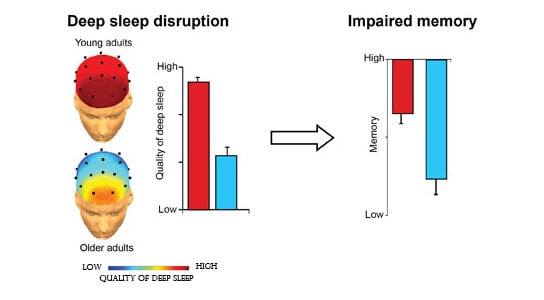
“When we are young, we have deep sleep that helps the brain store and retain new facts and information,” Walker said. “But as we get older, the quality of our sleep deteriorates and prevents those memories from being saved by the brain at night.”
Healthy adults typically spend one-quarter of the night in deep, non-rapid-eye-movement (REM) sleep. Slow waves are generated by the brain’s middle frontal lobe. Deterioration of this frontal region of the brain in elderly people is linked to their failure to generate deep sleep, the study found.
The discovery that slow waves in the frontal brain help strengthen memories paves the way for therapeutic treatments for memory loss in the elderly, such as transcranial direct current stimulation or pharmaceutical remedies. For example, in an earlier study, neuroscientists in Germany successfully used electrical stimulation of the brain in young adults to enhance deep sleep and doubled their overnight memory.
UC Berkeley researchers will be conducting a similar sleep-enhancing study in older adults to see if it will improve their overnight memory. “Can you jumpstart slow wave sleep and help people remember their lives and memories better? It’s an exciting possibility,” said Bryce Mander, a postdoctoral fellow in psychology at UC Berkeley and lead author of this latest study.
For the UC Berkeley study, Mander and fellow researchers tested the memory of 18 healthy young adults (mostly in their 20s) and 15 healthy older adults (mostly in their 70s) after a full night’s sleep. Before going to bed, participants learned and were tested on 120 word sets that taxed their memories.
As they slept, an electroencephalographic (EEG) machine measured their brain wave activity. The next morning, they were tested again on the word pairs, but this time while undergoing functional and structural Magnetic Resonance Imaging (fMRI) scans.
In older adults, the results showed a clear link between the degree of brain deterioration in the middle frontal lobe and the severity of impaired “slow wave activity” during sleep. On average, the quality of their deep sleep was 75 percent lower than that of the younger participants, and their memory of the word pairs the next day was 55 percent worse.
Meanwhile, in younger adults, brain scans showed that deep sleep had efficiently helped to shift their memories from the short-term storage of the hippocampus to the long-term storage of the prefrontal cortex.
Reference: “Prefrontal atrophy, disrupted NREM slow waves and impaired hippocampal-dependent memory in aging” by Bryce A Mander, Vikram Rao, Brandon Lu, Jared M Saletin, John R Lindquist, Sonia Ancoli-Israel, William Jagust and Matthew P Walker, 27 January 2013, Nature Neuroscience.
DOI: 10.1038/nn.3324
Co-authors of the study are William Jagust, Vikram Rao, Jared Saletin and John Lindquist of UC Berkeley; Brandon Lu of the California Pacific Medical Center and Sonia Ancoli-Israel of UC San Diego.
The research was funded by the National Institute of Aging of the National Institutes of Health.
Never miss a breakthrough: Join the SciTechDaily newsletter.
Follow us on Google and Google News.
1 Comment
I am a 63y/o physician on disability because after a traumatic event in my life when I was 48,began loosing memory of my profession,forgetting medical terminology,names of medications etc…I never have a good night sleep.Wake up multiple times during the night plus having severe nightmares.A few yrs ago,went to a neurologist with the complain of inability to express some words,and since I take coumadin,he ordered a PET Scan and atrophy of the left frontal lobe was the result.I wonder if my history is compatible with your findings?