
Close Menu
    Facebook X (Twitter) Instagram
    SciTechDaily
    • Biology
    • Chemistry
    • Earth
    • Health
    • Physics
    • Science
    • Space
    • Technology
    Facebook X (Twitter) Pinterest YouTube RSS
    SciTechDaily
    Home»Science»Understanding Dyscalculia and How the Brain Processes Numbers
    Science

    Understanding Dyscalculia and How the Brain Processes Numbers

    By SciTechDailyJanuary 10, 20132 Comments3 Mins Read
    Facebook Twitter Pinterest Telegram LinkedIn WhatsApp Email Reddit
    Share
    Facebook Twitter LinkedIn Pinterest Telegram Email Reddit
    Understanding-Dyscalculia-How-the-Brain-Processes-Numbers
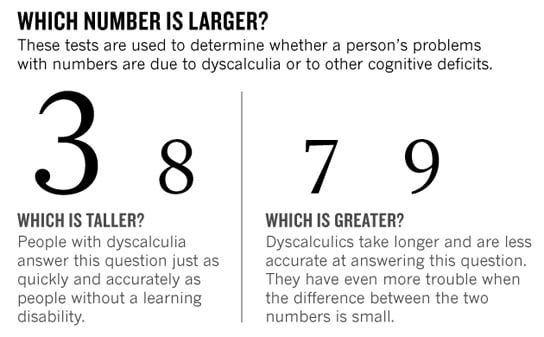
    Dyscalculia, also known as “number blindness,” is a learning disability similar to dyslexia, but for numbers. Credit: Nature 150–153, (10 January 2013), doi:10.1038/493150a

    Dyscalculia is a learning disability, which is sometimes called number blindness, and similar to dyslexia, but for numbers. Researchers estimate that as much as 7% of the population has dyscalculia, which can be marked by severe difficulties in dealing with numbers despite otherwise normal intelligence.

    Neuroscientists believe that the disorder illuminates the inner workings of the human brain and its innate number sense. The sense is as innate as vision or hearing, yet scientists disagree over its cognitive and neural basis.

    Brain Butterworth, a neuroscientist, is hoping to develop treatments for dyscalculia using learning software. If dyscalculia is a deficiency of basic number sense and not memory, attention, or language, then fostering the roots of the number sense could help dyscalculics. A classic sign of dyscalculia is a difficulty in grasping the place-value system.

    Early research led Butterworth to believe that numerical abilities relied on specialized brain networks. Brain scans of an early dyscalculic patient revealed lesions in the parietal lobe. But another patient with the opposite pattern of disability, neurodegeneration that robbed him of speech, language, and knowledge, still managed to do intricate calculations. These findings strengthened Butterworth’s belief that numerical abilities relied on specialized brain networks, and not only on those supporting general intelligence, as many scientists believed at the time.

    Number sense is evolutionarily ancient in humans, tens if not hundreds of millions of years old. Studies of chimpanzees, monkeys, newborn chicks, salamanders, and honeybees point to two parallel systems for representing quantities. The first one called the approximate number sense, distinguishes between larger and smaller quantities. The second one allows humans and some animals to instantly and precisely recognize small quantities of up to four.

    People who are poor at distinguishing approximate quantities do badly in math, indicating that the approximate-number system is crucial. Dyscalculics are poor at recognizing small numbers, indicating that this ability is also fundamental for numeracy. Brain scans of dyscalculics suggest that the intraparietal sulci are less active when processing numbers and less connected with the rest of the brain.

    Other neuroscientists think that approximation and a sense of small numbers, while critical, aren’t enough for humans to precisely grasp large numbers. They argue that language allows people to integrate the two systems, giving them the ability to intuitively distinguish two similar numbers, like 11,478 and 11,479.

    Researchers note that dyslexia, ADHD, and autism spectrum disorder are common among dyscalculics, and it can prove difficult to untangle these problems.

    Reference: “Dyscalculia: Number games” by Ewen Callaway, 9 January 2013, Nature.
    DOI: 10.1038/493150a

    Never miss a breakthrough: Join the SciTechDaily newsletter.
    Follow us on Google and Google News.

    Brain Activity Neurology Neuroscience
    Share. Facebook Twitter Pinterest LinkedIn Email Reddit

    Related Articles

    New Method of Measuring Brain Activity Could Lead to “Mind-Reading” Devices

    Study Reveals Cortex Used for Making Sensory Associations, Not the Hippocampus

    Study Shows Electrical Activity in the Brain after Clinical Death

    Brain Regions Associated With the Successful Spread of Ideas Identified

    Brain Disruption Shows That Mental Illnesses Have Biological Similarities

    Study Shows Breastfeeding Improves Brain Development in Infants

    Scientists Develop a Tool for Reading the Minds of Mice in Real-Time

    Researchers Find a Link between Poor Sleep, Memory Loss and Brain Deterioration

    Photos of Einstein’s Brain Show Unique Features

    2 Comments

    1. Charles Thomas Wild on July 10, 2013 10:41 am

      Dyscalculia is discussed, from time to time, at:

      The ADHD Bulletin Board:

      http//health.groups.yahoo.com/group/ADHD_Bulletin_Board/

      As you may or may not be aware of, some of the stimulants/alerting agents used to temporarily reduce ADHD have been called arithmetic pills since the FDA approved pills, for some, temporarily improve aspects of math ability for some users.

      Thank you for your article about Dyscalculia. Appreciate it.

      Reply
    2. Clay Beaudette on September 22, 2025 11:49 am

      Mr. and Mrs. Butterworth had the uncanny foresight to name their son, a future neuroscientist, BRAIN.

      Seriously, kudos to them. 🤯🙊

      Reply
    Leave A Reply Cancel Reply

    • Facebook
    • Twitter
    • Pinterest
    • YouTube

    Don't Miss a Discovery

    Subscribe for the Latest in Science & Tech!

    Trending News

    Popular Sugar-Free Sweetener Linked to Liver Disease, Study Warns

    What Is Hantavirus? The Deadly Disease Raising Alarm Worldwide

    Scientists Just Discovered How the Universe Builds Monster Black Holes

    Scientists Unveil New Treatment Strategy That Could Outsmart Cancer

    A Simple Vitamin May Hold the Key to Treating Rare Genetic Diseases

    Scientists Think the Real Fountain of Youth May Be Hiding in Your Gut

    Ravens Don’t Follow Wolves, They Predict Them

    This Common Knee Surgery May Be Doing More Harm Than Good

    Follow SciTechDaily
    • Facebook
    • Twitter
    • YouTube
    • Pinterest
    • Newsletter
    • RSS
    SciTech News
    • Biology News
    • Chemistry News
    • Earth News
    • Health News
    • Physics News
    • Science News
    • Space News
    • Technology News
    Recent Posts
    • Popular Supplement Ingredient Linked to Shorter Lifespan in Men
    • Scientists May Have Found a Way To Repair Nerve Damage in Multiple Sclerosis
    • GLP-1 Weight Loss Linked To Dramatically Lower Risk of Sleep Apnea, Kidney Disease and More
    • Scientists Uncover the Surprising Source of Strange Clouds Near the Milky Way’s Supermassive Black Hole
    • This Dazzling Green Snake Was Hiding in Plain Sight for Decades
    Copyright © 1998 - 2026 SciTechDaily. All Rights Reserved.
    • Science News
    • About
    • Contact
    • Editorial Board
    • Privacy Policy
    • Terms of Use

    Type above and press Enter to search. Press Esc to cancel.