
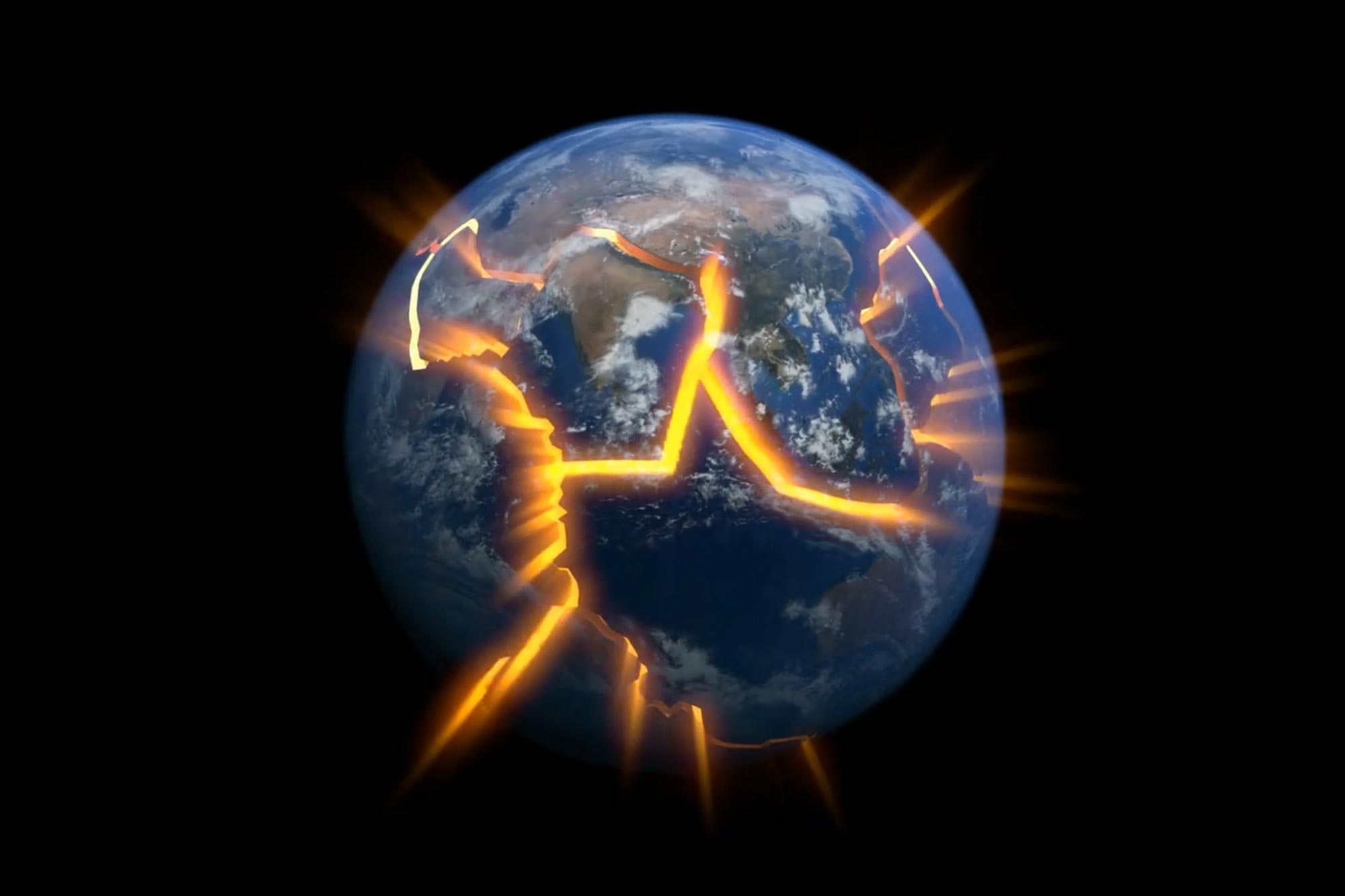
Deep beneath Africa, a massive flow of hot mantle rock appears to be quietly reshaping the continent in ways scientists did not fully expect.
New research is shedding light on why parts of East Africa are deforming in unexpected ways, revealing a powerful force rising from deep within the planet.
Scientists using advanced computer simulations have confirmed that the African Superplume, a massive flow of hot mantle rock rising from deep beneath southwest Africa, is shaping how the East African Rift System is breaking apart.
Continental rifting is the process that slowly tears a landmass apart, eventually forming new ocean basins over millions of years. It begins with the stretching of the lithosphere, Earth’s rigid outer shell. As this layer thins, the upper crust fractures, producing earthquakes and visible cracks, while deeper regions can flow more slowly and smoothly.
How the Lithosphere Responds to Stress
Geophysicist D. Sarah Stamps explains that this contrast in behavior depends on time scale and stress, much like a familiar material.
“If you hit Silly Putty with a hammer, it can actually crack and break,” said Stamps, associate professor in the Department of Geosciences, part of the Virginia Tech College of Science. “But if you slowly pull it apart, the Silly Putty stretches. So on different time scales, Earth’s lithosphere behaves in different ways.”
For decades, scientists have expected most deformation in rift zones to occur perpendicular to the direction of the rift, essentially pulling the crust apart sideways. The East African Rift System, the largest active continental rift on Earth, does show this pattern. But long-term GPS measurements have revealed something puzzling: parts of the region are also shifting parallel to the rift itself.

To investigate, researchers turned to detailed 3D thermomechanical models developed by Tahiry Rajaonarison, now a postdoctoral researcher at New Mexico Tech. His simulations show that this unusual, rift-parallel motion is driven by northward mantle flow tied to the African Superplume.
This finding helps resolve a long-standing debate about what forces dominate the rifting process. Some scientists have argued that relatively shallow forces, known as lithospheric buoyancy, are responsible. These forces are linked to the elevated African Superswell and variations in rock density. Others have pointed to deeper mantle traction forces caused by the horizontal movement of hot rock beneath the surface.
Resolving a Scientific Debate
Earlier modeling work in 2021 suggested that both forces are important. Buoyancy explains the expected sideways stretching, but it could not account for the newly observed parallel motion. The latest study fills that gap by identifying mantle flow from the superplume as the missing driver.
The research also explains a related phenomenon called seismic anisotropy, where seismic waves travel faster in certain directions because of how rocks are aligned underground. In East Africa, that alignment matches the direction of the superplume’s northward flow, offering further evidence of its influence.
“We are saying that the mantle flow is not driving the east-west, rift-perpendicular direction of some of the deformations, but that it may be causing the anomalous northward deformation parallel to the rift,” Rajaonarison said. “We confirmed previous ideas that lithospheric buoyancy forces are driving the rift, but we’re bringing new insight that anomalous deformation can happen in East Africa.”
Deep Earth Processes and Surface Change
The findings were published in Geophysical Research Letters, highlighting how processes occurring hundreds to thousands of kilometers below Earth’s surface can directly influence how continents break apart above.
A separate study also published in 2025 in Geophysical Research Letters focused on how smaller blocks of crust, known as microplates, behave within the rift. Using dense Global Navigation Satellite System data, scientists found that the Victoria microplate, located between major rift branches, is slowly rotating counterclockwise at about 0.0583 ± 0.0293° per million years (roughly 6.48 ± 3.26 millimeters per year, or about 0.26 ± 0.13 inches per year).
The Role of Microplates in Rift Dynamics
The study shows that most of the deformation is concentrated along the edges of this microplate, where faults slip at rates of about 1.8 to 2.2 millimeters per year (about 0.07 to 0.09 inches per year), while the interior remains mostly stable with only minor stretching in some areas.
This rotation helps explain why deformation in the region is not perfectly aligned with the rift itself. Instead, movement is slightly angled, reflecting a combination of forces acting at different depths. It also suggests that the breakup of Africa is not a simple, uniform process, but a complex interaction of deep mantle flow, surface forces, and the shifting motion of smaller crustal blocks.
“We’re excited about this result from Dr. Rajaonarison’s numerical modeling because it provides new information about the complex processes that shape the Earth’s surface through continental rifting,” Stamps said.
References:
“Constraining the Kinematics of the Victoria Microplate and the Northern Western Branch of the East African Rift System” by Asenath Kwagalakwe, D. Sarah Stamps, Folarin Kolawole, Estella A. Atekwana, Michael Taylor, Eliot A. Atekwana, Andrew B. Katumwehe, Peter H. Barry, Emmanuel A. Njinju, Joseph Nyago, Fred Tugume, John Mary Kiberu, Joan Nakajigo, Albert Kabanda, Gladys Kianji and Elifuraha Saria, 14 October 2025, Geophysical Research Letters.
DOI: 10.1029/2025GL116301
“A Geodynamic Investigation of Plume-Lithosphere Interactions Beneath the East African Rift” by Tahiry A. Rajaonarison, D. Sarah Stamps, John Naliboff, Andrew Nyblade and Emmanuel A. Njinju, 27 March 2023, Journal of Geophysical Research: Solid Earth.
DOI: 10.1029/2022JB025800
Never miss a breakthrough: Join the SciTechDaily newsletter.
Follow us on Google and Google News.