
Close Menu
    Facebook X (Twitter) Instagram
    SciTechDaily
    • Biology
    • Chemistry
    • Earth
    • Health
    • Physics
    • Science
    • Space
    • Technology
    Facebook X (Twitter) Pinterest YouTube RSS
    SciTechDaily
    Home»Earth»New Model Reveals Spreading Continents Kick-Started Plate Tectonics
    Earth

    New Model Reveals Spreading Continents Kick-Started Plate Tectonics

    By University of SydneySeptember 18, 2014No Comments3 Mins Read
    Facebook Twitter Pinterest Telegram LinkedIn WhatsApp Email Reddit
    Share
    Facebook Twitter LinkedIn Pinterest Telegram Email Reddit
    New Research on What Set the Earths Plates in Motion
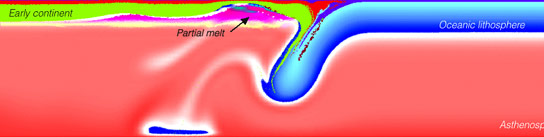
    A snapshot from the film after 45 million years of spreading. The pink is the region where the mantle underneath the early continent has melted, facilitating its spreading, and the initiation of the plate tectonic process. Credit: Patrice Rey, Nicolas Flament and Nicolas Coltice

    New research from the University of Sydney is shedding light on what set the Earth’s massive tectonic plates in motion, suggesting that it was triggered by the spreading of the early continents and eventually it became a self-sustaining process.

    The mystery of what kick-started the motion of our earth’s massive tectonic plates across its surface has been explained by researchers at the University of Sydney.

    “Earth is the only planet in our solar system where the process of plate tectonics occurs,” said Associate Professor Patrice Rey, from the University of Sydney’s School of Geosciences.

    “The geological record suggests that until three billion years ago the earth’s crust was immobile so what sparked this unique phenomenon has fascinated geoscientists for decades. We suggest it was triggered by the spreading of early continents then eventually became a self-sustaining process.”

    Associate Professor Rey is the lead author of an article on the findings published in Nature today.

    The other authors on the paper are Dr Nicolas Flament, also from the School of Geosciences and Professor Nicolas Coltice, from the University of Lyon.

    There are eight major tectonic plates that move above the earth’s mantle at rates up to 150 millimeters every year.

    In simple terms the process involves plates being dragged into the mantle at certain points and moving away from each other at others, in what has been dubbed ‘the conveyor belt’.

    Plate tectonics depends on the inverse relationship between density of rocks and temperature.

    At mid-oceanic ridges, rocks are hot and their density is low, making them buoyant or more able to float. As they move away from those ridges they cool down and their density increases until, where they become denser than the underlying hot mantle, they sink and are ‘dragged’ under.

    But three to four billion years ago, the earth’s interior was hotter, volcanic activity was more prominent, and tectonic plates did not become cold and dense enough to spontaneously sank.

    “So the driving engine for plate tectonics didn’t exist,” said Professor Rey said.

    “Instead, thick and buoyant early continents erupted in the middle of immobile plates. Our modeling shows that these early continents could have placed major stress on the surrounding plates. Because they were buoyant they spread horizontally, forcing adjacent plates to be pushed under at their edges.”

    “This spreading of the early continents could have produced intermittent episodes of plate tectonics until, as the earth’s interior cooled and its crust and plate mantle became heavier, plate tectonics became a self-sustaining process which has never ceased and has shaped the face of our modern planet.”

    The new model also makes a number of predictions explaining features that have long puzzled the geoscience community.

    Reference: “Spreading continents kick-started plate tectonics” by Patrice F. Rey, Nicolas Coltice and Nicolas Flament, 17 September 2014, Nature.
    DOI: 10.1038/nature13728


    Never miss a breakthrough: Join the SciTechDaily newsletter.
    Follow us on Google and Google News.

    Geophysics Geoscience Planetary Science Tectonic Plates University of Sydney
    Share. Facebook Twitter Pinterest LinkedIn Email Reddit

    Related Articles

    New Clues Show Earth’s “Boring Billion” Sparked the Rise of Life

    Quake-Ception – Groundbreaking Earthquake Discovery: Risk Models Overlook an Important Element

    “Great Unconformity” Puzzle: Geologists Dig Into Grand Canyon’s Mysterious Gap in Time

    A Billion Years in 40 Seconds: Mesmerizing Video Reveals the Evolution Our Dynamic Planet

    Secret of Australia’s Volcanoes Revealed: Why Has the East Coast Had Hundreds of Volcanoes Since the Dinosaur Age?

    Yale Researchers Find a Soft Spot in the Nazca Plate

    Geologists Reveal Earth’s Inner Core Has an Inner Core of Its Own

    Study Reveals How and When Earth Developed Its Rigid Tectonic Plates

    Scientists Link Earth’s Westward Drift of Magnetic Field and Superrotation of Inner Core

    Leave A Reply Cancel Reply

    • Facebook
    • Twitter
    • Pinterest
    • YouTube

    Don't Miss a Discovery

    Subscribe for the Latest in Science & Tech!

    Trending News

    Millions of People Have Osteopenia Without Realizing It – Here’s What You Need To Know

    Researchers Discover Boosting a Single Protein Helps the Brain Fight Alzheimer’s

    World-First Study Reveals Human Hearts Can Regenerate After a Heart Attack

    Why Your Dreams Feel So Real Sometimes and So Strange Other Times

    This Simple Home Device May Boost Brain Power in Adults Over 40

    Enormous Prehistoric Insects Puzzle Scientists

    Scientists Develop Bioengineered Chewing Gum That Could Help Fight Oral Cancer

    After 37 Years, the World’s Longest-Running Soil Warming Experiment Uncovers a Startling Climate Secret

    Follow SciTechDaily
    • Facebook
    • Twitter
    • YouTube
    • Pinterest
    • Newsletter
    • RSS
    SciTech News
    • Biology News
    • Chemistry News
    • Earth News
    • Health News
    • Physics News
    • Science News
    • Space News
    • Technology News
    Recent Posts
    • After 100 Years, Scientists Uncover Hidden Rule Governing Cosmic Rays
    • The Milky Way Has a Hidden Edge and Scientists Finally Mapped It
    • Scientists Stunned by New Organic Molecules Found on Mars
    • Scientists Discover Evolution’s 120-Million-Year-Old “Cheat Sheet”
    • This New “Sound Laser” Could Measure Gravity With Stunning Precision
    Copyright © 1998 - 2026 SciTechDaily. All Rights Reserved.
    • Science News
    • About
    • Contact
    • Editorial Board
    • Privacy Policy
    • Terms of Use

    Type above and press Enter to search. Press Esc to cancel.