
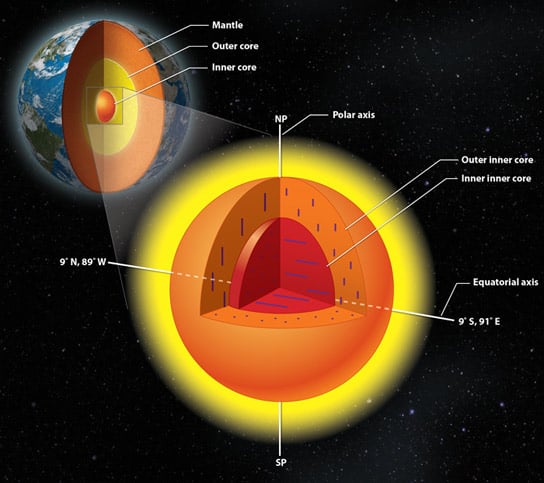
New research from a team of geologists reveals that the Earth’s inner core has an inner core of its own, with crystals aligned in a different direction.
Champaign, Illinois — Seismic waves are helping scientists to plumb the world’s deepest mystery: the planet’s inner core.
Thanks to a novel application of earthquake-reading technology, a research team at the University of Illinois and colleagues at Nanjing University in China have found that the Earth’s inner core has an inner core of its own, which has surprising properties that could reveal information about our planet.
Led by Xiaodong Song, a professor of geology at the U. of I., and visiting postdoctoral researcher Tao Wang, the team published its work in the journal Nature Geoscience on February 9.
“Even though the inner core is small – smaller than the moon – it has some really interesting features,” said Song. “It may tell us about how our planet formed, its history, and other dynamic processes of the Earth. It shapes our understanding of what’s going on deep inside the Earth.”
Researchers use seismic waves from earthquakes to scan below the planet’s surface, much like doctors use ultrasound to see inside patients. The team used a technology that gathers data not from the initial shock of an earthquake, but from the waves that resonate in the earthquake’s aftermath. The earthquake is like a hammer striking a bell; much like a listener hears the clear tone that resonates after the bell strike, seismic sensors collect a coherent signal in the earthquake’s coda.
“It turns out the coherent signal enhanced by the technology is clearer than the ring itself,” said Song. “The basic idea of the method has been around for a while, and people have used it for other kinds of studies near the surface. But we are looking all the way through the center of the earth.”
Looking through the core revealed a surprise at the center of the planet – though not of the type envisioned by novelist Jules Verne.
The inner core, once thought to be a solid ball of iron, has some complex structural properties. The team found a distinct inner-inner core, about half the diameter of the whole inner core. The iron crystals in the outer layer of the inner core are aligned directionally, north-south. However, in the inner-inner core, the iron crystals point roughly east-west. (See graphic for a visual map of the inner core.)
Not only are the iron crystals in the inner-inner core aligned differently, they behave differently from their counterparts in the outer-inner core. This means that the inner-inner core could be made of a different type of crystal, or a different phase.
“The fact that we have two regions that are distinctly different may tell us something about how the inner core has been evolving,” Song said. “For example, over the history of the earth, the inner core might have had a very dramatic change in its deformation regime. It might hold the key to how the planet has evolved. We are right in the center – literally, the center of the Earth.”
The U.S. National Science Foundation and the National Science Foundation of China supported this work.
Reference: “Equatorial anisotropy in the inner part of Earth’s inner core from autocorrelation of earthquake coda” by Tao Wang, Xiaodong Song and Han H. Xia, 9 February 2015, Nature Geoscience.
DOI: 10.1038/ngeo2354
Never miss a breakthrough: Join the SciTechDaily newsletter.
Follow us on Google and Google News.
1 Comment
Although this is new knowledge, it isn’t surprizing to me. Why? Well I’ll tell you. The purpose of the inner core is to keep the upper layers functioning to maintain and sustain the planet’s globe. This is efficacious as all the other dynamics make this unique planet a self sustaining one with recycling abilities second to none. More is involved. However, it would take way too much space here. They may still find a core within a core within a core.