

Researchers uncover why a complex earthquake in the south Atlantic sent an unexpected tsunami around the world in 2021.
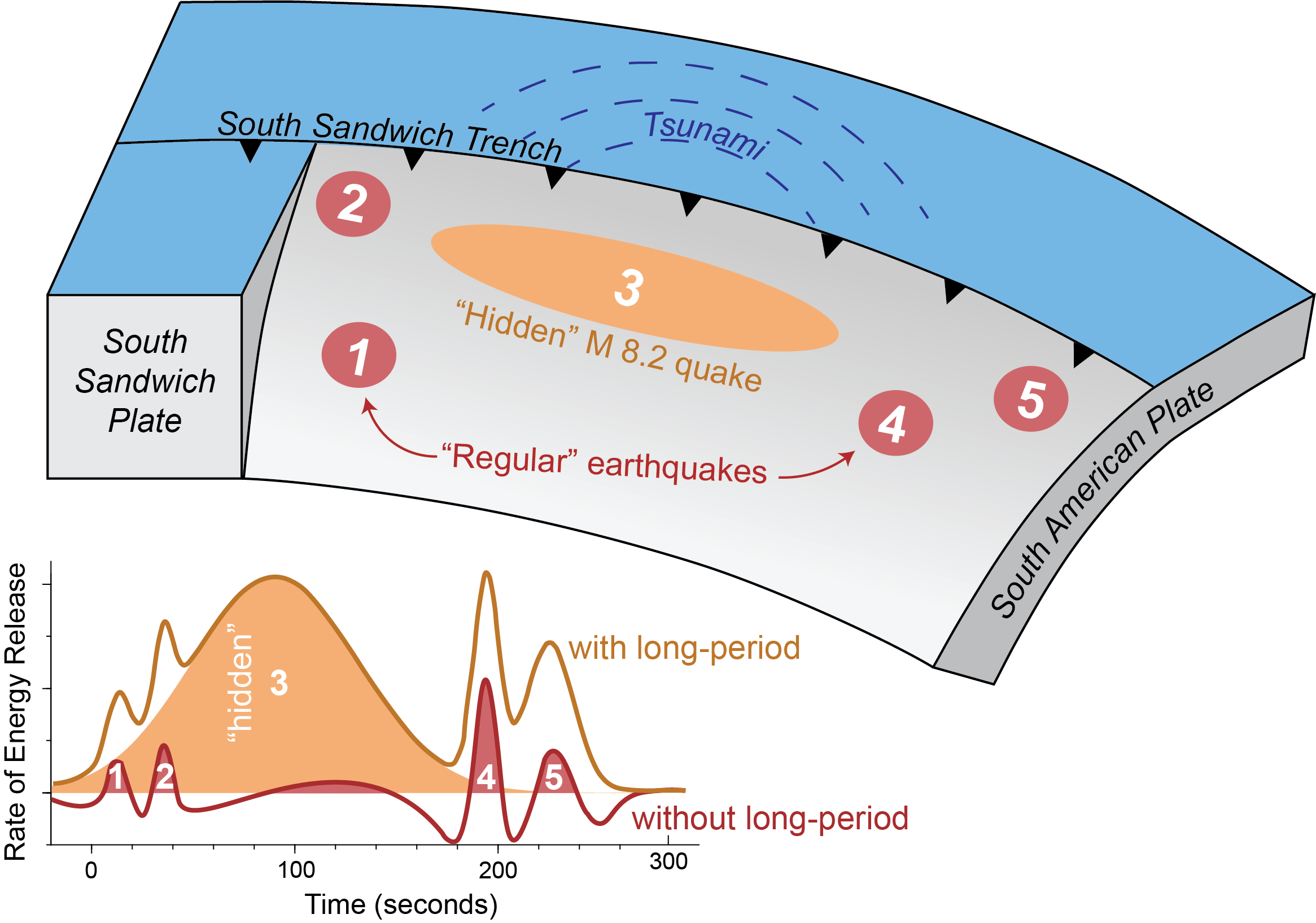
- A 47 km-deep (29 mi-deep), magnitude 7.5 earthquake that struck the south Atlantic in 2021 and caused a global tsunami was actually a sequence of five earthquakes.
- A shallow, “almost invisible” magnitude 8.2 quake accounted for 70% of the energy released during the event.
- Global earthquake monitoring needs to improve to understand and mitigate such complex earthquakes and their associated hazards.
Scientists have uncovered the source of a mysterious 2021 tsunami that sent waves around the globe.
Complex Earthquake Dynamics: A Series of Sub-Quakes
In August 2021, a magnitude 7.5 earthquake hit near the South Sandwich Islands, creating a tsunami that rippled around the globe. The epicenter was 47 kilometers below the Earth’s surface — too deep to initiate a tsunami — and the rupture was nearly 400 kilometers long, which should have generated a much larger earthquake.
Seismologists were puzzled and sought to understand what really happened that day in the remote South Atlantic.
A new study revealed the quake wasn’t a single event, but five, a series of sub-quakes spread out over several minutes. The third sub-quake was a shallower, slower magnitude 8.2 quake that hit just 15 kilometers (9 miles) below the surface. That unusual, “hidden” earthquake was likely the trigger of the worldwide tsunami.
The study was published in the AGU journal Geophysical Research Letters, which publishes short-format, high-impact papers with implications that span the Earth and space sciences.
Because the South Sandwich Islands earthquake was complex, with multiple sub-quakes, its seismic signal was difficult to interpret, according to lead study author Zhe Jia, a seismologist at the California Institute of Technology. The magnitude 8.2 quake was hidden within the tangle of seismic waves, which interfered with each other over the course of the event. The hidden quake’s signal wasn’t clear until Jia filtered the waves using a much longer period, up to 500 seconds. Only then did the 200-second-long quake, which Jia said accounted for over 70% of the energy released during the earthquake, become clear.
“The third event is special because it was huge, and it was silent,” Jia said. “In the data we normally look at [for earthquake monitoring], it was almost invisible.”
Implications for Earthquake and Tsunami Predictions
Predicting hazards for complex earthquakes can be difficult, as the South Sandwich Islands quake demonstrates. The USGS initially reported the magnitude 7.5 quake and only added the 8.2 event the following day, as the surprise tsunami lapped on shores up to 10,000 kilometers (6,200 miles) away from its point of origin.
“We need to rethink our way to mitigate earthquake-tsunami hazards. To do that, we need to rapidly and accurately characterize the true size of big earthquakes, as well as their physical processes,” Jia said.
Because this type of earthquake can result in unexpected tsunami, it’s critical to improve our predictions. “With these complex earthquakes, the earthquake happens and we think, ‘Oh, that wasn’t so big, we don’t have to worry.’ And then the tsunami hits and causes a lot of damage,” said Judith Hubbard, a geologist at the Earth Observatory of Singapore who was not involved in the study. “This study is a great example of how we can understand how these events work, and how we can detect them faster so we can have more warning in the future.”
Sneaky seismic signals
When an earthquake hits, it sends waves of vibration through the Earth. The global network of earthquake monitors uses those seismic waves to pinpoint the time, location, depth, and magnitude of an earthquake. Common monitoring often focuses on short- and medium-periods of waves, Jia said, and longer periods can be left out. But even incorporating long periods into monitoring, on its own, isn’t enough to catch complex earthquakes with messy seismic signals.
“It’s hard to find the second earthquake because it’s buried in the first one,” Jia said. “It’s very seldom complex earthquakes like this are observed. … And if we don’t use the right dataset, we cannot see what was hidden inside.”
A simple earthquake can easily be pinpointed and described, Jia said. But a messy one needs to be carefully broken down into its constituent parts, to find out what unique combination of simpler earthquakes built up the complex one.
Decomposing Seismic Signals: A New Algorithmic Approach
Jia and his colleagues developed an algorithm to tease apart the seismic signals during those messy earthquakes. By “decomposing” complex earthquake signals into simpler forms, using waves over different periods (varying from 20 to 500 seconds long), the algorithm can identify the location and properties of different sub-earthquakes. It’s akin to someone with perfect pitch hearing five dissonant notes struck at once, yet being able to identify each individual note.
“I think a lot of people are daunted by trying to work on events like this,” said Hubbard. “That somebody was willing to really dig into the data to figure it out is really useful.”
Both Jia and Hubbard noted a long-term goal is to automate the detection of such complex earthquakes, as we can for simple earthquakes. For the 2021 quake, the tsunami was small by the time it reached the shores, and most of the permanent residents of the remote, volcanic islands were penguins. But complex earthquakes can pose significant hazards if they generate larger tsunami or strike in a densely populated region.
Reference: “The 2021 South Sandwich Island Mw 8.2 Earthquake: A Slow Event Sandwiched Between Regular Ruptures” by Zhe Jia, Zhongwen Zhan and Hiroo Kanamori, 8 February 2022, Geophysical Research Letters.
DOI: 10.1029/2021GL097104
Never miss a breakthrough: Join the SciTechDaily newsletter.
Follow us on Google and Google News.