
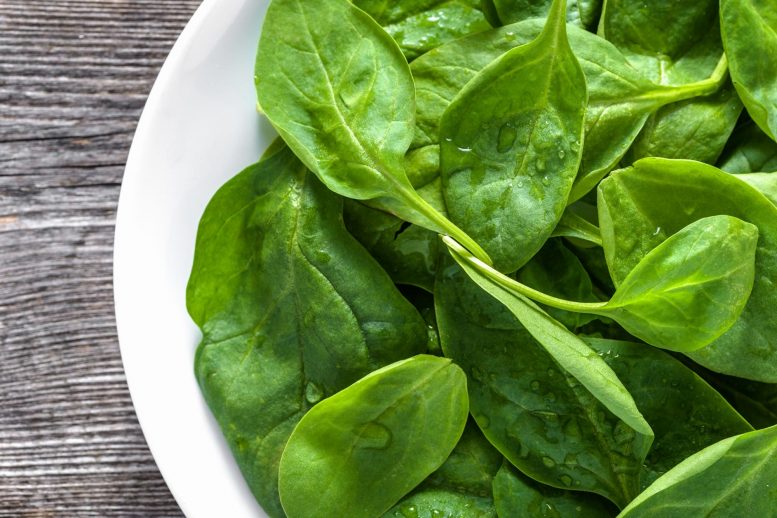
Eating just one cup of leafy green vegetables every day could boost muscle function, according to new Edith Cowan University (ECU) research.
The study, published today in the Journal of Nutrition, found that people who consumed a nitrate-rich diet, predominantly from vegetables, had significantly better muscle function of their lower limbs.
Poor muscle function is linked to a greater risk of falls and fractures and is considered a key indicator of general health and wellbeing.
Researchers examined data from 3,759 Australians taking part in Melbourne’s Baker Heart and Diabetes Institute AusDiab study over a 12-year period. They found those with the highest regular nitrate consumption had 11 percent stronger lower limb strength than those with the lowest nitrate intake. Up to 4 percent faster walking speeds were also recorded.
Lead researcher Dr. Marc Sim from ECU’s Institute for Nutrition Research said the findings reveal important evidence for the role diet plays in overall health.
“Our study has shown that diets high in nitrate-rich vegetables may bolster your muscle strength independently of any physical activity,” he said.
“Nevertheless, to optimize muscle function we propose that a balanced diet rich in green leafy vegetables in combination with regular exercise, including weight training, is ideal.”
Muscle function is vital for maintaining good overall health, especially bone strength later in life.
“With around one in three Australians aged over 65 suffering a fall each year, it’s important to find ways of preventing these events and their potentially serious consequences,” said Dr. Sim.
Go for Green
While leafy greens maybe some of our least favorite vegetables, they could be the most important, according to Dr. Sim.
The research found nitrate-rich vegetables, such as lettuce, spinach, kale, and even beetroot, provided the greatest health benefits.
“Less than one in ten Australians eat the recommended five to six serves of vegetables per day,” Dr. Sim said.
“We should be eating a variety of vegetables every day, with at least one of those serves being leafy greens to gain a range of positive health benefits for the musculoskeletal and cardiovascular system.”
“It’s also better to eat nitrate-rich vegetables as part of a healthy diet rather than taking supplements. Green leafy vegetables provide a whole range of essential vitamins and minerals critical for health.”
Building Knowledge
The study, a collaboration with Deakin University’s Institute of Physical Activity and Nutrition and the Baker Heart and Diabetes Institute, builds on Dr. Sim’s previous research into nitrate and muscle function in older women.
It also adds to growing evidence linking vegetables with cardiovascular health, including a recent ECU study into cruciferous vegetables and blood vessel health.
Dr. Sim said the next step of his research will be exploring strategies to increase leafy green vegetable consumption in the general population.
“We are currently recruiting for the MODEL Study, which examines how knowledge of disease can be used to prompt people in making long-term improvements to their diet and exercise,” said Dr. Sim.
Reference: “Dietary nitrate intake is positively associated with muscle function in men and women independent of physical activity levels” by Marc Sim, Lauren C Blekkenhorst, Nicola P Bondonno, Simone Radavelli-Bagatini, Peter Peeling, Catherine P Bondonno, Dianna J Magliano, Jonathan E Shaw, Richard Woodman, Kevin Murray, Joshua R Lewis, Robin M Daly and Jonathan M Hodgson, 24 March 2021, Journal of Nutrition.
DOI: 10.1093/jn/nxaa415
The Institute for Nutrition Research was established as an ECU Strategic Research Institute in 2020. Find out more about their work.
Never miss a breakthrough: Join the SciTechDaily newsletter.
Follow us on Google and Google News.
5 Comments
I’m strong to the finish ’cause I eats me spinach…
I’ll let myself out.
I love my green leafy vegetables but every time I look around it’s being recalled due to e coli or some other issue
Nothing new about it only rediscovering age old practice
Stale news already known
The two easiest ways to increase the number of people with healthy diets is to provide quick, easy, and healthful recipes AND to reduce costs.
One main reason the poor have unhealthy diets is because cheap and filling foods are full of fat and sodium and low in fiber and nutrition.