
Researchers have identified a two-dimensional material that could be used to store quantum information at room temperature.
Quantum memory is a major building block to be addressed in the building of a quantum internet, where quantum information is securely stored and sent via photons, or particles of light.
“There are defects in this material that can emit single photons, which means it could be used in quantum systems.” Hannah Stern
Single Photon Emission in Hexagonal Boron Nitride
Researchers from the Cavendish Laboratory at the University of Cambridge, in collaboration with colleagues from UT Sydney in Australia, have identified a two-dimensional material, hexagonal boron nitride, that can emit single photons from atomic-scale defects in its structure at room temperature.
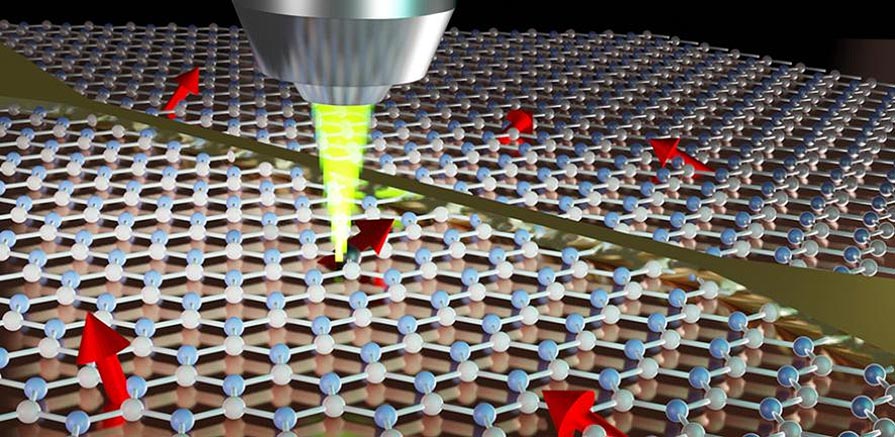
The researchers discovered that the light emitted from these isolated defects gives information about a quantum property that can be used to store quantum information, called spin, meaning the material could be useful for quantum applications. Importantly, the quantum spin can be accessed via light and at room temperature.
The finding could eventually support scalable quantum networks built from two-dimensional materials that can operate at room temperature. The results are reported in the journal Nature Communications.
Future communication networks will use single photons to send messages around the world, which will lead to more secure global communication technologies.
Computers and networks built on the principles of quantum mechanics would be both far more powerful and more secure than current technologies. However, in order to make such networks possible, researchers need to develop reliable methods of generating single, indistinguishable photons as carriers of information across quantum networks.
Spin in Quantum Information Storage
“We can send information from one place to another using photons, but if we’re going to build real quantum networks, we need to send information, store it, and send it somewhere else,” said Dr. Hannah Stern from Cambridge’s Cavendish Laboratory, the study’s co-first author, along with Qiushi Gu and Dr John Jarman. “We need materials that can hold onto quantum information for a certain amount of time at room temperature, but most current material platforms we’ve got are challenging to make and only work well at low temperatures.”
Hexagonal boron nitride is a two-dimensional material that is grown by chemical vapor deposition in large reactors. It’s cheap and scalable. Recent efforts have revealed the presence of single photon emitters and the presence of a dense ensemble of optically accessible spins, but not individually isolated spin-photon interfaces operating under ambient conditions.
“Usually, it’s a pretty boring material that’s normally used as an insulator,” said Stern, who is a Junior Research Fellow at Trinity College. “But we found that there are defects in this material that can emit single photons, which means it could be used in quantum systems. If we can get it to store quantum information in spin, then it’s a scalable platform.”
Experimental Setup and Magnetic Field-Dependent Responses
Stern and her colleagues set up a hexagon boron nitride sample near a tiny gold antenna and a magnet of set strength. By firing a laser at the sample at room temperature, they were able to observe lots of different magnetic field-dependent responses on the light being emitted from the material.
The researchers found that when they shone the laser on the material, they were able to manipulate the spin, or inherent angular momentum, of the defects, and use the defects as a way of storing quantum information.
“Typically, the signal is always the same in these systems, but in this case, the signal changes depending on the particular defect we’re studying, and not all defects show a signal, so there is a lot to still discover,” said co-first author Qiushi Gu. “There’s a lot of variation across the material, like a blanket draped over a moving surface – you see lots of ripples, and they’re all different.”
Professor Mete Atature, who supervised the work, adds “now that we have identified optically accessible isolated spins at room temperature in this material, the next steps will be to understand their photophysics in detail and explore the operation regimes for possible applications including information storage and quantum sensing. There will be a stream of fun physics following this work.”
Reference: “Room-temperature optically detected magnetic resonance of single defects in hexagonal boron nitride” by Hannah L. Stern, Qiushi Gu, John Jarman, Simone Eizagirre Barker, Noah Mendelson, Dipankar Chugh, Sam Schott, Hoe H. Tan, Henning Sirringhaus, Igor Aharonovich and Mete Atatüre, 1 February 2022, Nature Communications.
DOI: 10.1038/s41467-022-28169-z
The research was supported in part by the European Research Council. Mete Atature is a Fellow of St John’s College, Cambridge.
Never miss a breakthrough: Join the SciTechDaily newsletter.
Follow us on Google and Google News.