
Close Menu
    Facebook X (Twitter) Instagram
    SciTechDaily
    • Biology
    • Chemistry
    • Earth
    • Health
    • Physics
    • Science
    • Space
    • Technology
    Facebook X (Twitter) Pinterest YouTube RSS
    SciTechDaily
    Home»Technology»2D Nano Sandwich Is Deliciously Useful for Detecting Biomolecules
    Technology

    2D Nano Sandwich Is Deliciously Useful for Detecting Biomolecules

    By Rice UniversityMay 16, 20202 Comments3 Mins Read
    Facebook Twitter Pinterest Telegram LinkedIn WhatsApp Email Reddit
    Share
    Facebook Twitter LinkedIn Pinterest Telegram Email Reddit
    Monolayer Janus MoSSe
    Monolayer Janus MoSSe, a compound of molybdenum, sulfur, and selenium developed at Rice University, is adept at detecting biomolecules via surface-enhanced Raman spectroscopy. Its nonmetallic nature helps by curtailing background noise in the signal. Credit: Lou Group/Rice University

    Rice University engineers adapt 2D ‘sandwich’ for surface-enhanced Raman spectroscopy.

    A sandwich of molybdenum, sulfur, and selenium turns out to be deliciously useful for detecting biomolecules.

    Tests at Rice University’s Brown School of Engineering of a two-dimensional Janus compound showed it could be an effective and universal platform for improving the detection of biomolecules via surface-enhanced Raman spectroscopy (SERS).

    Using glucose to test the material proved its ability to boost its Raman enhancement factor by more than 100,000 times, which the researchers say is comparable to the highest-reported enhancement factor for 2D substrates.

    SERS is an established technique that enables the detection and identification of small concentrations of molecules — or even single molecules — that get close to or adsorbed by metallic surfaces, including nanoparticles. It’s often used to detect nanoscale proteins in bodily fluids, helping to detect diseases and determine treatments, and in environmental analysis.
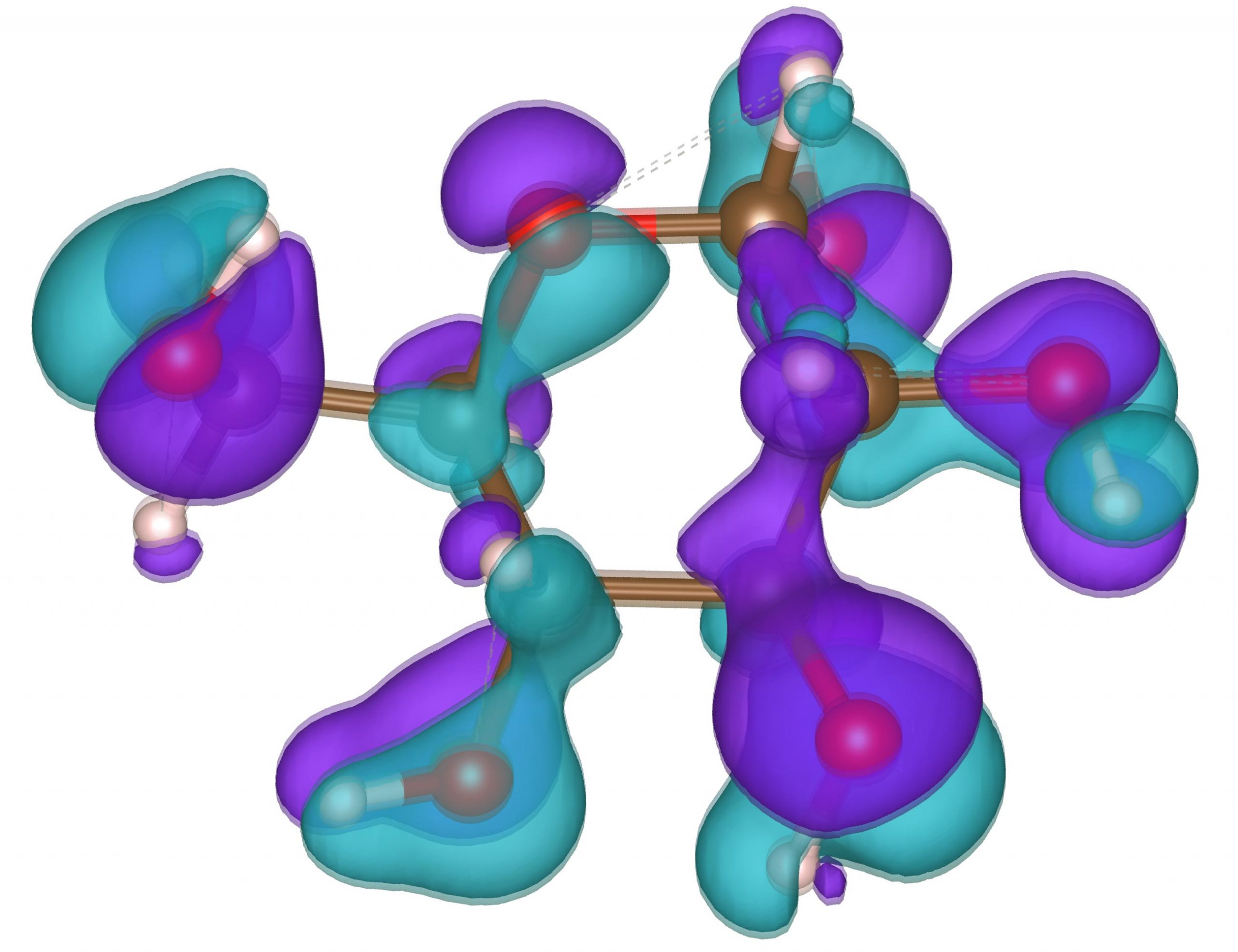
    Charge Distribution in Glucose
    A model created at Rice University illustrates charge distribution in glucose. The light blue region shows the electron cloud distribution in a single glucose molecule. The purple regions show the drastic charge redistribution when anchored to Janus MoSSE and detected via surface-enhanced Raman spectroscopy. Credit: Lou Group/Rice University

    But metallic SERS media often prompt side reactions that create background noise. Janus MoSSe synthesized at Rice is nonmetallic. “This work mainly addresses whether we can enhance the target molecules’ signal strength,” said materials scientist and principal investigator Jun Lou. “We wanted to know if we could make it stand out from the background noise.”

    The answer was clearly yes, as Lou and his team reported in Nanoscale.

    MoSSe, introduced by the Lou lab in 2017, was produced by chemical vapor deposition. Molybdenum sits in the middle with a layer of sulfur on one side and another of selenium on the other; hence the two-faced Janus characterization.

    The different electronegativities of each layer make it a SERS superstar, said lead author and Rice alumnus Shuai Jia, a former graduate student in Lou’s lab.

    “The dipole created between the top sulfur and the bottom selenium lands out-of-plane, and this creates an electrical field a few nanometers beyond the MoSSe,” Jia said. That field interacts with molecules that come close, enhancing their vibrational intensity enough to be detected.

    The researchers noted tests with MoSSe also detected molecules of the neurotransmitter dopamine and that the substrate should be adaptable to sense other molecules.

    Lou said there’s room for improvement. “We’re looking at hybrids of MoSSe with some metallic nanoparticles, and also trying to enhance the dipole strength,” he said.

    Reference: “Biomolecular sensing by surface-enhanced Raman scattering of monolayer Janus transition metal dichalcogenide” by Shuai Jia, Arkamita Bandyopadhyay, Hemant Kumar, Jing Zhang, Weipeng Wang, Tianshu Zhai, Vivek B. Shenoy and Jun Lou, 16 April 2020, Nanoscale.
    DOI: 10.1039/D0NR00300J

    Co-authors of the paper are postdoctoral researchers Jing Zhang and Weipeng Wang and graduate student Tianshu Zhai of Rice, and postdoctoral researchers Arkamita Bandyopadhyay and Hemant Kumar and Vivek Shenoy, the Eduardo D. Glandt President’s Distinguished Professor of materials science and engineering, mechanical engineering and applied mechanics and of bioengineering, at the University of Pennsylvania. Lou is a professor of materials science and nanoengineering and of chemistry.

    The Welch Foundation and the National Science Foundation supported the research.

    Never miss a breakthrough: Join the SciTechDaily newsletter.
    Follow us on Google and Google News.

    2D Materials Molecular Physics Nanotechnology Optics Popular Rice University
    Share. Facebook Twitter Pinterest LinkedIn Email Reddit

    Related Articles

    Elusive New Liquid Phase Found by Scientists After a Century of Searching

    Water-Splitting “Artificial Leaf” Module a Source of Perpetual Energy

    Solving Complex Problems at the Speed of Light

    “Perfect” Solar Energy Absorber Created by Laser Etching Metal With Nanoscale Structures

    Graphene Surprises Researchers Again: Strange ‘Melting’ Behavior

    Tubulane Inspired Ultrahard Polymers Are Full of Holes, but Stop Bullets Better Than Solid Materials

    Rice Engineers Develop Light-Driven Nanosubmarines

    New Shortcut Simplifies the Production of Solar Cells

    Spray Paint Battery Can be Painted on Virtually Any Surface

    2 Comments

    1. ahlam st on May 16, 2020 1:52 pm

      Really informative blog article.Thanks Again. Fantastic.

      Reply
    2. ENRIQUE OROZCO on May 16, 2020 9:18 pm

      Can this technology be used to detect coronavirus presence in surfaces or directly in humans?

      Reply
    Leave A Reply Cancel Reply

    • Facebook
    • Twitter
    • Pinterest
    • YouTube

    Don't Miss a Discovery

    Subscribe for the Latest in Science & Tech!

    Trending News

    Even Occasional Binge Drinking May Triple Liver Damage Risk

    Liftoff! NASA’s Artemis II Launch Sends Astronauts Around the Moon for First Time in 50 Years

    Scientists Discover New Way To Eliminate “Zombie Cells” Driving Aging

    This New Quantum Theory Could Change Everything We Know About the Big Bang

    This One Vitamin May Help Protect Your Brain From Dementia Years Later

    Stopping Weight-Loss Drugs Like Ozempic Can Quickly Erase Heart Benefits

    A 500-Million-Year-Old Surprise Is Forcing Scientists to Rethink Spider Evolution

    Coffee and Blood Pressure: What You Need To Know Before Your Next Cup

    Follow SciTechDaily
    • Facebook
    • Twitter
    • YouTube
    • Pinterest
    • Newsletter
    • RSS
    SciTech News
    • Biology News
    • Chemistry News
    • Earth News
    • Health News
    • Physics News
    • Science News
    • Space News
    • Technology News
    Recent Posts
    • Tiny 436-Million-Year-Old Fish Fossil Rewrites the Origins of Vertebrates
    • 1,800 Miles Down: Scientists Uncover Mysterious Movements at the Edge of Earth’s Core
    • Scientists Uncover Earth’s Hidden “Gold Kitchen” Beneath the Ocean Floor
    • You Don’t Need To Be Rich: New Study Reveals a Simple Life Is the Real Secret to Happiness
    • “Crazy Dice” Help Scientists Prove Only One 150-Year-Old Theory About Randomness Works
    Copyright © 1998 - 2026 SciTechDaily. All Rights Reserved.
    • Science News
    • About
    • Contact
    • Editorial Board
    • Privacy Policy
    • Terms of Use

    Type above and press Enter to search. Press Esc to cancel.