
Nanomaterial developments could lead to computers and phones running thousands of times faster.
The tiniest microchips yet can be made from graphene and other 2D-materials, using a form of ‘nano-origami’, physicists at the University of Sussex have found.
This is the first time any researchers have done this, and it is covered in a paper published in the ACS Nano journal.
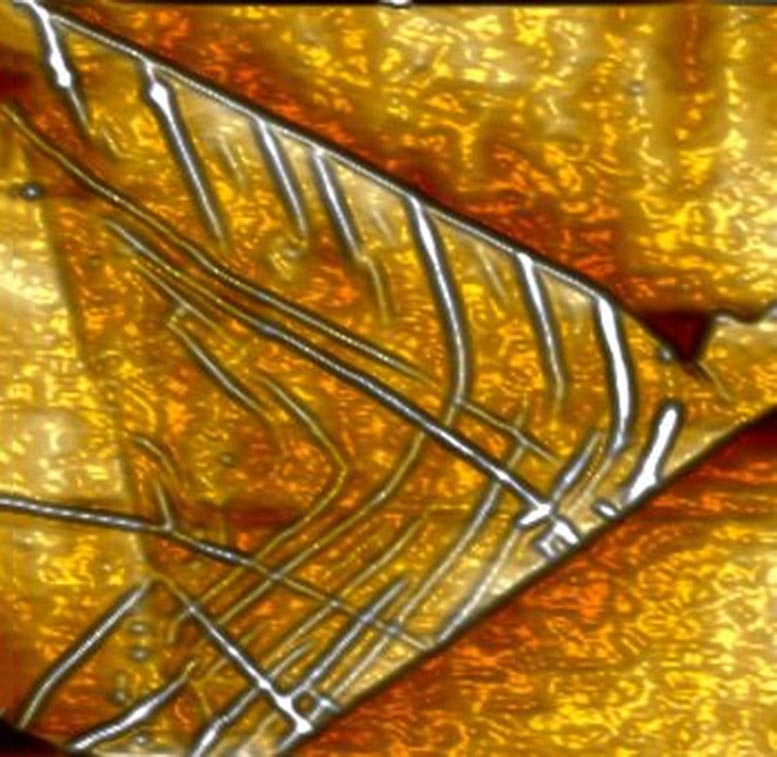
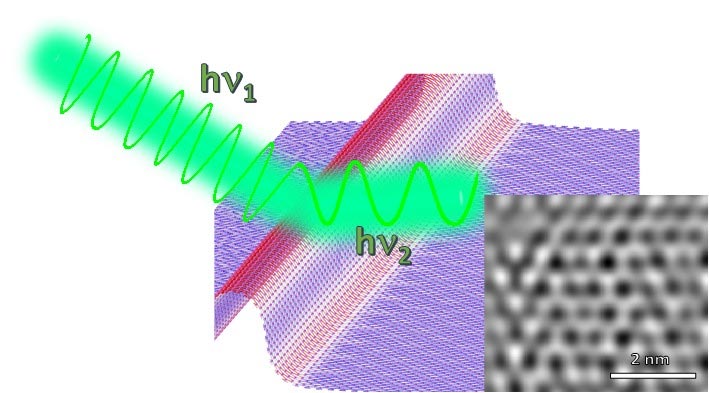
By creating kinks in the structure of graphene, researchers at the University of Sussex have made the nanomaterial behave like a transistor, and have shown that when a strip of graphene is crinkled in this way, it can behave like a microchip, which is around 100 times smaller than conventional microchips.
Prof Alan Dalton in the School of Mathematical and Physical Sciences at the University of Sussex, said:
“We’re mechanically creating kinks in a layer of graphene. It’s a bit like nano-origami.
Straintronics: The Future of Fast, Compact Devices
“Using these nanomaterials will make our computer chips smaller and faster. It is absolutely critical that this happens as computer manufacturers are now at the limit of what they can do with traditional semiconducting technology. Ultimately, this will make our computers and phones thousands of times faster in the future.
“This kind of technology – “straintronics” using nanomaterials as opposed to electronics – allows space for more chips inside any device. Everything we want to do with computers – to speed them up – can be done by crinkling graphene like this.”
Dr. Manoj Tripathi, Research Fellow in Nano-structured Materials at the University of Sussex and lead author on the paper, said:
“Instead of having to add foreign materials into a device, we’ve shown we can create structures from graphene and other 2D materials simply by adding deliberate kinks into the structure. By making this sort of corrugation we can create a smart electronic component, like a transistor, or a logic gate.”
The development is a greener, more sustainable technology. Because no additional materials need to be added, and because this process works at room temperature rather than high temperature, it uses less energy to create.
Reference: “Structural Defects Modulate Electronic and Nanomechanical Properties of 2D Materials” by Manoj Tripathi, Frank Lee, Antonios Michail, Dimitris Anestopoulos, James G. McHugh, Sean P. Ogilvie, Matthew J. Large, Aline Amorim Graf, Peter J. Lynch, John Parthenios, Konstantinos Papagelis, Soumyabrata Roy, M. A. S. R. Saadi, Muhammad M. Rahman, Nicola Maria Pugno, Alice A. K. King, Pulickel M. Ajayan and Alan B. Dalton, 25 January 2021, ACS Nano.
DOI: 10.1021/acsnano.0c06701
Never miss a breakthrough: Join the SciTechDaily newsletter.
Follow us on Google and Google News.
3 Comments
Nano-sized / Organic based energy storage; grid scale… this is how it will happen.
You could look up a physics page on Wikipedia for “energy density” of various materials, fuels and other energy systems. You will not find any fancy graphene or other trendy nano structures on any list ever.
A ton of uranium or thorium is only about the size of a large beach ball and holds within enough energy to power a city with 1GWe of power for a year. A human life time of energy fits in a small metal ball in your hand if you go with nuclear. Absolutely no electrical batteries are even needed because we know how to make nuclear completely dispacheable while renewables are utterly non dispacheable and need vast amounts of very expensive storage.
After that, chemical energy with chemical electron bonds are millions of times less energy dense. Batteries get much weaker still another order or two.
At the bottom are things like pumped air bags, hydro.
All of the nano sized organic graphene nonsence is just wishful almost religous thinking. Just read an actual physics text book instead and trust engineers to build the grid instead of policy wonks.
I do wish these graphene physicists would make an actual circuit instead of babbling on about fantastic possibilites, then it would be interesting as a circuit designer to see what it can do now. If you say you can make a transister or logic gate, then make one. Then make a cpu or memory structure too. You will find it’s not so easy to change technolgies.
Believe it or not, the 2 men most responsible for the architecture of the first decent DRAMs (MK 4096) at the 4K bit level in 1976 would completely understand the design of todays DRAMs because they are essentially exactly the same only dynamic nmos got replaced by static cmos circuits and the feature size went from 3u to maybe 20nm, and over all performance has barely changed from 400ns latency to maybe 40ns latency. Density has gone from 4K bits to 8B bits and remarkably the price per DRAM chip always stays near $4 per chip.
As for phones being faster, I really wish the modern smart phone had never been invented when you see what it does to kids. The fact that they are so slow speaks to the aweful software like android that runs on them. The ARM processor in them is a super computer in it’s own right but hobbled by the software stack running on it.