
Close Menu
    Facebook X (Twitter) Instagram
    SciTechDaily
    • Biology
    • Chemistry
    • Earth
    • Health
    • Physics
    • Science
    • Space
    • Technology
    Facebook X (Twitter) Pinterest YouTube RSS
    SciTechDaily
    Home»Space»Eye of the Galaxy: Hubble Reveals Galactic Structure in Intricate Detail
    Space

    Eye of the Galaxy: Hubble Reveals Galactic Structure in Intricate Detail

    By ESA/HubbleMarch 13, 2022No Comments2 Mins Read
    Facebook Twitter Pinterest Telegram LinkedIn WhatsApp Email Reddit
    Share
    Facebook Twitter LinkedIn Pinterest Telegram Email Reddit
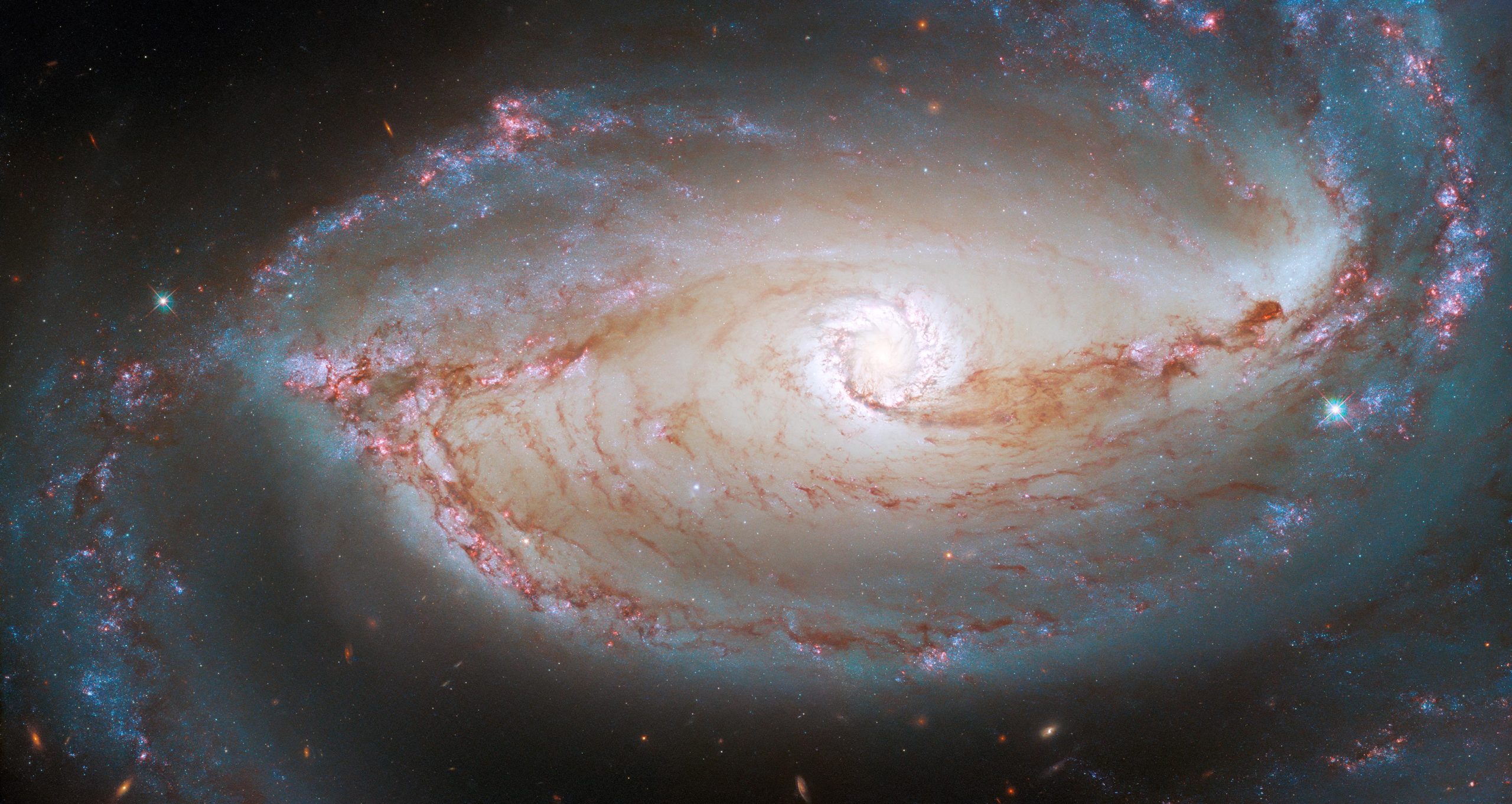
    Spiral Galaxy NGC 1097
    Hubble Space Telescope image of NGC 1097, a barred spiral galaxy that lies about 48 million light-years from Earth in the constellation Fornax. Credit: ESA/Hubble & NASA, D. Sand, K. Sheth

    NGC 1097, a barred spiral galaxy, was captured using the Hubble Space Telescope’s Wide Field Camera 3 (WFC3) and Advanced Camera for Surveys (ACS). The picture displays the galaxy’s intricate web of stars and dust, with dark red tendrils highlighting the dust structures.

    This finely detailed image shows the heart of NGC 1097, a barred spiral galaxy that lies about 48 million light-years from Earth in the constellation Fornax. This picture reveals the intricacy of the web of stars and dust at NGC 1097’s center, with the long tendrils of dust picked out in a dark red hue. The extent to which the galaxy’s structure is revealed is thanks to two instruments on the NASA/ESA Hubble Space Telescope: the Wide Field Camera 3 (WFC3) and the Advanced Camera for Surveys  (ACS).

    The idea that a single image can be taken using two different cameras is not very intuitive. However, it makes far more sense after delving into how beautiful astronomical images like this one are composed. A helpful starting point is to consider what color is, exactly. Our eyes can detect light waves at optical wavelengths between roughly 380 and 750 nanometers, using three types of receptors, each of which is sensitive to just a slice of that range. Our brain interprets these specific wavelengths as colors. By contrast, a telescope camera like the WFC3 or ACS is sensitive to a single, broad range of wavelengths to maximize the amount of light collected. Raw images from telescopes are always in greyscale, only showing the amount of the light captured across all those wavelengths.

    Color images from telescopes are indirectly possible, however, with the help of filters. By sliding a filter over the aperture of an instrument like the WFC3 or ACS, only light from a very specific wavelength range is let through — one such filter used in this image is for green light around 555 nanometers. This yields a greyscale image showing only the amount of light with that wavelength. This multicolor image of NGC 1097 is composed of images using seven different filters in total. 

    Never miss a breakthrough: Join the SciTechDaily newsletter.
    Follow us on Google and Google News.

    Astronomy European Space Agency Hubble Space Telescope NASA
    Share. Facebook Twitter Pinterest LinkedIn Email Reddit

    Related Articles

    Hubble’s Newest Discovery Isn’t a Star, It’s a Window Into the Dark Universe

    This Nearby Galaxy Shows How Frozen Clouds Ignite Into Stars

    This Chaotic Spiral Galaxy Is Still Recovering From a Cosmic Collision

    This Strange Spiral Galaxy Is Hiding a Massive Black Hole

    Hubble Zooms In on a Galaxy That Maps the Universe’s Expansion

    Hubble Captures a Dazzling Spiral Galaxy Alive With Birth and Destruction

    Hubble Spots a Glowing “Ring of Fire” in a Distant Spiral Galaxy

    Dust, Light & Ancient Collisions: The Sombrero Galaxy Like You’ve Never Seen It

    Star Formation in Motion: Hubble Reveals Spiraling Stars and Sculpted Nebulae

    Leave A Reply Cancel Reply

    • Facebook
    • Twitter
    • Pinterest
    • YouTube

    Don't Miss a Discovery

    Subscribe for the Latest in Science & Tech!

    Trending News

    Scientists Say This Hellish “Day-Night” Planet May Support Life

    Historians Got It Wrong: New Findings Rewrite the Story of the Battle of Hastings

    Scientists Just Broke the Solar Power Limit Everyone Thought Was Absolute

    Scientists Discover Protein That Turns Brown Fat Into a Calorie-Burning Machine

    Scientists Call for a Complete Rethink of Alzheimer’s Treatment

    Scientists Identify Molecular Switch That Lets Exercise Reverse Muscle Aging

    Why Your Most Vivid Dreams Might Be the Key to Deep, Restful Sleep

    A Bright Star Hid a Massive Secret for 50 Years: Mystery of Gamma Cassiopeiae Finally Solved

    Follow SciTechDaily
    • Facebook
    • Twitter
    • YouTube
    • Pinterest
    • Newsletter
    • RSS
    SciTech News
    • Biology News
    • Chemistry News
    • Earth News
    • Health News
    • Physics News
    • Science News
    • Space News
    • Technology News
    Recent Posts
    • A Simple Injection Could Help the Heart Heal Itself After a Heart Attack
    • This Gas Station Drug Is Driving a Surge in Poisonings and Hospitalizations
    • These Unusual Glaciers Don’t Behave Like Others – and Scientists Say They Are Incredibly Dangerous
    • Scientists Just Discovered a Hidden Freshwater World Beneath the Great Salt Lake
    • Why Your Daily Shower Could Be Worsening the Water Crisis
    Copyright © 1998 - 2026 SciTechDaily. All Rights Reserved.
    • Science News
    • About
    • Contact
    • Editorial Board
    • Privacy Policy
    • Terms of Use

    Type above and press Enter to search. Press Esc to cancel.