
Close Menu
    Facebook X (Twitter) Instagram
    SciTechDaily
    • Biology
    • Chemistry
    • Earth
    • Health
    • Physics
    • Science
    • Space
    • Technology
    Facebook X (Twitter) Pinterest YouTube RSS
    SciTechDaily
    Home»Space»Hubble Views Spiral Galaxy NGC 1097
    Space

    Hubble Views Spiral Galaxy NGC 1097

    By NASADecember 31, 20121 Comment3 Mins Read
    Facebook Twitter Pinterest Telegram LinkedIn WhatsApp Email Reddit
    Share
    Facebook Twitter LinkedIn Pinterest Telegram Email Reddit
    Barred Spiral Galaxy NGC 1097
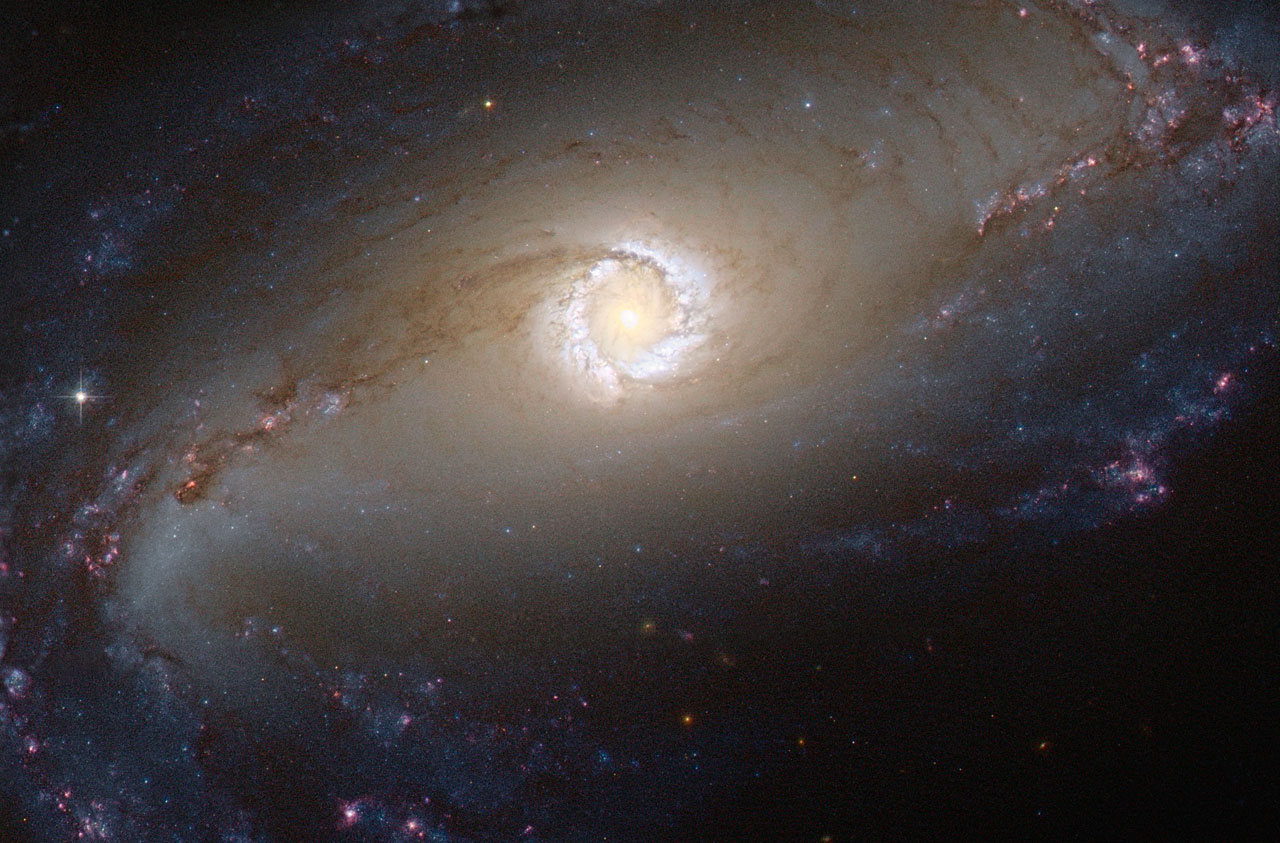
    The NASA/ESA Hubble Space Telescope provides us this week with a spectacular image of the bright star-forming ring that surrounds the heart of the barred spiral galaxy NGC 1097. Credit: ESA/Hubble & NASA

    This new Hubble image shows the star-forming ring that surrounds spiral galaxy NGC 1097, a galaxy that is located 45 million light-years away from Earth and features a supermassive black hole 100 million times the mass of our sun at the center.

    The NASA/ESA Hubble Space Telescope provides us this week with a spectacular image of the bright star-forming ring that surrounds the heart of the barred spiral galaxy NGC 1097. In this image, the larger-scale structure of the galaxy is barely visible: its comparatively dim spiral arms, which surround its heart in a loose embrace, reach out beyond the edges of this frame.

    This face-on galaxy, lying 45 million light-years away from Earth in the southern constellation of Fornax (The Furnace), is particularly attractive for astronomers. NGC 1097 is a Seyfert galaxy. Lurking at the very center of the galaxy, a supermassive black hole 100 million times the mass of our sun is gradually sucking in the matter around it. The area immediately around the black hole shines powerfully with radiation coming from the material falling in.

    The distinctive ring around the black hole is bursting with new star formation due to an inflow of material toward the central bar of the galaxy. These star-forming regions are glowing brightly thanks to emission from clouds of ionized hydrogen. The ring is around 5,000 light-years across, although the spiral arms of the galaxy extend tens of thousands of light-years beyond it.

    NGC 1097 is also pretty exciting for supernova hunters. The galaxy experienced three supernovae (the violent deaths of high-mass stars) in the 11-year span between 1992 and 2003. This is definitely a galaxy worth checking on a regular basis.

    However, what is really exciting about NGC 1097 is that it is not wandering alone through space. It has two small galaxy companions, which dance “the dance of stars and the dance of space” like the gracious dancer of the famous poem The Dancer by Khalil Gibran.

    The satellite galaxies are NGC 1097A, an elliptical galaxy orbiting 42,000 light-years from the center of NGC 1097 and a small dwarf galaxy named NGC 1097B. Both galaxies are located out beyond the frames of this image and they cannot be seen. Astronomers have indications that NGC 1097 and NGC 1097A have interacted in the past.

    This picture was taken with Hubble’s Advanced Camera for Surveys using visual and infrared filters.

    Never miss a breakthrough: Join the SciTechDaily newsletter.
    Follow us on Google and Google News.

    Astronomy Black Hole Hubble Space Telescope NASA Popular
    Share. Facebook Twitter Pinterest LinkedIn Email Reddit

    Related Articles

    The Big Bang’s Dark Legacy Revealed by Hubble: Unexpected Black Holes

    Hubble Finds Phantom Imprint in Space Revealing Black Hole Roaming Our Milky Way Galaxy

    Spiral Snapshot Hides an Astronomical Monstrosity

    Gas Far Outside of Our Galaxy Illuminated by Enormous Burst of Energy Unleashed by Milky Way’s Black Hole

    OwO What’s This? Astronomers Study Galactic Bulge for Clues to Black Hole Mystery

    Star Torn Apart and Devoured by Ravenous Supermassive Black Hole

    Hubble Reveals That Markarian 231 is Powered by a Double Black Hole

    5,000 Light Year Long Jet of Superheated Gas Ejected From a Supermassive Black Hole

    Hubble and VLA View Elliptical Galaxy Hercules A

    1 Comment

    1. Angus Stone on January 1, 2013 2:43 am

      You see, black holes are actually extremely bright 😉
      What a beautiful image!

      Reply
    Leave A Reply Cancel Reply

    • Facebook
    • Twitter
    • Pinterest
    • YouTube

    Don't Miss a Discovery

    Subscribe for the Latest in Science & Tech!

    Trending News

    Largest-Ever Study Finds Medicinal Cannabis Ineffective for Anxiety, Depression, PTSD

    250-Million-Year-Old Egg Solves One of Evolution’s Biggest Mysteries

    Living With Roommates Might Be Changing Your Gut Microbiome Without You Knowing

    Century-Old Cleaning Chemical Linked to 500% Increased Risk of Parkinson’s Disease

    What if Your Memories Never Happened? Physicists Take a New Look at the Boltzmann Brain Paradox

    One of the Universe’s Largest Stars May Be Getting Ready To Explode

    Scientists Discover Enzyme That Could Supercharge Ozempic-Like Weight Loss Drugs

    Popular Sweetener Linked to DNA Damage – “It’s Something You Should Not Be Eating”

    Follow SciTechDaily
    • Facebook
    • Twitter
    • YouTube
    • Pinterest
    • Newsletter
    • RSS
    SciTech News
    • Biology News
    • Chemistry News
    • Earth News
    • Health News
    • Physics News
    • Science News
    • Space News
    • Technology News
    Recent Posts
    • A Simpler Path to Super-Resolution: Scientists Reinvent Microscopy
    • Scientists Uncover Hidden Genetic Cause of Diabetes in Babies
    • Amazonian Chocolate Could Become the Next Superfood, Scientists Say
    • Challenging the Narrative: New Study Shows U.S. Life Expectancy Is Rising Across All States
    • Mystery Illness Kills 5 in Burundi As Doctors Scramble for Answers
    Copyright © 1998 - 2026 SciTechDaily. All Rights Reserved.
    • Science News
    • About
    • Contact
    • Editorial Board
    • Privacy Policy
    • Terms of Use

    Type above and press Enter to search. Press Esc to cancel.