
Close Menu
    Facebook X (Twitter) Instagram
    SciTechDaily
    • Biology
    • Chemistry
    • Earth
    • Health
    • Physics
    • Science
    • Space
    • Technology
    Facebook X (Twitter) Pinterest YouTube RSS
    SciTechDaily
    Home»Space»Titan Experiences Seasonal Changes
    Space

    Titan Experiences Seasonal Changes

    By SciTechDailyOctober 3, 20121 Comment2 Mins Read
    Facebook Twitter Pinterest Telegram LinkedIn WhatsApp Email Reddit
    Share
    Facebook Twitter LinkedIn Pinterest Telegram Email Reddit
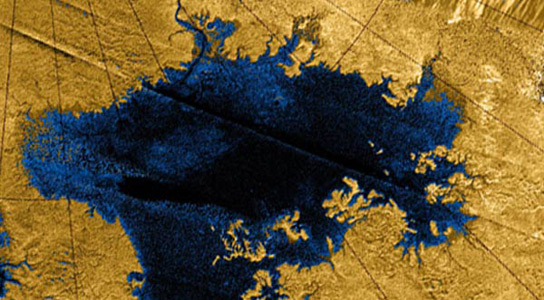
    hyrdocarbon-lake-titan
    Hydrocarbon lake on Saturn’s moon Titan.

    Astronomers have been researching Saturn’s moon Titan for roughly 30 years, discovering that the moon experiences seasonal changes that affect it more than previously thought.

    The researchers presented their findings during the European Planetary Science Congress of 2012 in Madrid last Friday. Athena Coustenis, from the Paris-Meudon Observatory in France, analyzed the data. Just like Earth, the seasons on Titan change. There are differences in atmospheric temperatures, chemical composition and circulation patterns, especially around the poles. Hydrocarbon lakes form around the north-polar region during the winter due to colder temperatures and condensation. A haze layer surrounds Titan at the northern pole and it is significantly reduced during the equinox because of atmospheric circulation patterns. These rapid changes were unexpected, especially in the deeper layers of the atmosphere.
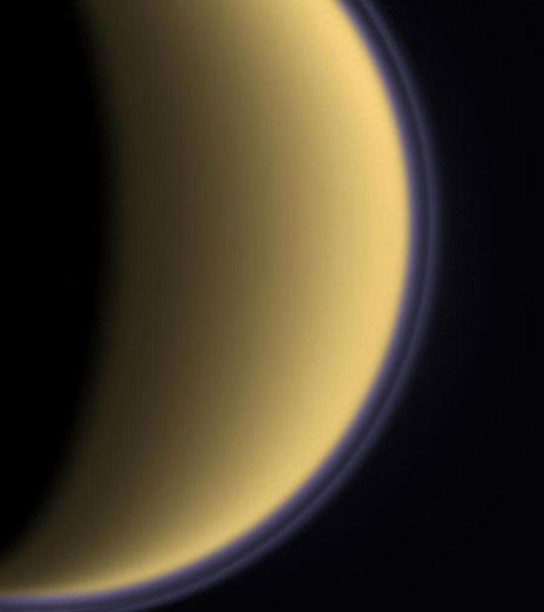
    saturn-titan-haze
    Haze on Saturn’s moon Titan

    Solar radiation is the main cause of these cycles and is the dominant energy source for Titan’s atmosphere. It breaks up nitrogen and methane into more complex molecules, such as ethane, and acts as the driving force for chemical changes. Titan has an inclination of about 27 degrees, which is similar to Earth’s, meaning that sunlight reaches different areas with varying intensity due to the tilt. Titan is 10.69 AU away from Earth.

    These conclusions are based on the analyzed data from several different missions, including Voyager 1 (1980), the Infrared Space Observatory (1997), and the Cassini spacecraft (2004 onwards), and complemented by ground-based observations. Each season on Titan spans about 7.5 years and it takes 29.5 years for Saturn to orbit Sol, so data has now been gathered for an entire Titan year.

    In terms of climate, meteorology and astrobiology, the conditions on Titan provide scientists with a great opportunity to study conditions similar to our own planet, while at the same time remaining a paradise for exploring new geological, atmospheric, and internal processes.

    Never miss a breakthrough: Join the SciTechDaily newsletter.
    Follow us on Google and Google News.

    Astronomy Planetary Science Saturn Titan
    Share. Facebook Twitter Pinterest LinkedIn Email Reddit

    Related Articles

    Cassini Views Saturn’s Dramatic Transition from Winter to Summer

    NASA’s Cassini Spacecraft Completes Final Flyby of Titan

    Video Shows Images of Titan’s Surface from Huygens Probe

    New Cassini Image of Titan above Saturn’s Rings

    Cassini Reveals Monstrous Ice Cloud in Titan’s South Polar Region

    NASA’s Cassini Spacecraft Views a Cloudy Saturn and Titan

    Astronomers Celebrate 10 Year Anniversary of Titan Landing

    Cassini Reveals Clues about Saturn’s Moon Titan

    Simulation May Explain Saturnian System

    1 Comment

    1. Madanagopal.V.C. on October 3, 2012 9:52 am

      How nice it would be for boozers to see lakes of methyl and ethyl alcohol and raining on them on seasons like earth? Titan not only receives solar radiation that drives the seasons on this exotic satelite of Saturn but also it will give an exotic view of two suns (for Titans) , one being distant cool Sun and other one being nearby failed star Saturn. The radiation from Jupiter also should contribute to this driving force on clouds of hydrocarbons and make seasons on its tilted axis of 27 degrees. Any future search for living organisms should be only from Titan because of rich hydrocarbons in its atmosphere.Thank You.

      Reply
    Leave A Reply Cancel Reply

    • Facebook
    • Twitter
    • Pinterest
    • YouTube

    Don't Miss a Discovery

    Subscribe for the Latest in Science & Tech!

    Trending News

    The Universe Is Expanding Too Fast and Scientists Can’t Explain Why

    “Like Liquid Metal”: Scientists Create Strange Shape-Shifting Material

    Early Warning Signals of Esophageal Cancer May Be Hiding in Plain Sight

    Common Blood Pressure Drug Shows Surprising Power Against Deadly Antibiotic-Resistant Superbug

    Scientists Uncover Dangerous Connection Between Serotonin and Heart Valve Disease

    Scientists Discover a “Protector” Protein That Could Help Reverse Hair Loss

    Bone-Strengthening Discovery Could Reverse Osteoporosis

    Scientists Uncover Hidden Trigger Behind Stem Cell Aging

    Follow SciTechDaily
    • Facebook
    • Twitter
    • YouTube
    • Pinterest
    • Newsletter
    • RSS
    SciTech News
    • Biology News
    • Chemistry News
    • Earth News
    • Health News
    • Physics News
    • Science News
    • Space News
    • Technology News
    Recent Posts
    • Scientists Create Improved Insulin Cells That Reverse Diabetes in Mice
    • Scientists Stunned After Finding Plant Thought Extinct for 60 Years
    • A Common Diabetes Drug May Hold the Key to Stopping HIV From Coming Back
    • Ancient “Syphilis-Like” Disease in Vietnam Challenges Key Scientific Assumptions
    • Drinking Alcohol To Cope in Your 20s Could Damage Your Brain for Life
    Copyright © 1998 - 2026 SciTechDaily. All Rights Reserved.
    • Science News
    • About
    • Contact
    • Editorial Board
    • Privacy Policy
    • Terms of Use

    Type above and press Enter to search. Press Esc to cancel.