
Close Menu
    Facebook X (Twitter) Instagram
    SciTechDaily
    • Biology
    • Chemistry
    • Earth
    • Health
    • Physics
    • Science
    • Space
    • Technology
    Facebook X (Twitter) Pinterest YouTube RSS
    SciTechDaily
    Home»Space»Scientists May Have Found the Key to Jupiter and Saturn’s Moon Mystery
    Space

    Scientists May Have Found the Key to Jupiter and Saturn’s Moon Mystery

    By Kyoto UniversityApril 13, 20261 Comment3 Mins Read
    Facebook Twitter Pinterest Telegram LinkedIn WhatsApp Email Reddit
    Share
    Facebook Twitter LinkedIn Pinterest Telegram Email Reddit

    Simulations Show Jupiter’s Magnetic Field Creates Cavity Saturn Lacks One
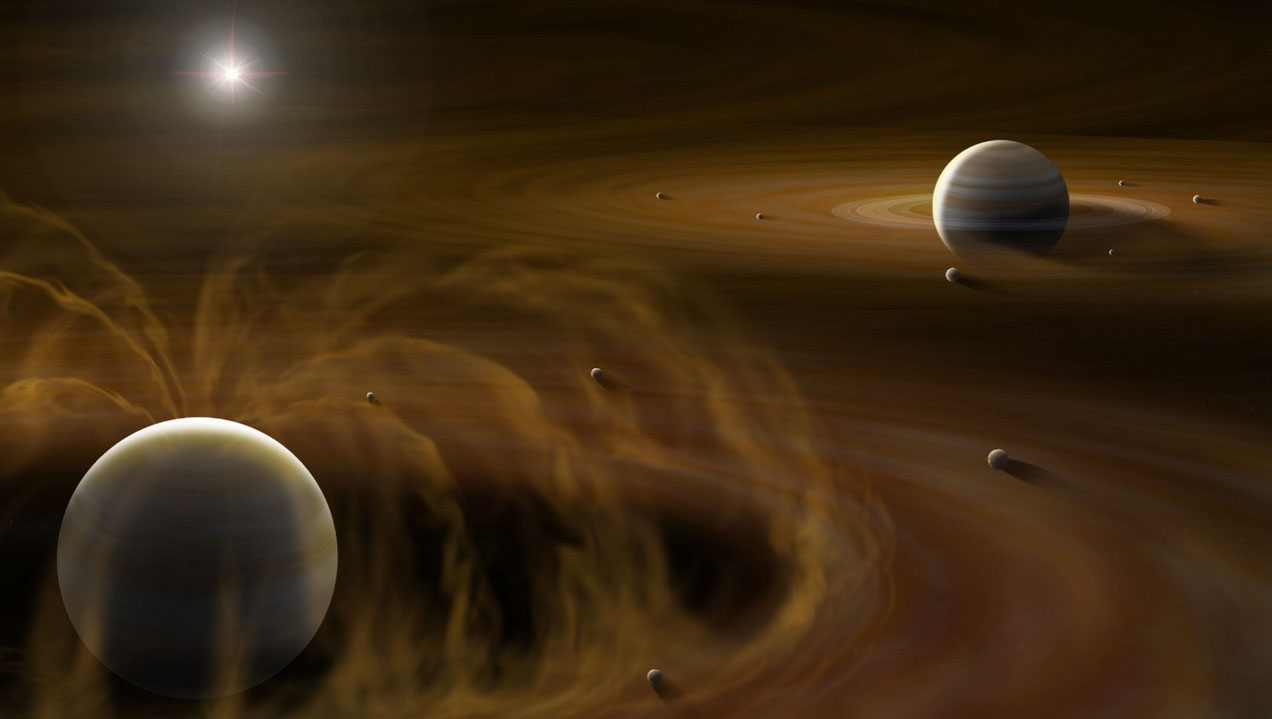
    Artist’s impression of the simulations conducted in this research. Jupiter (lower left) has a strong magnetic field which creates a cavity in its circumplanetary disk. Saturn (upper right) lacks a strong magnetic field so its circumplanetary disk evolves without a cavity. Credit: Credit: Yuri I. Fujii/L-INSIGHT [Kyoto University], Illustrator: Shinichiro Kinoshita
    Jupiter and Saturn may seem similar as gas giants, yet their vastly different moon systems reveal a deeper story shaped by magnetic forces and planetary evolution.

    Jupiter and Saturn, the two largest planets in our Solar System, also host the most extensive systems of moons. Jupiter is currently known to have more than 100 moons, while Saturn, along with its prominent ring system, has more than 280.

    Despite these large numbers, their moon systems are very different. Jupiter has four major moons, including Ganymede, the largest moon in the Solar System. Saturn, on the other hand, is dominated by a single standout moon, Titan, which ranks as the second largest.

    Because both planets are gas giants, scientists have long tried to understand why their satellite systems developed so differently. Existing theories of moon formation offer some explanations, but recent research on stellar magnetic fields suggests those ideas may need revision. One key question involves magnetic accretion and whether an inner cavity can form in Jupiter’s circumplanetary disk, the accumulation of material orbiting a planet from which satellites may form.

    Building a Unified Model

    Researchers from Japan and China, including a team at Kyoto University, set out to create a model that could explain both systems using the same physical principles. Such a model could also help scientists understand moon formation in planetary systems beyond our own.

    “Testing planet formation theory is somewhat difficult because we have only our Solar System for reference, but there are multiple satellite systems close to us whose detailed characteristics we can observe,” says first author Yuri I. Fujii.

    To explore how Jupiter and Saturn evolved, the team ran numerical simulations of their internal structures during their early stages. This allowed them to track changes in temperature and magnetic field strength over time. They also modeled the circumplanetary disks surrounding each planet and carried out N-body simulations to study how moons formed and migrated. These calculations were performed using a PC cluster at the Center for Computational Astrophysics at the National Astronomical Observatory of Japan.

    Magnetic Fields Shape Moon Systems

    The simulations show that the contrasting moon systems of Jupiter and Saturn can be traced to differences in the structure of their surrounding disks, which are influenced by magnetic field strength.

    Jupiter’s strong magnetic field likely created a magnetospheric cavity within its disk. This region may have helped trap and preserve major moons such as Io, Europa, and Ganymede.

    In comparison, Saturn’s early magnetic field appears to have been too weak to produce a similar cavity, making it harder for migrating moons to survive within the disk.

    These findings offer a framework for studying exomoons and circumplanetary disks around distant gas giants. According to the model, planets similar in size to Jupiter or larger are expected to form compact systems with multiple moons, while Saturn-sized planets may end up with only one or two. The researchers plan to extend this work to better understand other moon systems, including those beyond the Solar System.

    Reference: “Different architecture of Jupiter and Saturn satellite systems from magnetospheric cavity formation” by Yuri I. Fujii, Masahiro Ogihara and Yasunori Hori, 2 April 2026, Nature Astronomy.
    DOI: 10.1038/s41550-026-02820-x

    Funding: Japan Society for the Promotion of Science, National Natural Science Foundation of China, Kyoto University

    Never miss a breakthrough: Join the SciTechDaily newsletter.
    Follow us on Google and Google News.

    Astronomy Astrophysics Jupiter Kyoto University Planetary Science Popular Saturn
    Share. Facebook Twitter Pinterest LinkedIn Email Reddit

    Related Articles

    Scientists Crack Mystery Behind Jupiter and Saturn’s Wild Polar Weather

    What’s Happening to Jupiter’s Great Red Spot? The Solar System’s Largest Storm Could Finally Disappear

    Icy Enigma Unveiled: Researchers Crack the Code of Jupiter and Saturn’s Moons’ Radar Signatures

    NASA Discovers “Very Weird” Molecule in Titan’s Atmosphere

    Volcanic Impact on Jupiter’s Moon Io Shown Directly for the First Time

    New Physical Model Explains the Origin of Water in Our Solar System

    A Billion or More Jupiter-Like Worlds Could Be Orbiting Stars in the Milky Way

    Chandra Observations Show Solar Storms Trigger Jupiter’s ‘Northern Lights’

    LBT Reveals Lava Lake on Jupiter’s Moon Io

    1 Comment

    1. Dav_Daddy on April 15, 2026 1:18 pm

      I wonder if that’s why Earth has a large Moon while Venus doesn’t? Despite the fact that it appears both had a collision with something very large early in their formation.

      Reply
    Leave A Reply Cancel Reply

    • Facebook
    • Twitter
    • Pinterest
    • YouTube

    Don't Miss a Discovery

    Subscribe for the Latest in Science & Tech!

    Trending News

    Scientists May Have Found the Key to Jupiter and Saturn’s Moon Mystery

    Scientists Uncover Brain Changes That Link Pain to Depression

    Saunas May Do More Than Raise Body Temperature – They Activate Your Immune System

    Exercise in a Pill? Metformin Shows Surprising Effects in Cancer Patients

    Hidden Oceans of Magma Could Be Protecting Alien Life

    New Study Challenges Alzheimer’s Theories: It’s Not Just About Plaques

    Artificial Sweeteners May Harm Future Generations, Study Suggests

    Splashdown! NASA Artemis II Returns From Record-Breaking Moon Mission

    Follow SciTechDaily
    • Facebook
    • Twitter
    • YouTube
    • Pinterest
    • Newsletter
    • RSS
    SciTech News
    • Biology News
    • Chemistry News
    • Earth News
    • Health News
    • Physics News
    • Science News
    • Space News
    • Technology News
    Recent Posts
    • Scientists Discover Game-Changing New Way To Treat High Cholesterol
    • Breakthrough Drug Delays Rheumatoid Arthritis for Years After Treatment Ends
    • This Small Change to Your Exercise Routine Could Be the Secret to Living Longer
    • Physicists Discover a Strange New Kind of One-Dimensional Particle
    • Scientists Discover Unexpected Climate Benefit Hidden in Forest Soils
    Copyright © 1998 - 2026 SciTechDaily. All Rights Reserved.
    • Science News
    • About
    • Contact
    • Editorial Board
    • Privacy Policy
    • Terms of Use

    Type above and press Enter to search. Press Esc to cancel.