
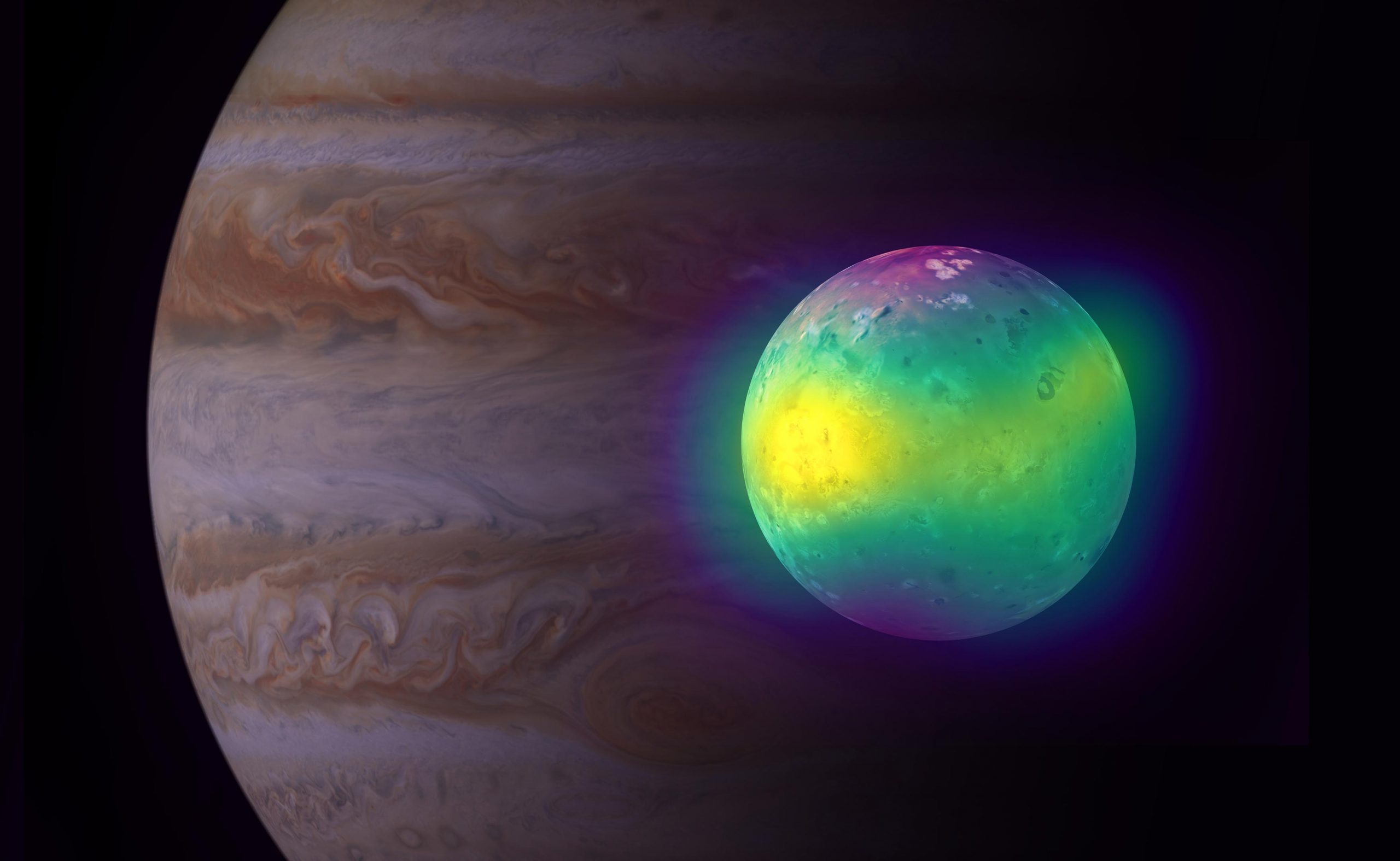
New radio images from the Atacama Large Millimeter/submillimeter Array (ALMA) show for the first time the direct effect of volcanic activity on the atmosphere of Jupiter’s moon Io.
Io is the most volcanically active moon in our solar system. It hosts more than 400 active volcanoes, spewing out sulfur gases that give Io its yellow-white-orange-red colors when they freeze out on its surface.
Although it is extremely thin – about a billion times thinner than Earth’s atmosphere – Io has an atmosphere that can teach us about Io’s volcanic activity and provide us a window into the exotic moon’s interior and what is happening below its colorful crust.
Previous research has shown that Io’s atmosphere is dominated by sulfur dioxide gas, ultimately sourced from volcanic activity. “However, it is not known which process drives the dynamics in Io’s atmosphere,” said Imke de Pater of the University of California, Berkeley. “Is it volcanic activity, or gas that has sublimated (transitioned from solid to gaseous state) from the icy surface when Io is in sunlight?“
To distinguish between the different processes that give rise to Io’s atmosphere, a team of astronomers used ALMA to make snapshots of the moon when it passed in and out of Jupiter’s shadow (they call this an “eclipse”).
This video shows images of Jupiter’s moon Io in radio (made with ALMA), and optical light (made with Voyager 1 and Galileo missions). The ALMA images were taken when Io passed into Jupiter’s shadow in March 2018 (eclipse), and from Jupiter’s shadow into sunlight in September 2018. These radio images for the first time show plumes of sulfur dioxide (in yellow) rise up from the volcanoes on Io. Credit: ALMA (ESO/NAOJ/NRAO), I. de Pater et al.; NRAO/AUI NSF, S. Dagnello; NASA
“When Io passes into Jupiter’s shadow, and is out of direct sunlight, it is too cold for sulfur dioxide gas, and it condenses onto Io’s surface. During that time we can only see volcanically-sourced sulfur dioxide. We can therefore see exactly how much of the atmosphere is impacted by volcanic activity,” explained Statia Luszcz-Cook from Columbia University, New York.
Thanks to ALMA’s exquisite resolution and sensitivity, the astronomers could, for the first time, clearly see the plumes of sulfur dioxide (SO2) and sulfur monoxide (SO) rise up from the volcanoes. Based on the snapshots, they calculated that active volcanoes directly produce 30-50 percent of Io’s atmosphere.
The ALMA images also showed a third gas coming out of volcanoes: potassium chloride (KCl). “We see KCl in volcanic regions where we do not see SO2 or SO,” said Luszcz-Cook. “This is strong evidence that the magma reservoirs are different under different volcanoes.”
Io is volcanically active due to a process called tidal heating. Io orbits Jupiter in an orbit that is not quite circular and, like our Moon always faces the same side of Earth, so does the same side of Io always face Jupiter. The gravitational pull of Jupiter’s other moons Europa and Ganymede causes tremendous amounts of internal friction and heat, giving rise to volcanoes such as Loki Patera, which spans more than 200 kilometers (124 miles) across. “By studying Io’s atmosphere and volcanic activity we learn more about not only the volcanoes themselves, but also the tidal heating process and Io’s interior,” added Luszcz-Cook.
A big unknown remains the temperature in Io’s lower atmosphere. In future research, the astronomers hope to measure this with ALMA. “To measure the temperature of Io’s atmosphere, we need to obtain a higher resolution in our observations, which requires that we observe the moon for a longer period of time. We can only do this when Io is in sunlight since it does not spend much time in eclipse,” said de Pater. “During such an observation, Io will rotate by tens of degrees. We will need to apply software that helps us make un-smeared images. We have done this previously with radio images of Jupiter made with ALMA and the Very Large Array (VLA).”
Reference: “ALMA Observations of Io Going into and Coming out of Eclipse” by Imke de Pater, Statia Luszcz-Cook, Patricio Rojo, Erin Redwing, Katherine de Kleer and Arielle Moullet, 6 November 2020, Planetary Science Journal.
DOI: 10.3847/PSJ/abb93d
The National Radio Astronomy Observatory is a facility of the National Science Foundation, operated under cooperative agreement by Associated Universities, Inc.
Never miss a breakthrough: Join the SciTechDaily newsletter.
Follow us on Google and Google News.
3 Comments
Aother Big unknown is , just like our knowledge about the dark side of our moon is limited ( except for the fact that China landed a spacecraft of the dark side of the moon recently and has not disclosed its findings widely, Ioalso has a dark side which we seem to know very little abou?
Wow.
It’s not even wrong. Saying it’s wrong would imply that you could raise a rational argument against it, but frankly that would be akin to arguing with flat earthers. Who on earth is employing these lunatics?
Sekar, China has released findings from Chang’e 4 and its rover Yutu 2 about the far side of the moon. NASA has published extensive Apollo photographic coverage of the far side, and is currently mapping it to 50cm resolution with the Lunar Reconnaissance Orbiter. Finally, DSCOVR regularly looks at the lunar far side. All that is available online for your review. Finally, past missions like GRAIL have published their results, too.