
Close Menu
    Facebook X (Twitter) Instagram
    SciTechDaily
    • Biology
    • Chemistry
    • Earth
    • Health
    • Physics
    • Science
    • Space
    • Technology
    Facebook X (Twitter) Pinterest YouTube RSS
    SciTechDaily
    Home»Space»GBT Reveals Hidden Details in Starburst Galaxy M82
    Space

    GBT Reveals Hidden Details in Starburst Galaxy M82

    By National Radio Astronomy ObservatoryDecember 10, 2013No Comments3 Mins Read
    Facebook Twitter Pinterest Telegram LinkedIn WhatsApp Email Reddit
    Share
    Facebook Twitter LinkedIn Pinterest Telegram Email Reddit
    GBT Reveals Hidden Details in Starburst Galaxy M82
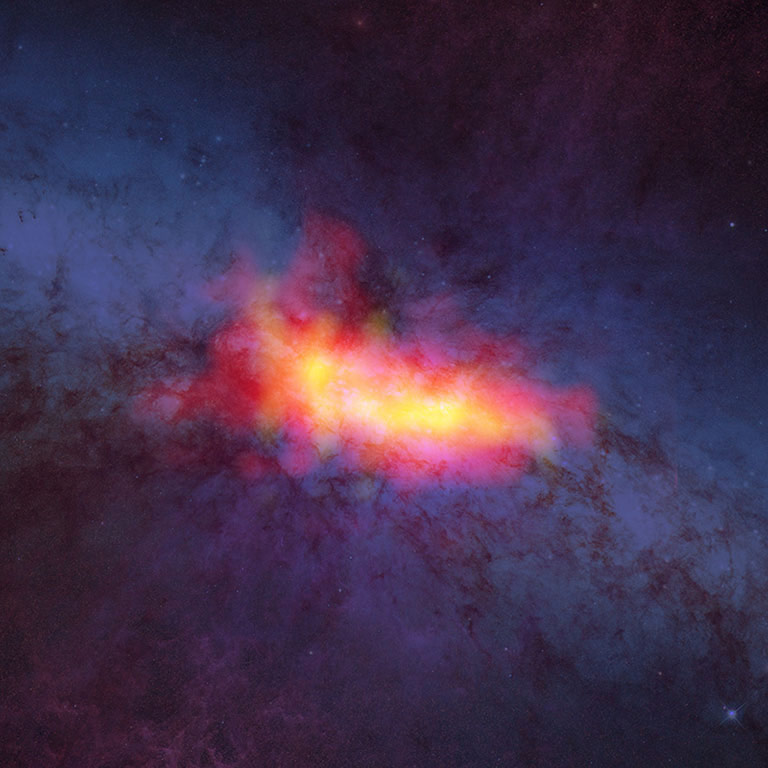
    This composite image of starburst galaxy M82 shows the distribution of dense molecular gas as seen by the GBT (yellow and red) and the background stars and dust as seen by Hubble (blue). The yellow areas correspond to regions of intense star formation. The red areas trace outflows of gas from the disk of the galaxy. Credit: Bill Saxton (NRAO/AUI/NSF); Hubble/NASA

    Using the Green Bank Telescope, astronomers reveal never-before-seen details and present the most sensitive maps yet of HCN and HCO+ in the starburst galaxy M82.

    Using the new, high-frequency capabilities of the National Science Foundation’s Robert C. Byrd Green Bank Telescope (GBT), astronomers have captured never-before-seen details of the nearby starburst galaxy M82. These new data highlight streamers of material fleeing the disk of the galaxy as well as concentrations of dense molecular gas surrounding pockets of intense star formation.

    M82, which is located approximately 12 million light-years away in the constellation Ursa Major, is a classic example of a starburst galaxy — one that is producing new stars tens to hundreds of times faster than our own Milky Way. Its relatively nearby location made it an ideal target for the GBT’s newly equipped “W-Band” receiver, which is capable of detecting the millimeter wavelength light that is emitted by molecular gas. This new capability makes the GBT the world’s largest single-dish, millimeter-wave telescope.

    “With this new vision, we were able to look at M82 to explore how the distribution of molecular gas in the galaxy corresponded to areas of intense star formation,” said Amanda Kepley, a post-doctoral fellow at the National Radio Astronomy Observatory (NRAO) in Green Bank, West Virginia, and lead author on a paper accepted for publication in the Astrophysical Journal Letters. “Having this new capability may help us understand why stars form where they do.”

    Astronomers recognize that dense molecular gas goes hand-in-hand with areas of star formation, but the connection is poorly understood and this relationship may be different in different types of galaxies. By creating wide-angle maps of the gas in galaxies, astronomers hope to better understand this complex interplay.

    To date, however, these kinds of observations have not been easy since molecules that are used to map the distribution of dense gas, like HCN (hydrogen cyanide) and HCO+ (formylium), shine feebly in millimeter light. With its new W-Band receiver, the GBT was able to make highly sensitive, wide-angle images of these gases in and around M82.

    “The GBT data clearly show billowing concentrations of dense molecular gas huddled around areas that are undergoing bursts of intense star formation,” said Kepley. “They also reveal giant outflows of ionized gas fleeing the disk of the galaxy. These outflows are driven by star formation deep within the galaxy.”

    This capability will enable astronomers to quickly survey entire galaxies and different parts within galaxies. Such surveys would complement higher resolution observations with the new Atacama Large Millimeter/submillimeter Array (ALMA) telescope in Chile.

    The 100-meter GBT is located in the National Radio Quiet Zone and the West Virginia Radio Astronomy Zone, which protect the incredibly sensitive telescope from unwanted radio interference.

    The National Radio Astronomy Observatory is a facility of the National Science Foundation, operated under cooperative agreement by Associated Universities, Inc.

    Reference: “The Green Bank Telescope Maps the Dense, Star-Forming Gas in the Nearby Starburst Galaxy M82” by Amanda A. Kepley, Adam K. Leroy, David Frayer, Antonio Usero, Josh Marvil and Fabian Walter, 13 December 2013, The Astrophysical Journal Letters.
    DOI: 10.1088/2041-8205/780/1/L13
    arXiv:1312.1595


    Never miss a breakthrough: Join the SciTechDaily newsletter.
    Follow us on Google and Google News.

    Astronomy Astrophysics National Radio Astronomy Observatory Popular Star Formation Telescope
    Share. Facebook Twitter Pinterest LinkedIn Email Reddit

    Related Articles

    “No One Had Any Idea This Existed” – Astronomers Discover Hidden River of Gas Flowing to the Milky Way’s Heart

    VLA Reveals Unexpected “Storm” in Teacup Galaxy

    Astronomers Discover Triple System of Two White Dwarfs and Neutron Star

    New Research Boosts Binary-Star Formation Theory

    Infrared Dark Clouds Reveal Why Some Stars are Bigger than Others

    Signs of Star Formation Near Supermassive Black Hole at the Galactic Center

    Fermi’s Motion Captured by Vela Pulsar Video

    Massive Outburst in Spiral Galaxy NGC 660 Surprises Astronomers

    Astronomers Obtain Precise Measurements of the Two Kepler-16 Stars

    Leave A Reply Cancel Reply

    • Facebook
    • Twitter
    • Pinterest
    • YouTube

    Don't Miss a Discovery

    Subscribe for the Latest in Science & Tech!

    Trending News

    New Study Reveals Why Ozempic Works Better for Some People Than Others

    Climate Change Is Altering a Key Greenhouse Gas in a Way Scientists Didn’t Expect

    New Study Suggests Gravitational Waves May Have Created Dark Matter

    Scientists Discover Why the Brain Gets Stuck in Schizophrenia

    Scientists Engineer “Tumor-Eating” Bacteria That Devour Cancer From Within

    Even “Failed” Diets May Deliver Long-Term Health Gains, Study Finds

    NIH Scientists Discover Powerful New Opioid That Relieves Pain Without Dangerous Side Effects

    Collapsing Plasma May Hold the Key to Cosmic Magnetism

    Follow SciTechDaily
    • Facebook
    • Twitter
    • YouTube
    • Pinterest
    • Newsletter
    • RSS
    SciTech News
    • Biology News
    • Chemistry News
    • Earth News
    • Health News
    • Physics News
    • Science News
    • Space News
    • Technology News
    Recent Posts
    • The Surprising Reason You Might Want To Sleep Without a Pillow
    • Household Cats Could Hold the Secret to Fighting Breast Cancer
    • Scientists Say This Natural Hormone Reverses Obesity by Targeting the Brain
    • This 15,000-Year-Old Discovery Changes What We Know About Early Human Creativity
    • 35-Million-Year-Old Mystery: Strange Arachnid Discovered Preserved in Amber
    Copyright © 1998 - 2026 SciTechDaily. All Rights Reserved.
    • Science News
    • About
    • Contact
    • Editorial Board
    • Privacy Policy
    • Terms of Use

    Type above and press Enter to search. Press Esc to cancel.