
Newly identified Midpoint cloud reveals rare insight into star formation and the movement of galactic material toward the center of the Milky Way.
A group of astronomers from around the world has identified a vast cloud of gas and dust in an underexplored part of the Milky Way. This structure, classified as a Giant Molecular Cloud (GMC), spans roughly 60 parsecs, or about 200 light-years in length.
Described in a new paper in the Astrophysical Journal, the team used the U.S. National Science Foundation’s Green Bank Telescope (NSF GBT) to investigate a molecular cloud labeled M4.7-0.8, also known as the Midpoint cloud. Their findings reveal a highly active environment, featuring regions that may be on the verge of forming new stars.
Confirming a massive structure
“One of the big discoveries of the paper was the GMC itself. No one had any idea this cloud existed until we looked at this location in the sky and found the dense gas. Through measurements of the size, mass, and density, we confirmed this was a giant molecular cloud,” shares Natalie Butterfield, an NSF National Radio Astronomy Observatory (NSF NRAO) scientist and lead author of this paper.
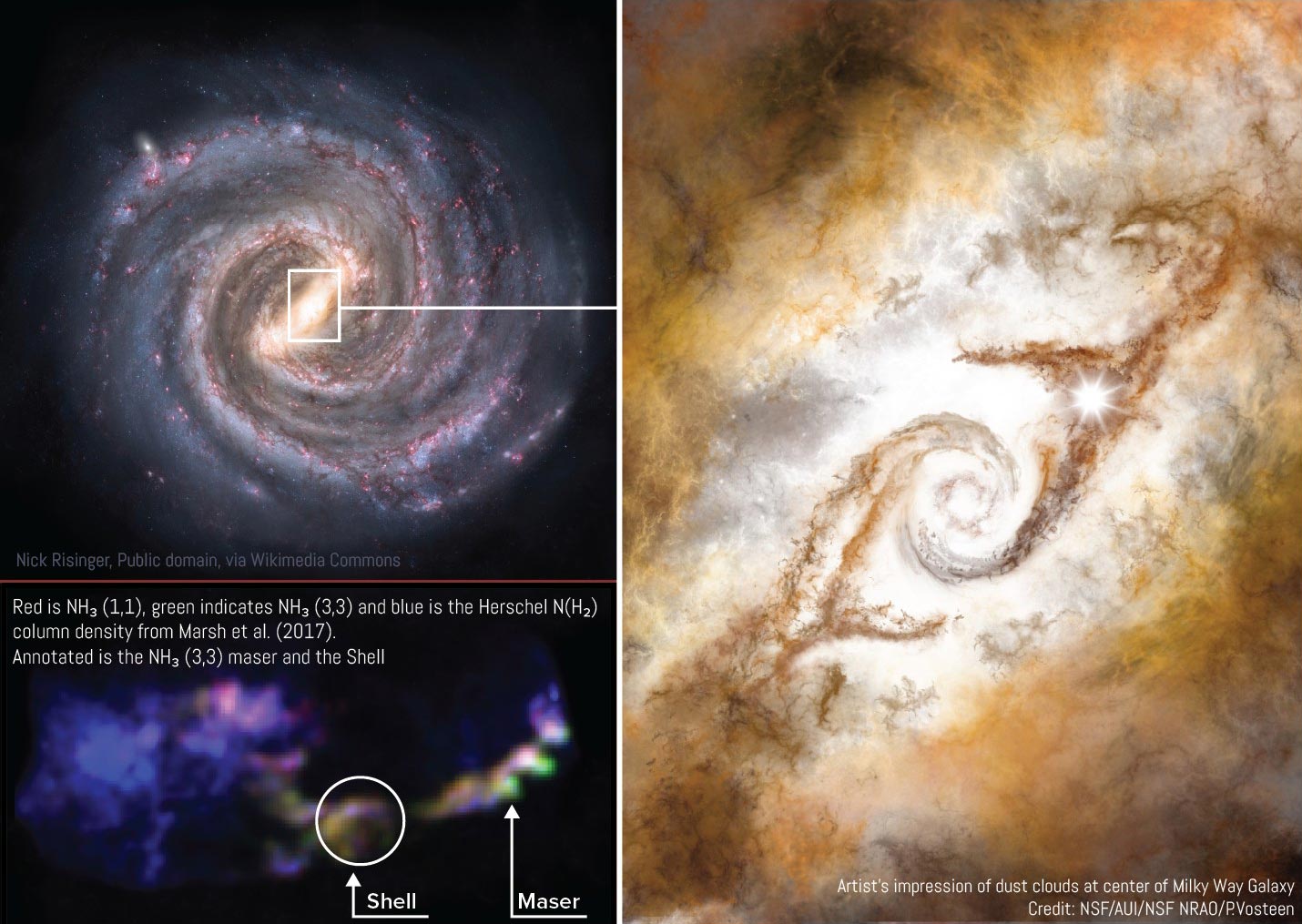
“These dust lanes are like hidden rivers of gas and dust that are carrying material into the center of our galaxy,” explained Butterfield. “The Midpoint cloud is a place where material from the galaxy’s disk is transitioning into the more extreme environment of the galactic center and provides a unique opportunity to study the initial gas conditions before accumulating in the center of our galaxy.”
Clues from molecular tracers
Researchers using the NSF Green Bank Telescope (NSF GBT) focused their observations on molecules such as ammonia (NH₃) and cyanobutadiyne (HC₅N), both of which are reliable indicators of dense interstellar gas. Their data not only uncovered the previously undetected Midpoint cloud within one of the Milky Way’s inward-moving dust lanes but also revealed several key features:
- A newly identified maser: The team detected a previously unknown maser—a naturally occurring source of concentrated microwave radiation—linked to ammonia gas. These signals are often associated with regions where stars are actively forming.
- Sites of potential star formation: Within the cloud, researchers identified compact gas and dust clumps that may soon give rise to new stars. One such clump, named Knot E, may be a frEGG (free-floating evaporating gas globule), a dense object gradually being worn away by radiation from nearby stars.
- Signs of stellar feedback: A shell-like structure inside the cloud may be the result of energetic events, such as dying stars expelling material into the surrounding region.
- High gas turbulence: The cloud’s gas exhibits intense turbulence, similar to what is observed in the galaxy’s central zones. This chaotic motion might stem from material funneling in through the dust lanes or from interactions with other nearby clouds.
“Star formation in galactic bars is a bit of a puzzle,” said Larry Morgan, a scientist with the NSF Green Bank Observatory (NSF GBO), “The strong forces in these regions can actually suppress star formation. However, the leading edges of these bars, such as where the Midpoint is located, can accumulate dense gas and trigger new star formation.”
The team’s findings suggest that the Midpoint cloud is a crucial link in the flow of material from the Milky Way’s disk to its center. By studying this region, astronomers can learn more about how galaxies build their central structures and form new stars in extreme environments.
Reference: “Discovery of a Giant Molecular Cloud at the Midpoint of the Galactic Bar Dust Lanes: M4.7–0.8” by Natalie O. Butterfield, Larry K. Morgan, Ashley T. Barnes, Adam Ginsburg, Savannah Gramze, Mark R. Morris, Mattia C. Sormani, Cara D. Battersby, Charlie Burton, Allison H. Costa, Elisabeth A. C. Mills, Jürgen Ott, Michael Rugel and Harrison West, 16 July 2025, The Astrophysical Journal.
DOI: 10.3847/1538-4357/adc687
Never miss a breakthrough: Join the SciTechDaily newsletter.
Follow us on Google and Google News.
2 Comments
Very interesting like to read more Coen
This article contains concepts and language from my original work:
“Solar Matter–Antimatter Highways: A 5D Model of Interstellar Charge Redistribution and Gravity-Field Formation”
DOI: https://doi.org/10.5281/zenodo.16503982 (Published July 27, 2025, Zenodo)
This work is licensed under Creative Commons Attribution 4.0 International and Apache License 2.0, which require proper credit to the author, Robert Weber, and inclusion of the license terms. Please update the article to reflect this attribution as required.