
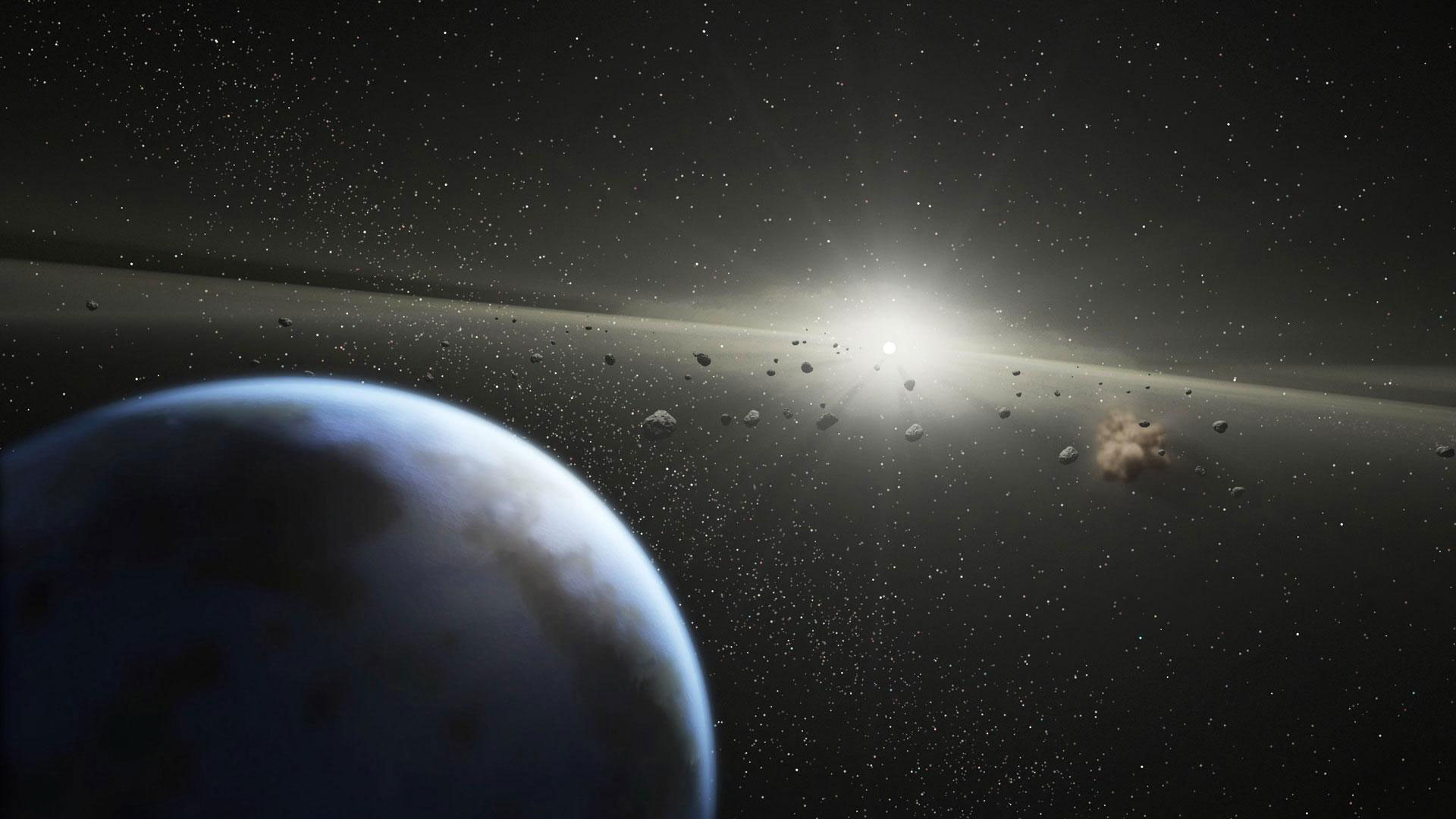
Equipped with Newton’s law of universal gravitation (published in Principia 330 years ago) and powerful computational resources (used to apply the law to more than 10,000 interacting bodies), a young Brazilian researcher and his former postdoctoral supervisor have just proposed a new physical model to explain the origin of water on Earth and the other Earth-like objects in the Solar System.
The article, “Origin of water in the inner Solar System: Planetesimals scattered inward during Jupiter and Saturn’s rapid gas accretion”, was published in the planetary science journal Icarus.
The authors of the article are André Izidoro, who is affiliated with São Paulo State University’s Guaratinguetá School of Engineering (FEG-UNESP) and supported by a Young Investigator Grant from FAPESP, and the American astrophysicist Sean Raymond, who is currently with the Bordeaux Astrophysics Laboratory in France.
“The idea that Earth’s water came predominantly from asteroids isn’t new. It’s practically a consensus among researchers. Our work isn’t groundbreaking in that sense. What we did was associate the asteroid contribution with the formation of Jupiter. Based on the resulting model, we ‘delivered to Earth’ amounts of water consistent with currently estimated values,” Izidoro told Agência FAPESP.
Estimates of the amount of water on Earth vary a great deal. If the unit of measurement is terrestrial oceans, some scientists speak of three to four of them, while others estimate dozens. The variation derives from the fact that the amounts of water in the planet’s hot mantle and its rocky crust are unknown. In any event, the model proposed covers the full range of estimates.
“First of all, it’s important to leave aside the idea that Earth received all its water via the impacts of comets from very distant regions. These ‘deliveries’ also occurred, but their contributions came later and were far less significant in percentage terms,” Izidoro said. “Most of our water came to the region currently occupied by Earth’s orbit before the planet was formed.”
To understand how this happened, it is worth restating the scenario defined in the conventional model of the Solar System’s formation and then adding the new model for the advent of water. The initial condition is a gigantic cloud of gas and cosmic dust. Owing to some kind of gravitational disturbance or local turbulence, the cloud collapses and is attracted by a specific inner region that becomes a center.
With the accumulation of matter, at about 4.5 billion years ago, the center became so massive and hot that it began the process of nuclear fusion, which transformed it into a star. Meanwhile, the remaining cloud continued to orbit the center and its matter agglutinated to form a disk, which later fragmented to define protoplanetary niches.
“The water-rich region of this disk is estimated to have been located several astronomical units from our Sun. In the inner region, closer to the star, the temperature was too high for water to accumulate except, perhaps, in very small amounts in the form of vapor,” Izidoro said.
An astronomical unit (AU) is the average distance from the Earth to the Sun. The region between 1.8 AU and 3.2 AU is currently occupied by the Asteroid Belt, with hundreds of thousands of objects. The asteroids located between 1.8 AU and 2.5 AU are mostly water-poor, whereas those located beyond 2.5 AU are water-rich. The process whereby Jupiter was formed can explain the origin of this division, according to Izidoro.
“The time elapsed between the Sun’s formation and the complete dissipation of the gas disk was quite short on the cosmogonic scale: from only 5 million to, at most, 10 million years,” he said. “The formations of gas giants as massive as Jupiter and Saturn can only have occurred during this youthful phase of the Solar System, so it was during this phase that Jupiter’s rapid growth gravitationally disturbed thousands of water-rich planetesimals, dislodging them from their original orbits.”
Jupiter is believed to have a solid core with a mass equivalent to several times that of Earth. This core is surrounded by a thick and massive layer of gas. Jupiter could only have acquired this wrapping during the solar nebular phase, when the system was forming and a huge amount of gaseous material was available.
The acquisition of this gas by gravitational attraction was very fast because of the great mass of Jupiter’s embryo. In the vicinity of the formation of the giant planet, located beyond the “snow line”, thousands of planetesimals (rocky bodies similar to asteroids) orbited the center of the disk and, simultaneously, attracted each other.
The rapid increase of Jupiter’s mass undermined the fragile gravitational equilibrium of this system with many bodies. Several planetesimals were engulfed by proto-Jupiter. Others were propelled to the outskirts of the Solar System. In addition, a smaller number were hurled into the disk’s inner region, delivering water to the material that later formed the terrestrial planets and the Asteroid Belt.
“The period during which the Earth was formed is dated to between 30 million and 150 million years after the Sun’s formation,” Izidoro said. “When this happened, the region of the disk in which our planet was formed already contained large amounts of water, delivered by the planetesimals scattered by Jupiter and also by Saturn. A small proportion of Earth’s water may have arrived later via collisions with comets and asteroids. An even smaller proportion may have been formed locally through endogenous physicochemical processes. But most of it came with the planetesimals.”
His argument is supported by the model he built with his former supervisor. “We used supercomputers to simulate the gravitational interactions among multiple bodies by means of numerical integrators in Fortran,” he explained. “We introduced a modification to include the effects of the gas present in the medium during the era of planet formation because, in addition to all the gravitational interactions that were going on, the planetesimals were also impacted by the action of what’s known as ‘gas drag’, which is basically a ‘wind’ blowing in the opposite direction of their movement. The effect is similar to the force perceived by a cyclist in motion as the molecules of air collide with his body.”
Owing to gas drag, the initially very elongated orbits of the planetesimals scattered by Jupiter were gradually “circularized”. It was this effect that implanted these objects in what is now the Asteroid Belt.
A key parameter in this type of simulation is the total mass of the solar nebula at the start of the process. To arrive at this number, Izidoro and Raymond used a model proposed in the early 1970s that was based on the estimated masses of all the objects currently observed in the Solar System.
To compensate for losses due to matter ejection during the formation of the system, the model corrects the current masses of the different objects such that the proportions of heavy elements (oxygen, carbon, etc.) and light elements (hydrogen, helium, etc.) are equal to those of the Sun. The rationale for this is the hypothesis that the compositions of the gas disk and the Sun were the same. Following these alterations, the estimated mass of the primitive cloud is obtained.
“Furthermore, our new model also considered the different sizes of the existing asteroids, which range from kilometers to hundreds of kilometers in length, because the gas tends to affect smaller asteroids more than others,” Izidoro said.
The simulation based on these parameters can be seen in this animation:
The horizontal axis shows the distance to the Sun in AU. The objects’ orbital eccentricities are plotted along the vertical axis. As the animation progresses, it illustrates how the system evolved during the formative stage. The two black dots, located at just under 5.5 AU and a little past 7.0 AU, correspond to Jupiter and Saturn respectively. During the animation, these bodies grow as they accrete gas from the protoplanetary cloud, and their growth destabilizes planetesimals, scattering them in various directions. The different colors assigned to the planetesimals serve merely to show where they were to begin with and how they were scattered. The gray area marks the current position of the Asteroid Belt. Time passes in thousands of years, as shown at the top of the chart.
A second animation adds a key ingredient, which are the migrations of Jupiter and Saturn to positions nearer the Sun during their growth processes.
All calculations of the gravitational interactions among the bodies were based on Newton’s law. Numeric integrators enabled the researchers to calculate the positions of each body at different times, which would be impossible to do for some 10,000 bodies without a supercomputer.
Reference: “Origin of water in the inner Solar System: Planetesimals scattered inward during Jupiter and Saturn’s rapid gas accretion” Sean N. Raymond and Andre Izidor, 7 July 2017, Icarus.
DOI: 10.1016/j.icarus.2017.06.030
Never miss a breakthrough: Join the SciTechDaily newsletter.
Follow us on Google and Google News.
8 Comments
Pure nonsense. How could asteroids drop off that much water and where are the asteroids? Don’t you know water is formed high in the sky by electricity combining the elements?
Where are the asteroids? Part of Earth’s mantle & crust, obviously.
No, it’s not obvious
When you reject creationism it’s tough to explain origins. Unfortunately all these alternatives explanations don’t even make sense even to the people proposing them.
Creationism??? The mother of all un-testable assumptions.
Even evolution is untested and goes against scientific reasoning. One requires faith (in evelution) to believe what evolution says. Its claims can’t be tested, can’t be verified etc.
And ooh I had forgotten that no one can has observed evolutionary processes taking place. So what we have and know about evolution are theories and assumption rather than proven scientific facts.
Amazing well writen article. Awesome job I enjoyed reading how water was formed in our universe.