
Close Menu
    Facebook X (Twitter) Instagram
    SciTechDaily
    • Biology
    • Chemistry
    • Earth
    • Health
    • Physics
    • Science
    • Space
    • Technology
    Facebook X (Twitter) Pinterest YouTube RSS
    SciTechDaily
    Home»Biology»How Farming Ants Harness Beneficial Bacteria for Survival
    Biology

    How Farming Ants Harness Beneficial Bacteria for Survival

    By PNAS NexusNovember 7, 2024No Comments2 Mins Read
    Facebook Twitter Pinterest Telegram LinkedIn WhatsApp Email Reddit
    Share
    Facebook Twitter LinkedIn Pinterest Telegram Email Reddit
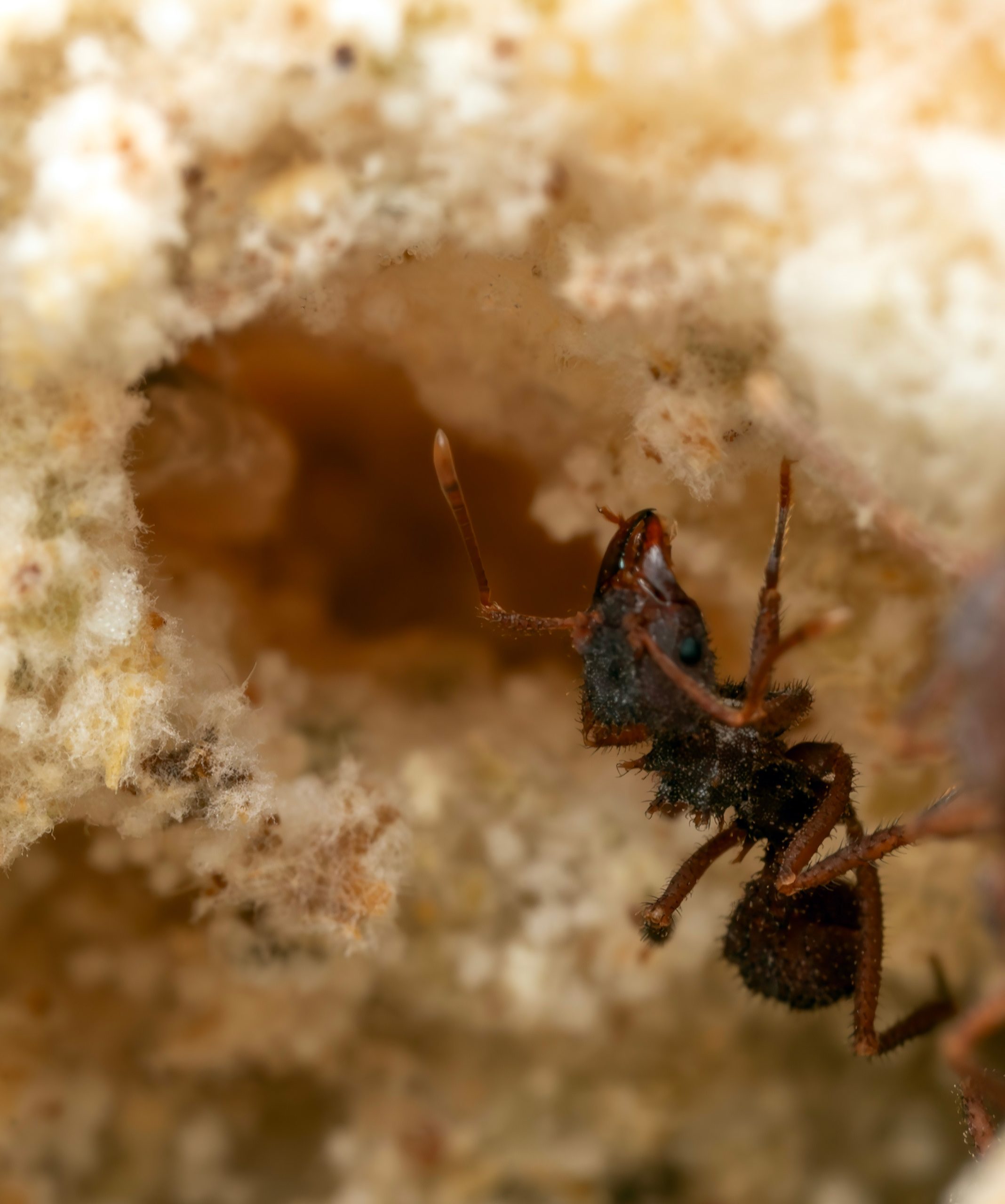
    Mycetomoellerius zetecki
    Mycetomoellerius zetecki, one of the studied ant species. Actinobacteria are just visible as a pale area on the chest plates. Credit: David R. Nash

    A new study finds that attine ants developed structural adaptations to host bacteria, specifically Pseudonocardia, which aids their fungal farming.

    A study explores the evolution of beneficial bacteria residing within and on the surface of farming ants. Attine ants engage in a mutualistic relationship by cultivating fungi, one of the most extensively studied symbioses in nature. In the 1990s, researchers discovered an additional partner in this relationship: an actinobacterium known as Pseudonocardia. This bacterium inhabits the ants’ cuticle—their protective exoskeleton—where it is nourished by secretions from subcuticular glands.

    Pseudonocardia is known to kill the fungal pathogen Escovopsis, that might destroy the ants’ mutualistic fungus. Jacobus J. Boomsma and colleagues sequenced samples from 194 ants from 11 attine species collected in Panama to assess the extent of coevolution between ants and their cuticular residents.

    Three of the 11 attine species had abundant Pseudonocardia, including two Acromyrmex leaf-cutting ants. Five other species had cuticular actinobacteria other than Pseudonocardia, with no clear phylogenetic patterns.

    Insights into Ant Gland Structure and Function

    The authors examined the ants’ nourishment glands with transmission electron microscopy, revealing similar structures across species, suggesting that attine ants evolved structural and functional adaptations for hosting cuticular actinobacteria only once, shortly after the origin of fungus farming.

    Clearly, however, the glands are capable of nourishing bacterial strains other than Pseudonocardia. Comparing phylogenies of ants and their cuticular and gut Pseudonocardia indicates that Pseudonocardia were initially gut symbionts and became cuticular symbionts late in attine evolution, around 20 million years ago, coincident with the evolution of new genera in Central/North America.

    According to the authors, earlier contradictory findings can be explained by not separating guts and cuticles during sequencing, and because ants easily acquire non-natural actinobacteria when held for longer periods in lab settings.

    Reference: “From the inside out: Were the cuticular Pseudonocardia bacteria of fungus-farming ants originally domesticated as gut symbionts?” by Tabitha M Innocent, Panagiotis Sapountzis, Mariya Zhukova, Michael Poulsen, Morten Schiøtt, David R Nash and Jacobus J Boomsma, 15 October 2024, PNAS Nexus.
    DOI: 10.1093/pnasnexus/pgae391

    Never miss a breakthrough: Join the SciTechDaily newsletter.
    Follow us on Google and Google News.

    Ants Entomology Evolutionary Biology
    Share. Facebook Twitter Pinterest LinkedIn Email Reddit

    Related Articles

    The Insect Apocalypse Hits Fiji: 79% of Native Ants Are Vanishing

    Cannibal Wood Ants Were Stuck in a Polish Nuclear Weapons Bunker – Here’s What Happened

    Ants vs. Humans: Solving the Mystery of How Ants Manage Traffic So Well

    Recording Breaking Speed: World’s Fastest Ant Clocked at 855mm/s, an Incredible 47 Strides/s

    Ants Fight Plant Diseases by Secreting Antibiotics – Potential for Use in Agriculture

    The Unexpected Role Ant-Plant Partnerships May Play in Ant Evolution

    Wood Ants Survive for Years Trapped in a Nuclear Weapons Bunker

    Periodical Cicadas Manipulate the Populations of Predatory Birds

    Hyperparasite Fungus Limits the Effects of ‘Zombie-Ant’ Fungus

    Leave A Reply Cancel Reply

    • Facebook
    • Twitter
    • Pinterest
    • YouTube

    Don't Miss a Discovery

    Subscribe for the Latest in Science & Tech!

    Trending News

    Common Laxative May Help Reverse Depression-Related Brain Fog

    Younger Generations Are Aging Faster – and It May Be Fueling a Surge in Cancer

    New Discovery Could Unlock Quantum Computers the Size of a Coin

    Shingles Vaccine Linked to 24% Lower Dementia Risk in Older Adults

    Scientists Found a Wordle Trick That Solves 99% of Puzzles

    A Hidden Galaxy Called Shadow Blaster May Explain One of Astronomy’s Biggest Mysteries

    These 3 Common Sleep Habits May Be Aging Your Brain Faster

    Rare Goblin Shark Spotted Alive in Its Natural Habitat for the First Time

    Follow SciTechDaily
    • Facebook
    • Twitter
    • YouTube
    • Pinterest
    • Newsletter
    • RSS
    SciTech News
    • Biology News
    • Chemistry News
    • Earth News
    • Health News
    • Physics News
    • Science News
    • Space News
    • Technology News
    Recent Posts
    • New Fossils Show the Arctic Was an Evolutionary Powerhouse During the Age of Dinosaurs
    • What Happened to Australasia’s Lost Crocodiles? New Research Reveals a Dramatic Extinction Story
    • 520-Million-Year-Old Fossils Solve One of Evolution’s Biggest Mysteries
    • This Extraordinary Desert Mouse Defies Aging – and It Could Change Human Longevity
    • A Simple Blood Test Can Reveal the True Age of Your Brain, Heart, and Other Organs
    Copyright © 1998 - 2026 SciTechDaily. All Rights Reserved.
    • Science News
    • About
    • Contact
    • Editorial Board
    • Privacy Policy
    • Terms of Use

    Type above and press Enter to search. Press Esc to cancel.