
Scientists have unlocked a groundbreaking way to produce clean hydrogen using microwaves, drastically reducing the extreme heat required for conventional methods.
By harnessing microwave energy, the team lowered the reaction temperature by over 60%, making hydrogen production far more efficient and sustainable. A key breakthrough was the rapid creation of oxygen vacancies, essential for splitting water into hydrogen, in just minutes rather than hours.
Revolutionizing Hydrogen Production with Microwaves
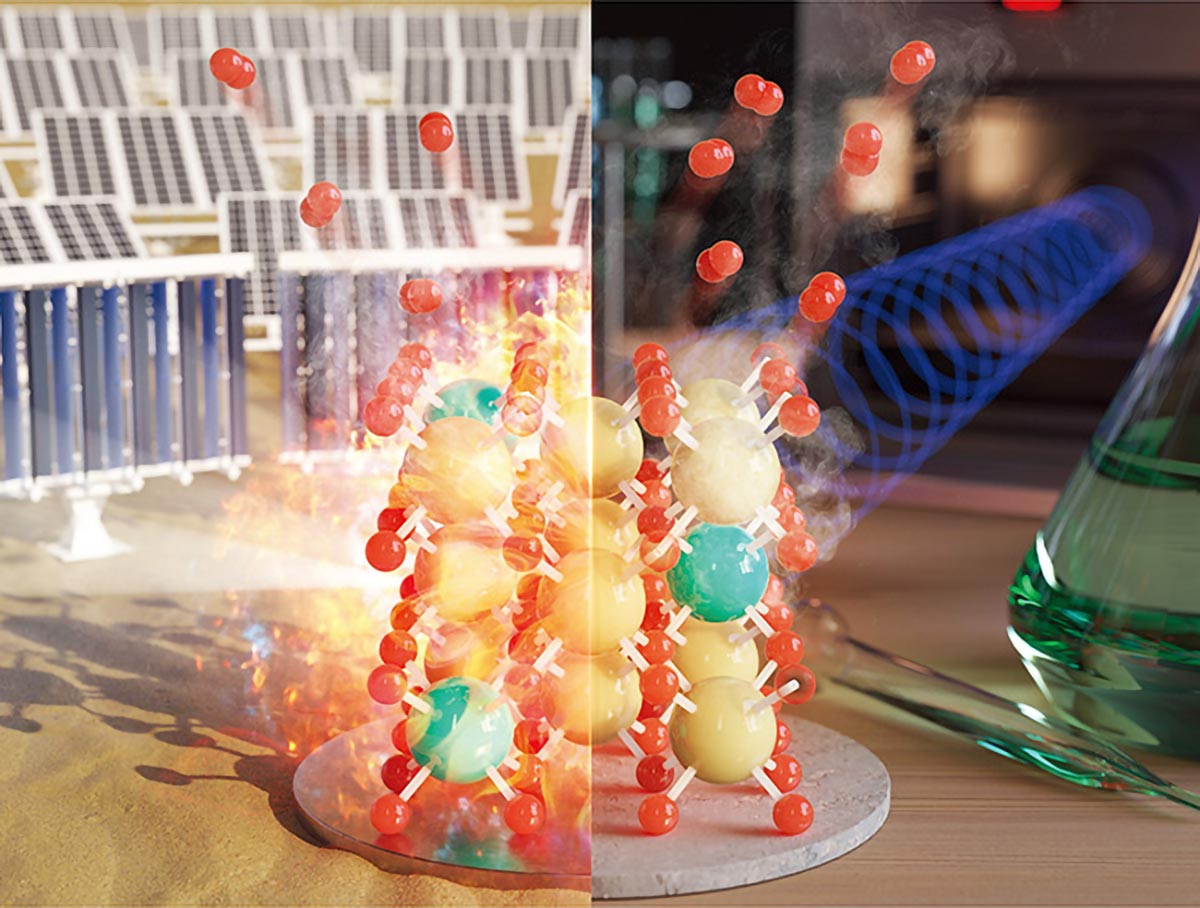
A research team at POSTECH has developed a groundbreaking technology that overcomes key challenges in clean hydrogen production using microwaves. Led by Professor Gunsu S. Yun and Professor Hyungyu Jin, along with doctoral candidates Jaemin Yoo and Dongkyu Lee, the team also uncovered the scientific mechanism behind this innovative process. Their findings, featured as the Inside Front Cover (see image above) of Journal of Materials Chemistry A, represent a major step toward more sustainable energy solutions.
As the world moves away from fossil fuels, clean hydrogen is emerging as a promising alternative due to its zero carbon emissions. However, current hydrogen production methods face significant hurdles. Traditional thermochemical techniques, which use metal oxide oxidation-reduction reactions, require extreme temperatures — sometimes as high as 1,500°C (~2,700°F). This makes the process highly energy-intensive, expensive, and difficult to scale for widespread use.
Microwaves: An Unexpected Energy Source for Hydrogen
To address these challenges, the POSTECH team turned to a familiar yet underutilized energy source: “microwaves”[1] energy, the same source used in household microwave ovens. While microwaves are commonly associated with heating food, they can also drive chemical reactions efficiently. The researchers demonstrated that microwave energy could lower the reduction temperature of Gd-doped ceria (CeO2) — a benchmark material for hydrogen production — to below 600℃ (~1,100°F), cutting the temperature requirement by over 60 percent. Remarkably, microwave energy was found to replace 75 percent of the thermal energy needed for the reaction, a breakthrough for sustainable hydrogen production.

Creating Oxygen Vacancies in Record Time
Another critical advancement lies in the creation of “oxygen vacancies,”[2] which are defects in the material structure essential for splitting water into hydrogen. Conventional methods often take hours at extremely high temperatures to form these vacancies. The POSTECH team achieved the same results in just minutes at temperatures below 600°C (~1,100°F) by leveraging microwave technology. This rapid process was further validated with a thermodynamic model, which provided valuable insight into the mechanism underlying the microwave-driven reaction.
A Game-Changer for Commercial Viability
Professor Hyungyu Jin stated, “This research has the potential to revolutionize the commercial viability of thermochemical hydrogen production technologies. It will also pave the way for the development of new materials optimized for microwave-driven chemical processes.” Professor Gunsu Yun added, “Introducing a new mechanism powered by microwaves and overcoming the limitations of existing processes are major achievements, made possible through the close interdisciplinary collaboration of our research team.”
Notes
- Microwaves — Electromagnetic waves with frequencies ranging from 300 MHz to 300 GHz. They are commonly used to transmit energy or heat materials in wireless communication, radar systems, and microwave ovens.
- Oxygen vacancy — A state in which an oxygen atom is missing from within a material, leaving behind an empty site. This vacancy can play a critical role in enhancing electron flow or chemical reactivity.
Reference: “Thermodynamic assessment of Gd-doped CeO2 for microwave-assisted thermochemical reduction” by Dongkyu Lee, Jaemin Yoo, Gunsu S. Yun and Hyungyu Jin, 5 November 2024, Journal of Materials Chemistry A.
DOI: 10.1039/D4TA05804F
This study was supported by the Circle Foundation’s Innovative Science and Technology Program, the Ministry of Science and ICT’s Mid-Career Researcher Program, POSTECH’s Basic Science Research Institute, and the Ministry of Trade, Industry, and Energy.
Never miss a breakthrough: Join the SciTechDaily newsletter.
Follow us on Google and Google News.
7 Comments
Does it peak at a particular microwave frequency?
VERY good question! I wonder if the researchers have thought of that?
“As the world moves away from fossil fuels, clean hydrogen is emerging as a promising alternative due to its zero carbon emissions.”
There are two problems with the above statement; 1) There is scant evidence that anyone is at risk of being trampled in the move “away from fossil fuels.” 2) The statement strongly suggests that they don’t understand that the problem isn’t with inherent toxicity of CO2, but just too much of a good thing.
Large-scale use of hydrogen will come with its own set of problems, perhaps worse. Immediately obvious is the increased relative humidity in urban areas from the byproduct of oxidizing hydrogen — H2O. CO2 is a well-mixed gas, effectively being distributed around the world. Whereas, water vapor is a condensing gas, meaning that the humidity and consequent precipitation will be localized in urban regions and immediately downwind, amplifying the effect. Furthermore, generating the hydrogen from water means that all of the residual impurities will be concentrated and create a disposal problem, not unlike de-desalinization. Actually, there are many other problems as well.
Before hydrogen advocates get too excited about the prospect of replacing fossil fuels with hydrogen, there needs to be an in depth analysis of all the potential side effects and costs to determine if it actually would result in an improvement in the situation. After all, water vapor is a more powerful ‘greenhouse gas’ than CO2.
I see ther is promising research into converting ammonia into green hydrogen. Could the microwave process for producing hydrogen improve on that research?
Nobody said anything about “trampling,” unless I missed that part. Also, there’s no implication of a single reason for moving away. Case in point: scarcity. Fossil fuels won’t last forever. Also, the US being beholden to unpredictable OPEC amd other fluctuations in quantity amd price. Both very valid reasons for moving away.
You are right, nobody except me mentioned “trampling.” I was trying to inject a little humor into the discussion. My apologies.
Actually, fossil fuels probably WILL last forever, they will just become too expensive to burn and will have to be reserved for lubricants, plastics, and other industrial feedstocks.
At issue is whether hydrogen will save us from global warming, or just give us a different problem resulting from large-scale use. As should be evident from my remarks above, I believe a hydrogen-based energy economy will just give us new problems. The alternative would be to use the hydrogen to generate electricity through controlled thermonuclear fusion. However, as NASA has discovered, there is no such thing as a free launch.
Thanks for an excellent research…..
It will remove poverty from earth 👍
[email protected]
(Guitar Uncle GNT 🎸 ) on Google