
Scientists have uncovered why a critical part of photosynthesis only uses one of two seemingly identical pathways, revealing hidden energy barriers and structural nuances that could help engineer more efficient artificial systems.
Scientists from the Indian Institute of Science (IISc) and the California Institute of Technology (Caltech) have uncovered the reason behind a long-standing mystery in the early stages of photosynthesis. This vital natural process enables plants, algae, and certain bacteria to harness sunlight, generating oxygen and storing energy in chemical form.
The researchers discovered why a crucial step in energy transfer, specifically the movement of electrons, occurs through only one side of a protein-pigment complex that kickstarts photosynthesis. Their findings have been published in the Proceedings of the National Academy of Sciences.
Although photosynthesis has been studied extensively, many aspects of it remain unclear. The process involves a complex chain of electron transfers between pigment molecules, and its speed and structural complexity make it difficult to fully understand. Moreover, slight variations in how different organisms perform photosynthesis add to the challenge. Gaining deeper insights into these mechanisms could support the development of advanced technologies like artificial leaves and fuel cells that replicate nature’s ability to convert sunlight into usable energy.
Photosystem II: The Launchpad of Photosynthesis
In most organisms, a protein-pigment complex called Photosystem II (PSII) kickstarts photosynthesis by trapping energy from sunlight and splitting water, providing oxygen molecules and supplying electrons that get shuttled to subsequent proteins and molecules.
PSII contains two identical arms, called D1 and D2, around which four chlorophyll molecules and two pheophytins – pigments related to chlorophyll – are symmetrically arranged. These arms are also linked to electron-carrier molecules called plastoquinones. Electrons flow first from chlorophyll to pheophytin, then from pheophytin to plastoquinone.
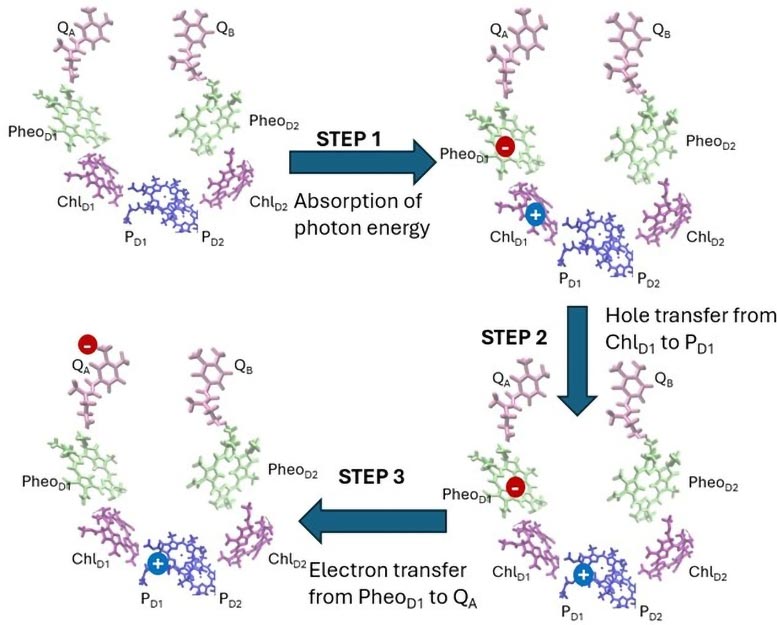
But studies have shown that electrons seem to flow only along D1 – a mystery that has puzzled researchers for a long time. “Despite the structural symmetry between the D1 and D2 protein branches in PSII, only the D1 branch is functionally active,” says Aditya Kumar Mandal, first author and PhD student in the Department of Physics, IISc.
Mapping the Energy Landscape
In this study, the researchers used a combination of molecular dynamics simulations, quantum mechanical calculations, and Marcus theory (a Nobel Prize-winning framework for electron transfer) to map the energy landscape for electron movement in both branches. “We assessed the electron transfer efficiency step-by-step through both D1 and D2 branches,” says Shubham Basera, PhD student in the Department of Physics and one of the authors.
The team found that the D2 branch has a much higher energy barrier, which makes electron transport energetically unfavourable. Specifically, the transfer of electrons from pheophytin to plastoquinone in D2 requires twice as much activation energy as D1 – a barrier that electrons seem unable to overcome, preventing energy from flowing forward.
The researchers also simulated the current-voltage characteristics of both branches and found that the resistance against electron movement in D2 was two orders of magnitude higher than that in D1.
Engineering Future Photosynthesis
The asymmetry in electron flow may also be influenced by subtle differences in the protein environment around the PSII and how the pigments are embedded in it, the researchers suggest. For example, the chlorophyll pigment in D1 has an excitation state at a lower energy than its D2 counterpart, suggesting that the D1 pigment has a better chance of attracting and transferring electrons.
The researchers also suggest that tweaking some of these components can boost or rewire electron flow across PSII. For example, swapping chlorophyll and pheophytin in D2 could overcome the electron block, because chlorophyll needs lower activation energy than pheophytin.
“Our research presents a significant step forward in understanding natural photosynthesis,” says Prabal K Maiti, Professor at the Department of Physics and one of the corresponding authors of the study. “These findings may help design efficient artificial photosynthetic systems capable of converting solar energy into chemical fuels, contributing to innovative and sustainable renewable energy solutions.”
This is a beautiful combination of theory at various levels to address a long-standing problem culminating in a new level of understanding, but still leaving mysteries to be challenged, says Bill Goddard, Professor at Caltech and one of the corresponding authors.
Reference: “Unveiling the charge transport blockade in the D2 branch of the photosystem II reaction center” by Aditya Kumar Mandal, Shubham Basera, William A. Goddard and Prabal K. Maiti, 8 July 2025, Proceedings of the National Academy of Sciences.
DOI: 10.1073/pnas.2405023122
Funding: Anusandhan National Research Foundation (ANRF), India
Never miss a breakthrough: Join the SciTechDaily newsletter.
Follow us on Google and Google News.
2 Comments
Phothoscantythist is very good maths to every humanty futre evalutoinetc
Nice research