
Close Menu
    Facebook X (Twitter) Instagram
    SciTechDaily
    • Biology
    • Chemistry
    • Earth
    • Health
    • Physics
    • Science
    • Space
    • Technology
    Facebook X (Twitter) Pinterest YouTube RSS
    SciTechDaily
    Home»Biology»Priapulid Worms Highlight Need to Rename A Group of Animals
    Biology

    Priapulid Worms Highlight Need to Rename A Group of Animals

    By SciTechDailyOctober 29, 2012No Comments2 Mins Read
    Facebook Twitter Pinterest Telegram LinkedIn WhatsApp Email Reddit
    Share
    Facebook Twitter LinkedIn Pinterest Telegram Email Reddit
    priapulus-caudatus
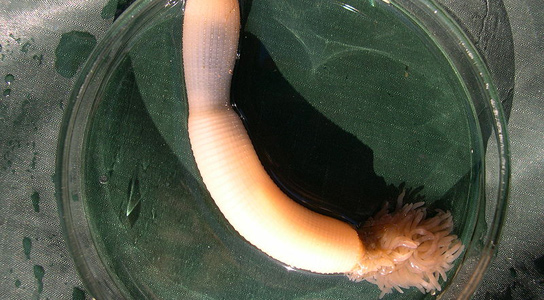
    A Priapus caudatus worm. Credit: Wikipedia

    A new study on the development of priapulids, known colloquially as penis worms, throws doubt on a feature that has been thought to define one of the largest groups of animals for more than a century.

    The researchers published their findings in the journal Current Biology. Protostomes have historically been defined by the order in which they develop a mouth and an anus as embryos. However, gene-expression data suggests that this is incorrect.

    There might be a need to rename the protostome class of animals. There are tiny differences in how embryos develop in the different branches in the tree of life, which can lead to monumental changes in adults. When an embryonic ball of cells develops two indentations instead of one, the organism will develop a separate mouth and anus contrary to the single opening that jellyfish and sea anemones have. In 1908, animals with both a mouth and anus were divided into two groups. The protostomes formed their mouth first, the anus second. In the other animals, the mouth formed after the anus.

    Protostomes include priapulids and other invertebrates. Deuterostomes include vertebrate animals, like humans, and some spineless animals. Tracing how cells divide in all organisms remains technically challenging; however, by using DNA sequence data, it’s been possible to see the general shape of this evolutionary tree.

    Molecular techniques that have used the analysis of gene expression have revealed that a primitive protostome, Priapus caudatus, develops like a deuterostome. These animals are living fossils, since they haven’t changed much in millions of years, and look almost identical to their ancestors, which littered the ocean floor during the Cambrian period. This suggests that early protostomes developed differently. The order of the mouth and anus is now uncertain.

    Other similarities, like DNA sequences indicate that priapulids are closely related to protostomes. This is not the first report of a maverick protostome. Embryologists have previously noted variations in how protostome mouths develop.

    Reference: “Deuterostomic Development in the Protostome Priapulus caudatus” by José M. Martín-Durán, Ralf Janssen, Sofia Wennberg, Graham E. Budd and Andreas Hejnol, 25 October 2012, Current Biology.
    DOI: 10.1016/j.cub.2012.09.037

    Never miss a breakthrough: Join the SciTechDaily newsletter.
    Follow us on Google and Google News.

    Evolutionary Biology Molecular Biology Popular Taxonomy
    Share. Facebook Twitter Pinterest LinkedIn Email Reddit

    Related Articles

    Life’s Greatest Leap: Scientists Decode the Origins of Complex Cells

    Scientists Discover a Gene for Brain Size

    Epigenetics Are Important To Evolutionary Success

    Study Provides Picture of Human Expansion From Africa

    Pegomastax Africanus, A Miniature Dinosaur That Thrived in Southern Africa

    Viruses Attack Mitochondria to Travel and Spread Within the Nervous System

    Pentaradially Symmetrical Brittle Stars Move Bilaterally, Like People

    World’s Smallest Primate Issues High-Frequency Calls Like Bats

    Researchers Complete Genome Sequence of a Denisovan Human Finger Bone

    Leave A Reply Cancel Reply

    • Facebook
    • Twitter
    • Pinterest
    • YouTube

    Don't Miss a Discovery

    Subscribe for the Latest in Science & Tech!

    Trending News

    Breakthrough Bowel Cancer Trial Leaves Patients Cancer-Free for Nearly 3 Years

    Natural Compound Shows Powerful Potential Against Rheumatoid Arthritis

    100,000-Year-Old Neanderthal Fossils in Poland Reveal Unexpected Genetic Connections

    Simple “Gut Reset” May Prevent Weight Gain After Ozempic or Wegovy

    2.8 Days to Disaster: Scientists Warn Low Earth Orbit Could Suddenly Collapse

    Common Food Compound Shows Surprising Power Against Superbugs

    5 Simple Ways To Remember More and Forget Less

    The Atomic Gap That Could Cost the Semiconductor Industry Billions

    Follow SciTechDaily
    • Facebook
    • Twitter
    • YouTube
    • Pinterest
    • Newsletter
    • RSS
    SciTech News
    • Biology News
    • Chemistry News
    • Earth News
    • Health News
    • Physics News
    • Science News
    • Space News
    • Technology News
    Recent Posts
    • Scientists Discover Stem Cells That Could Regrow Teeth and Bone
    • Scientists Discover Natural Molecule That Stops Alzheimer’s Protein Clumps From Forming
    • Early Cannabis Use May Stall Key Brain Skills in Teens
    • Popular Vitamin D Supplement Has “Previously Unknown” Negative Effect, Study Finds
    • Powerful Antioxidant Found To Play a Key Role in Proper Protein Folding
    Copyright © 1998 - 2026 SciTechDaily. All Rights Reserved.
    • Science News
    • About
    • Contact
    • Editorial Board
    • Privacy Policy
    • Terms of Use

    Type above and press Enter to search. Press Esc to cancel.