
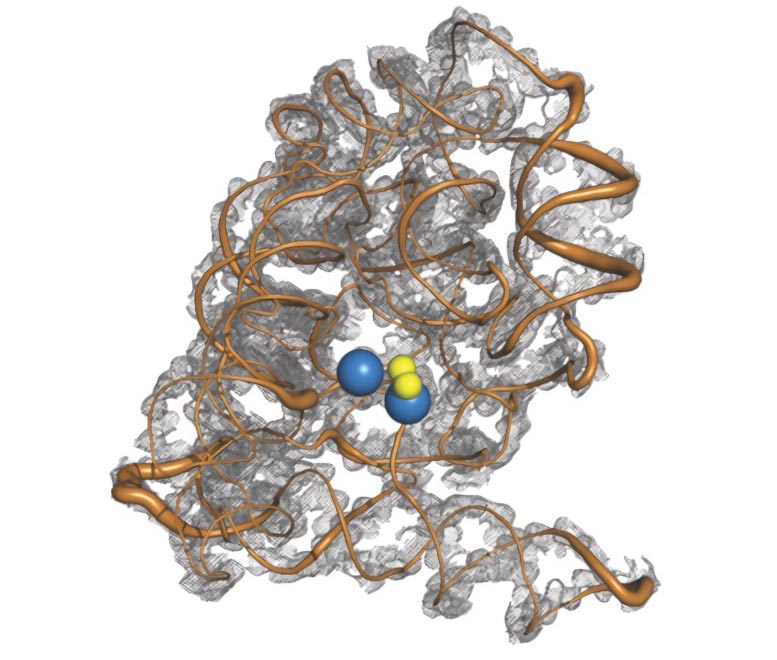
A newly published paper from researchers at Yale University looks at the process of splicing RNA at the atomic level, establishing RNA’s chemical and structural complexity and showing that it is capable of recruiting diverse metals and orienting them to work with RNA.
Scientists at Yale University have described in the greatest detail yet aspects of the chemical processes by which RNA carries out the expression of our genes.
In a paper published October 26 in the journal Cell, researchers report 14 crystal structures for a group II intron — an enzyme involved in RNA splicing, a critical phase of genetic reproduction. These new views capture the enzyme’s working parts and multiple steps in its operation, revealing the chemical mechanisms at work.
“We didn’t just get a snapshot — we caught the intron in action,” said principal investigator Anna Pyle, the William Edward Gilbert Professor of Molecular, Cellular and Developmental Biology and professor of chemistry at Yale.
A major function of RNA is copying all genetic information and making it readable by the cellular protein factories, the ribosomes. But RNA needs to be edited, and an early step in the editing process is splicing.
Splicing consists of breaking apart the RNA and recombining its pieces in ways that produce just the right protein the organism requires at any given time. In many organisms this vital cut-and-paste action is sometimes self-catalyzed by intrinsic RNA components called group II introns. In more complex organisms, including humans, the process is performed by a similar yet more sophisticated machinery, the spliceosome, which has evolved from and works like the group II introns.
“Splicing is a very basic phase of gene expression,” said Pyle, who is also an investigator of the Howard Hughes Medical Institute. “Whenever splicing gets messed up, you’ll find a disease that results. Until now we haven’t really understood the splicing reaction chemically.”
The paper, which builds on previous work in Pyle’s lab, looks at the process of splicing at the atomic level and further establishes RNA’s chemical and structural complexity, showing it is capable of recruiting diverse metals, such as magnesium and potassium, and orienting them to work with RNA. The research particularly highlights the role and diversity of metal ions in the process.
“We are making a map of the landscape that catalyzes splicing reactions,” said Marco Marcia, a postdoctoral researcher in Pyle’s lab and the paper’s lead author. “We see dynamic states before and after reaction.”
The researchers said RNA may perform more functions than previously thought. “RNA is revealing its ability to utilize metals in the environment to do its chemical transformations,” Pyle said. “RNA can do complex chemistry, just like a protein can.”
Reference: “Visualizing group II intron catalysis through the stages of splicing” by Marco Marcia and Anna Marie Pyle, 26 October 2012, Cell.
DOI: 10.1016/j.cell.2012.09.033
The National Institutes of Health and the Howard Hughes Medical Institute provided support for the research.
Never miss a breakthrough: Join the SciTechDaily newsletter.
Follow us on Google and Google News.
1 Comment
It is an RNA world completely as I had mentioned in one of the articles published by me under “Science Frontiers – a Probe by Madan ” in the specific article titled “DNA, RNA or Phospholipid layer, What is God ?”. RNA holds the key for life rather than DNA in as much as it constitutes most of the cytoplasm and cell organelles. For example, Ribosomes which are protein manufacturing factories, in any living being is made up of RNA-Protein complex mostly made up of 50S and 30S sub-units of RNA only. It is these RNA sub-units which reads mRNA and tRNA to get the formula for concerned Proteins in the Ribosome complex. It is the work of iRNA to cut the unused mRNA pieces into small units of ACT and CAG`s to supply templates for tRNA. It is the same RNA job as indicated in the article to slice and paste mRNA chains from DNA copies of Nucleus to construct the Protein that is the building blocks for morphology of any living being.
RNA`s chemical and structural complexities should be probed further to unravel the mysteries of life. Thank You.