
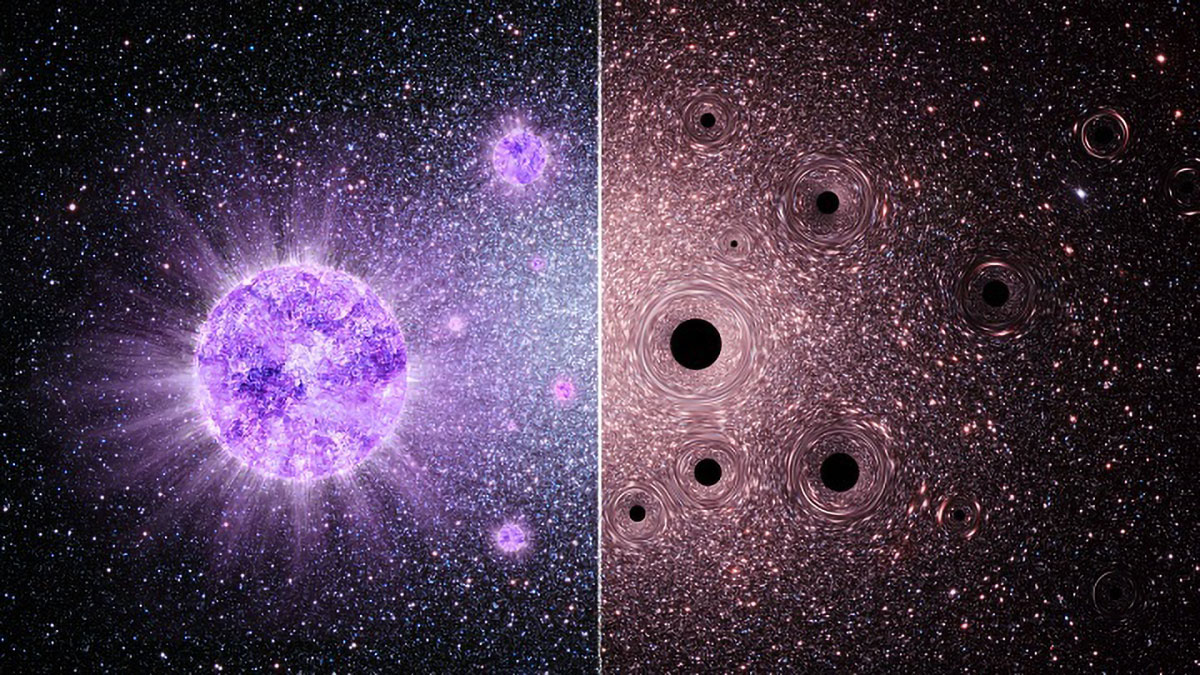
A new model sheds light on the long-standing chemical mysteries found in globular clusters, the ancient archives of the universe.
An international collaboration led by ICREA researcher Mark Gieles, from the Institute of Cosmos Sciences of the University of Barcelona (ICCUB) and the Institute of Space Studies of Catalonia (IEEC), has created a pioneering model that explains how extremely massive stars (EMS) with more than 1,000 times the mass of the Sun shaped the formation and early evolution of the universe’s oldest star clusters.
Published in the Monthly Notices of the Royal Astronomical Society, the research shows that these short-lived stellar giants played a major role in altering the chemical makeup of globular clusters (GCs), which rank among the most ancient and mysterious star systems known.
Globular clusters: the ancient archives of the universe
Globular clusters are tightly packed, spherical collections containing hundreds of thousands to millions of stars, present in nearly all galaxies, including our Milky Way. Most of these clusters are older than 10 billion years, suggesting that they were born soon after the Big Bang.
The stars within globular clusters show strikingly unusual chemical patterns, including unexpected levels of helium, nitrogen, oxygen, sodium, magnesium, and aluminium. For decades, these anomalies have puzzled astronomers. The presence of these “multiple populations” hints at complex chemical enrichment processes that occurred as the clusters formed, likely involving extremely hot stellar material acting as “contaminants.”
A new model for cluster formation
The new study is based on a star formation model known as the inertial-inflow model, extending it to the extreme environments of the early universe. The researchers show that, in the most massive clusters, turbulent gas naturally gives rise to extremely massive stars (EMS) weighing between 1,000 and 10,000 solar masses. These EMSs release powerful stellar winds rich in high-temperature hydrogen combustion products, which then mix with the surrounding pristine gas and form chemically distinct stars.
“Our model shows that just a few extremely massive stars can leave a lasting chemical imprint on an entire cluster,” says Mark Gieles (ICREA-ICCUB-IEEC). “It finally links the physics of globular cluster formation with the chemical signatures we observe today.”
Researchers Laura Ramírez Galeano and Corinne Charbonnel, from the University of Geneva, point out that “it was already known that nuclear reactions in the centers of extremely massive stars could create the appropriate abundance patterns. We now have a model that provides a natural pathway for forming these stars in massive star clusters.”
This process occurs rapidly — within one to two million years — before any supernova explodes, ensuring that the gas in the cluster remains free from supernova contamination.
A new window onto the early universe and black holes
The implications of the discovery extend far beyond the Milky Way. The authors propose that the nitrogen-rich galaxies discovered by the James Webb Space Telescope (JWST) are likely dominated by EMS-rich-globular clusters), formed during the early stages of galaxy formation.
“Extremely massive stars may have played a key role in the formation of the first galaxies,” adds Paolo Padoan (Dartmouth College and ICCUB-IEEC). “Their luminosity and chemical production naturally explain the nitrogen-enriched proto-galaxies that we now observe in the early universe with the JWST.”
These colossal stars are likely to end their lives collapsing into intermediate-mass black holes (more than 100 solar masses), which could be detected by gravitational wave signals.
The study provides a unifying framework that connects star formation physics, cluster evolution, and chemical enrichment. It suggests that EMSs were key drivers of early galaxy formation, simultaneously enriching globular clusters and giving rise to the first black holes.
Reference: “Globular cluster formation from inertial inflows: accreting extremely massive stars as the origin of abundance anomalies” by Mark Gieles, Paolo Padoan, Corinne Charbonnel, Jorick S Vink and Laura Ramírez-Galeano, 4 November 2025, Monthly Notices of the Royal Astronomical Society.
DOI: 10.1093/mnras/staf1314
Never miss a breakthrough: Join the SciTechDaily newsletter.
Follow us on Google and Google News.