
Recycling waste nutrients could cut fertilizer use, but coordination and infrastructure are key.
Nutrients recovered from animal and human waste could sharply cut the need for synthetic fertilizers in the United States, according to a new Cornell University study that considers practical challenges such as processing and transportation.
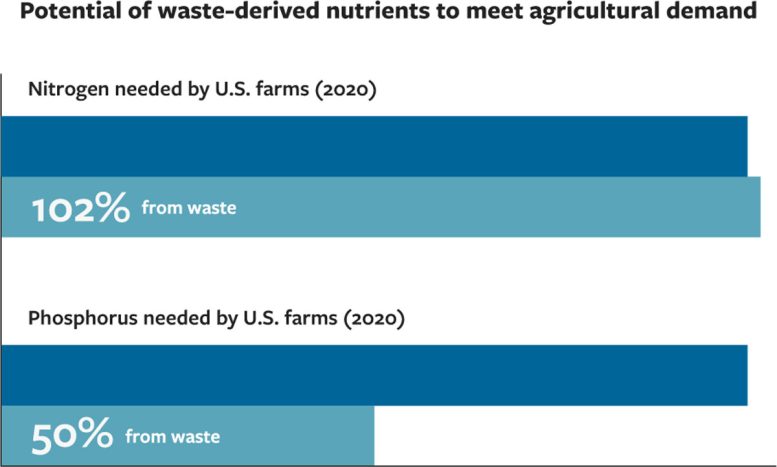
Published in Nature Sustainability, the study estimates that waste from people and livestock could theoretically supply 102% of the nitrogen and 50% of the phosphorus required for U.S. agriculture. This represents a value exceeding $5.7 billion each year. However, the researchers identified a key obstacle: waste is often generated in areas with dense human or livestock populations, while the greatest fertilizer demand occurs elsewhere.
By mapping both waste sources and agricultural needs, the team found that a significant share of nutrients can still be used efficiently. About 37% of nitrogen and 46% of phosphorus could be applied locally, while more than half of the remaining surplus could be transported to nearby regions at relatively low economic and environmental cost.
Coordination and Environmental Benefits
“This is a coordination problem, not a resource problem,” said corresponding author and assistant professor Chuan Liao. “Even considering the real-world constraints, there’s still a substantial amount of nutrients that can be economically redistributed to meet crop needs.”
The findings outline a path to tap into a largely unused resource and reduce reliance on synthetic fertilizers, which require large amounts of energy to produce, harm ecosystems, and are often imported.
“Excessive use of synthetic fertilizers leads to water pollution, and the production itself generates more emissions—it’s a very intensive process,” Liao said. “And you can see with the Iran War, there are supply-chain issues that can lead to great food insecurity as well.”
Mapping Supply, Demand, and Inequality
Using publicly available data, the researchers mapped where human and animal waste is produced and where nutrients are needed for 15 major crops, with a spatial resolution of about 10 kilometers (6.2 miles). Surpluses were concentrated in densely populated and livestock-heavy regions such as the Northeast and parts of the West, while shortages were common in the Midwest and southern Great Plains. The team also evaluated how feasible it would be to move nutrients, accounting for processing and transport costs.
They found that both extreme surpluses and shortages often occurred in poorer counties, where residents face higher risks of food insecurity and poorer health outcomes. According to Liao, pollution may play a role. In areas with excess nutrients, waste can run off into waterways. In regions with shortages, farmers depend more heavily on synthetic fertilizers, which can damage soil and water quality.
“The nutrient inequality seems to mirror social inequality in a large sense,” Liao said. “So potentially fixing the nutrient flow can promote environmental justice.”
Local Solutions and System Coordination
Liao emphasized that expanding waste-based fertilization should start at the local level. For example, a pig farm surrounded by cornfields could supply nutrients directly to nearby crops if the right systems are in place.
“We’re advocating for a decentralized system so that waste can be processed locally,” Liao said. “But in order to do this, we need to coordinate across different sectors such as agriculture, waste, and energy. The technology is there, but we need governance and infrastructure to scale up to the entire U.S.”
Reference: “Realizing an equitable circular bionutrient economy in the United States” by Shuai Zhou, Danning Lu, Lucinda Li, Krisztina Mosdossy, Rebecca Nelson, Johannes Lehmann and Chuan Liao, 15 April 2026, Nature Sustainability.
DOI: 10.1038/s41893-026-01811-0
Funding for the study came from the National Science Foundation and the USDA, with seed funding from the Cornell Atkinson Center for Sustainability.
Never miss a breakthrough: Join the SciTechDaily newsletter.
Follow us on Google and Google News.
2 Comments
After the fiasco of using “treated” human sewer sludge on 70M acres that were later found to now be contaminated with PFAS why would anyone try using this stuff again!?! And that’s not even accounting for all the drugs, antibiotics and hormones in there that cycle through all the humans and animals!
How will animal and human waste be “precessed” to make it safe for transportation and application on food crops? Especially with the low and no till systems.
The article gives the impression that only synthetic fertilizer cause polution.