
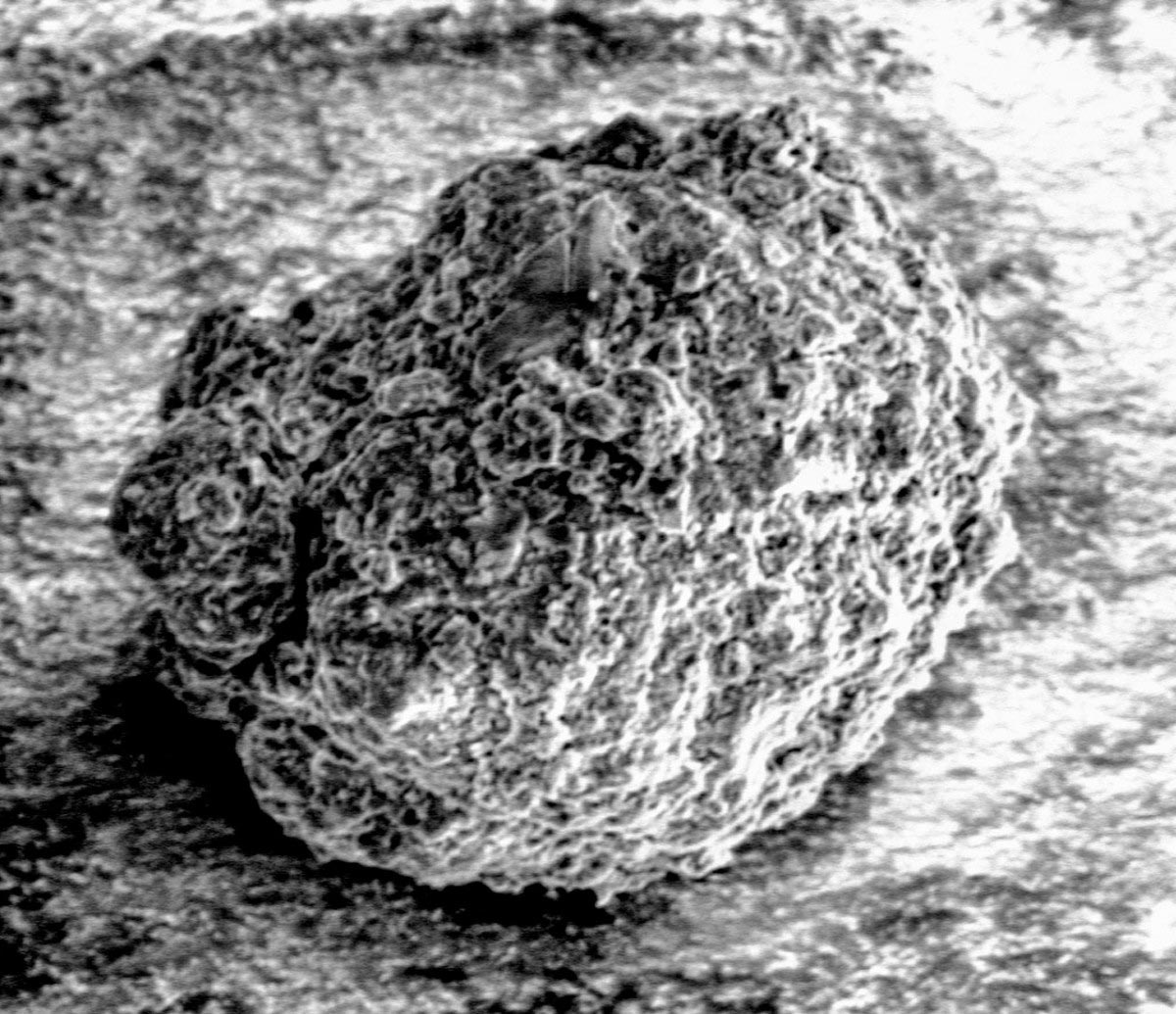
The Earth’s soils contain more than three times the amount of carbon than is found in the atmosphere, but the processes that bind carbon in the soil are still not well understood.
Improving such understanding may help researchers develop strategies for sequestering more carbon in soil, thereby keeping it out of the atmosphere where it combines with oxygen and acts as a greenhouse gas.
A new study describes a breakthrough method for imaging the physical and chemical interactions that sequester carbon in soil at near-atomic scales, with some surprising results.
The study, “Organo-organic and Organo-mineral Interfaces in Soil at the Nanometer Scale,” was published on November 30, 2020, in Nature Communications.
At that resolution, the researchers showed – for the first time – that soil carbon interacts with both minerals and other forms of carbon from organic materials, such as bacterial cell walls and microbial byproducts. Previous imaging research had only pointed to layered interactions between carbon and minerals in soils.
“If there is an overlooked mechanism that can help us retain more carbon in soils, then that will help our climate,” said senior author Johannes Lehmann, the Liberty Hyde Bailey Professor in the School of Integrative Plant Science, Soil and Crop Sciences Section, in the College of Agriculture and Life Sciences. Angela Possinger Ph.D. ’19, who was a graduate student in Lehmann’s lab and is currently a postdoctoral researcher at Virginia Tech University, is the paper’s first author.
Since the resolution of the new technique is near-atomic scale, the researchers are not certain what compounds they are looking at, but they suspect the carbon found in soils is likely from metabolites produced by soil microbes and from microbial cell walls. “In all likelihood, this is a microbial graveyard,” Lehmann said.
“We had an unexpected finding where we could see interfaces between different forms of carbon and not just between carbon and minerals,” Possinger said. “We could start to look at those interfaces and try to understand something about those interactions.”
The technique revealed layers of carbon around those organic interfaces. It also showed that nitrogen was an important player for facilitating the chemical interactions between both organic and mineral interfaces, Possinger said.
As a result, farmers may improve soil health and mitigate climate change through carbon sequestration by considering the form of nitrogen in soil amendments, she said.
While pursuing her doctorate, Possinger worked for years with Cornell physicists – including co-authors Lena Kourkoutis, associate professor of applied and engineering physics, and David Muller, the Samuel B. Eckert Professor of Engineering in Applied and Engineering Physics, and the co-director of the Kavli Institute at Cornell for Nanoscale Science – to help develop the multi-step method.
The researchers planned to use powerful electron microscopes to focus electron beams down to sub-atomic scales, but they found the electrons modify and damage loose and complex soil samples. As a result, they had to freeze the samples to around minus 180 degrees Celsius, which reduced the harmful effects from the beams.
“We had to develop a technique that essentially keeps the soil particles frozen throughout the process of making very thin slices to look at these tiny interfaces,” Possinger said.
The beams could then be scanned across the sample to produce images of the structure and chemistry of a soil sample and its complex interfaces, Kourkoutis said.
“Our physics colleagues are leading the way globally to improve our ability to look very closely into material properties,” Lehmann said. “Without such interdisciplinary collaboration, these breakthroughs are not possible.”
The new cryogenic electron microscopy and spectroscopy technique will allow researchers to probe a whole range of interfaces between soft and hard materials, including those that play roles in the function of batteries, fuel cells, and electrolyzers, Kourkoutis said.
Reference: “Organo–organic and organo–mineral interfaces in soil at the nanometer scale” by Angela R. Possinger, Michael J. Zachman, Akio Enders, Barnaby D. A. Levin, David A. Muller, Lena F. Kourkoutis and Johannes Lehmann, 30 November 2020, Nature Communications.
DOI: 10.1038/s41467-020-19792-9
Coauthors include Michael Zachman Ph.D. ’18, a former graduate student in Kourkoutis’ lab; Akio Enders, a former researcher in Lehmann’s lab; and Barnaby Levin Ph.D. ’17, a former graduate student in Muller’s lab.
The study was funded by the National Science Foundation, the Technical University of Munich Institute for Advanced Study, the Andrew W. Mellon Foundation and the Cornell College of Agriculture and Life Sciences Alumni Foundation.
Never miss a breakthrough: Join the SciTechDaily newsletter.
Follow us on Google and Google News.