
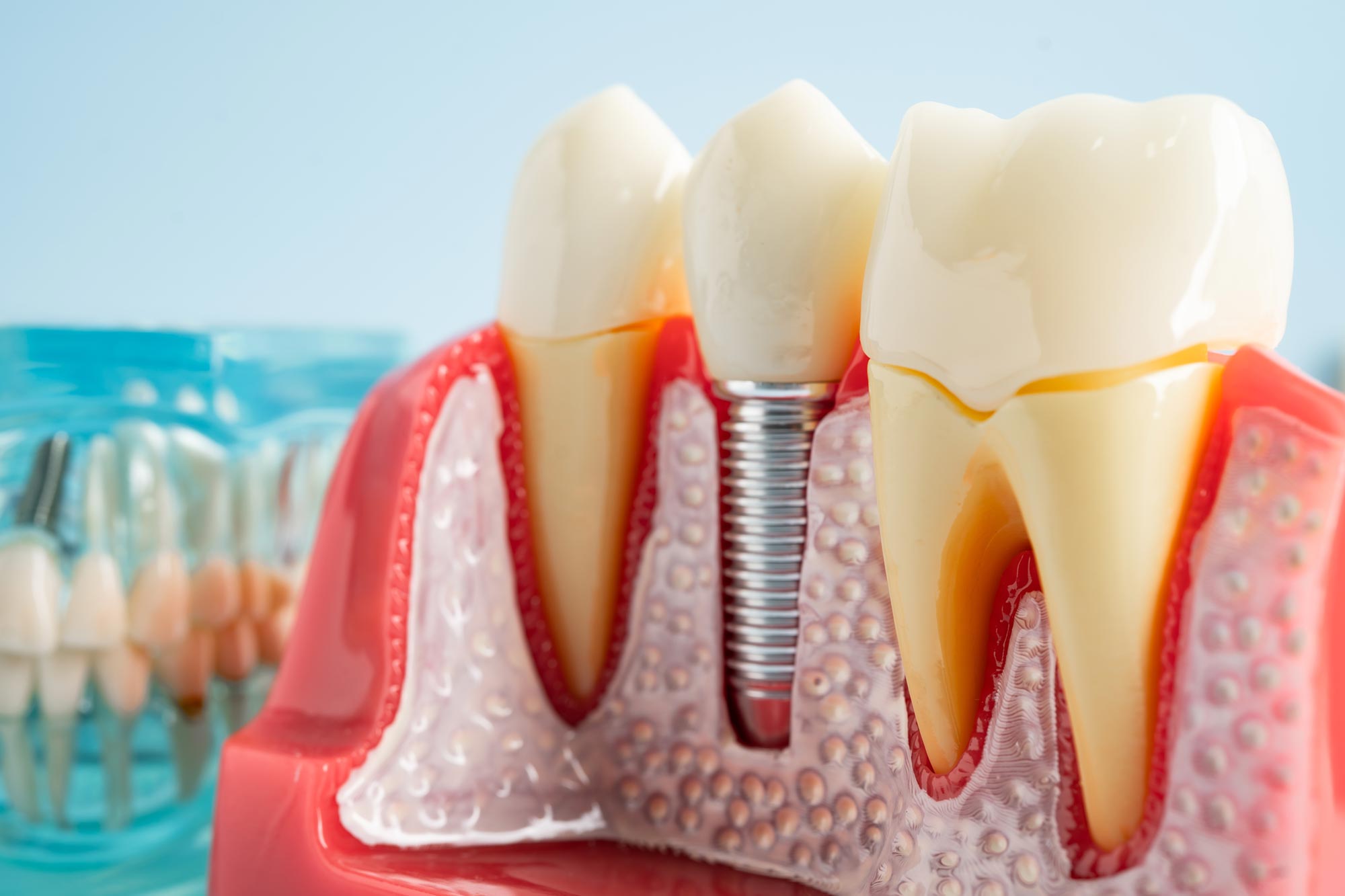
Researchers have uncovered why a common and costly dental implant infection often resists antibiotics.
Dental implants have helped tens of millions of people regain a full set of stable, functional teeth, something traditional dentures cannot provide. However, between 10% and 20% of implant recipients eventually develop peri-implantitis, a serious infection that damages the jawbone around the implant.
For years, researchers have known that antibiotics often fail to stop this infection, but the reason remained unclear.
Researchers at the Rutgers School of Dental Medicine have now identified a possible explanation in a study published in PNAS Nexus. Their findings show that bacteria can corrode dental implants, causing them to release microscopic titanium particles into nearby tissue. These particles interfere with immune cells that are supposed to fight infection, trapping them in a prolonged inflammatory state that ultimately destroys the surrounding jawbone.
Using human tissue samples, cultured immune cells, and genetically engineered mice, the researchers identified a specific calcium channel in macrophages, the immune cells responsible for engulfing bacteria, that is activated by the titanium particles. When that channel was disabled in mice, the disease did not develop. The discovery points to the first promising drug target for a condition that affects up to one in five implant patients and costs more than $1 billion annually worldwide.
Titanium Particles Trigger Destructive Immune Responses
“For the first time, we show why all the antibiotic treatments that work around teeth do not work around implants,” said Georgios Kotsakis, the study’s senior author and the assistant dean for clinical research at the dental school. “Now that we know the cause, we can start developing therapeutics.”
Peri-implantitis has puzzled researchers because it closely resembles periodontitis, a common gum disease affecting natural teeth that is caused by many of the same oral bacteria. In natural teeth, antibiotics and routine cleaning usually resolve the infection. Around implants, however, those same treatments succeed less than half the time, while bone loss often continues.
Most studies over the past two decades have focused primarily on bacteria. Kotsakis and his colleagues instead examined the implants themselves. They found that bacteria living on implant surfaces create acidic biofilms that gradually corrode titanium, releasing billions of particles smaller than a red blood cell. Similar particle shedding can also occur during routine cleanings, particularly when dentists use metal instruments designed for natural teeth.
Once inside the gum tissue, the particles become coated with lipopolysaccharide, a toxin produced by bacteria. To the immune system, these coated particles resemble massive bacteria that cannot be broken down. Macrophages engulf the particles but are unable to digest the metal. As a result, the cells become stuck in a hyperinflammatory state and release signaling molecules such as interleukin-1 beta, a protein linked to inflammatory conditions, including rheumatoid arthritis and Alzheimer’s disease.
How Inflammation Fuels Bone Loss and Infection
The ongoing inflammation gradually destroys bone tissue. At the same time, macrophages become less effective at eliminating the original bacterial infection. Laboratory experiments showed that macrophages exposed to titanium particles absorbed less than half as many bacteria as untreated cells. “These particles are little magnets that attract the bacterial toxin, and they hijack the immune system, preventing it from clearing bacteria,” said Kotsakis. “You have a perfect storm that defies antibiotics.”
The researchers traced this chain of events to a calcium channel called TRPC1 (a specialized, pore-forming protein structure within cell membranes). Mice engineered without TRPC1 responded very differently to the combination of titanium particles and bacteria. They developed much smaller abscesses, produced lower levels of inflammatory cytokines, and regained normal bacterial clearance.
Supported by funding from the National Institutes of Health, Kotsakis’ team is now evaluating drug candidates that target the same biological pathway in human cells.
For people who already have dental implants, another important finding involves routine maintenance. Regular professional cleanings remain one of the strongest known protections against peri-implantitis, but the cleaning method matters. Until about a decade ago, many dentists used metal scalers designed for natural teeth to clean implants. Research from the Rutgers team and others has shown that these instruments can damage implant surfaces, promote corrosion, and increase disease risk. Today, nonabrasive cleaning methods have become the standard approach.
Reference: “Implant-derived titanium particles impair macrophage bacterial clearance via TRPC1 and lysosomal dysfunction” by Juliana Girón Bastidas, Danyal A Siddiqui, Viviane Nascimento Da Conceicao, Yuyang Sun, Mashael Al Thunayan, Brij B Singh and Georgios A Kotsakis, 21 March 2026, PNAS Nexus.
DOI: 10.1093/pnasnexus/pgag081
Never miss a breakthrough: Join the SciTechDaily newsletter.
Follow us on Google and Google News.
2 Comments
Interesting reading —–although I am way out of the latest in dentistry. When I was in d. school it was considered a success if 50% of the implants “took.” Much better today,of course. A description of some of the implant procecures of those days sound like mideval tortures
Interesting reading —–although I am way out of the latest in dentistry. When I was in d. school it was considered a success if 50% of the implants “took.” Much better today,of course. A description of some of the implant procecures of those days sound like mideval tortures