

By applying a 1980s algorithm to mathematical structures known as tensor networks, Flatiron Institute researchers showed that classical computers can solve a class of problems once claimed to require quantum computers.
A problem once touted as requiring a quantum computer has now been solved on a laptop.
Using advanced mathematical techniques and sophisticated software, physicists at the Center for Computational Quantum Physics (CCQ) at the Simons Foundation’s Flatiron Institute and collaborators at Boston University showed that a conventional computer can successfully simulate a notoriously difficult quantum system previously claimed to be beyond the reach of classical computing.
Their breakthrough demonstrates that clever algorithms can dramatically extend the capabilities of traditional computers, opening new avenues for studying quantum dynamics and potentially offering a powerful new approach for solving complex optimization problems. The researchers report their findings in Science.
Why qubits overwhelm computers
The challenge involved simulating a quantum system made up of hundreds of interacting ‘qubits’, the quantum computing counterpart to the bits used by classical computers, arranged in square, cubic, or diamond lattices. Classical bits can be either 0 or 1, while qubits can exist in superpositions of multiple values. That feature makes their behavior especially hard for traditional computers to model.
In a March 2025 article, also published in Science, a group of quantum computing researchers reported that they had calculated the behavior of a particularly complex qubit system using a quantum computer. They also argued that a classical computer could not reproduce the result.
“Whenever we [at the CCQ] see these kinds of claims, we’re always a bit skeptical,” says Joseph Tindall, an associate research scientist at the CCQ and first author on the new Science paper. “Like, ‘Did you try this? Did you try that?’”
For the CCQ researchers, the claim offered a clear way to test their own methods. The problem served as an opportunity to take their tools “out for a test drive,” says study co-author and CCQ research scientist Miles Stoudenmire. “We could have picked some more arbitrary target,” Stoudenmire says. “But it was like ‘Why not pick this one that has a big claim attached to it?’”
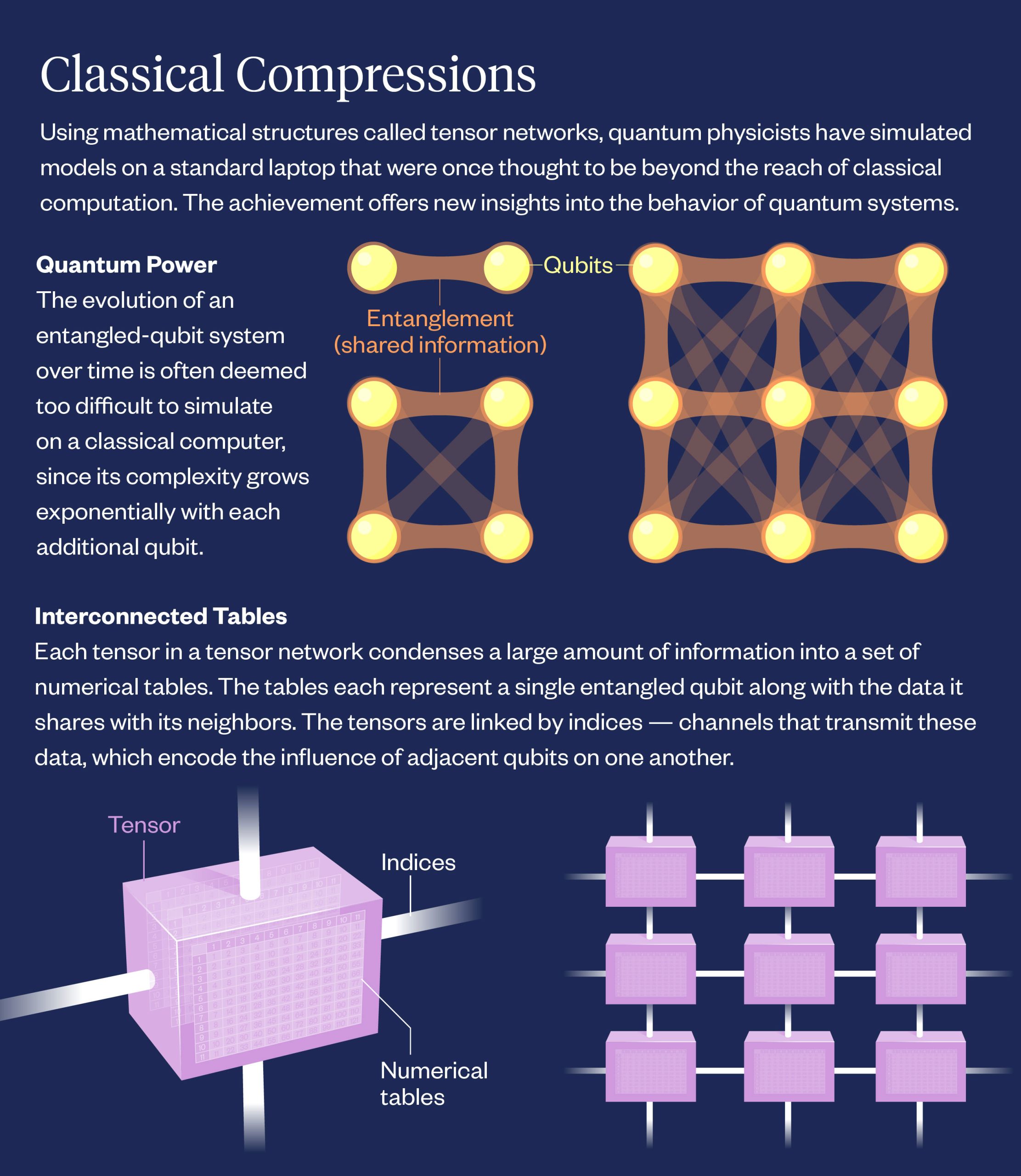
A major difficulty comes from quantum entanglement, which prevents the qubits from being treated as separate objects, even when they are far apart. Tindall says that dealing with this kind of entanglement requires advanced algorithms.
“When you have lots of particles that interact by quantum physics, you have this wave function that describes the state of the system,” Tindall says. “It’s this huge object that rapidly gets bigger and bigger the more particles there are.”
Because the wave function grows exponentially, “I just can’t directly store it on my computer,” he says. This is a familiar obstacle in quantum physics, but handling such wave functions is essential for predicting the behavior of quantum materials, including superconductors.
Tensor networks compress the problem
The CCQ team made the problem manageable by creating and using new tools built around tensor networks. Tindall compares them to “a zip file for the wave function where you’ve taken all this information, and you’ve compressed it into this mathematical data structure full of these small tables of numbers that are interconnected to each other.”
With tensor networks, the calculation became possible on classical computers. Tindall carried out many of the first calculations on a laptop using ITensor, a high-performance tensor network software library developed at the CCQ. The new simulations show how the ITensor team is finding fresh uses for tensor-based techniques. In this case, the simulations captured three-dimensional dynamics with a 3D tensor network.
“It’s this very powerful compression that can be very effective, but it’s a pretty complex mathematical object,” Tindall says. “This really is a bit of a frontier, because working with these objects — especially in three dimensions — is very untrodden. You need sophisticated codes and algorithms to deal with them; it’s a software engineering challenge in itself.”
Old algorithms find new reach
The team completed many of its simulations with relatively modest computing resources. For the early calculations, Tindall used belief propagation, an algorithm from the 1980s that has recently been adapted for quantum systems. “It’s a little more approximate than some of the other methods, but it’s way cheaper, and we can run it much more directly on lots of harder problems,” Stoudenmire says. He contrasts that with “more sophisticated methods in the past of our field” that “wouldn’t be able to even start going for some of these three-dimensional problems, because they’re so big.”
Even with limited hardware, the researchers showed that their simulations reached state-of-the-art accuracy. The results converged on answers consistent with theoretical predictions and produced accurate results on smaller test problems. They also matched the results reported by the quantum computing group, without using a quantum computer.
Classical and quantum tools converge
Although classical and quantum computing researchers can appear to be competing over the limits of their fields, Tindall and Stoudenmire say the two approaches can also inform each other.
“The good side of the classical versus quantum computing debate is that there’s a lot of synergy between the kind of simulations we’re interested in and the codes we write and what can be realized on these quantum computers,” Tindall says. “That can help guide us, and it can also help guide quantum computing researchers, because, obviously, the barrier for entry for us to simulate certain things is a lot easier than for them, because we don’t have to build a quantum computer. I can just write some code and press ‘run’ on my personal computer.”
The researchers are now extending their methods beyond qubit systems to problems involving electrons that can move between sites. These are even more difficult problems and are closely tied to the simulation of quantum materials. “They’re really, quantitatively, a lot harder problems,” Stoudenmire says. “So that’s one of our next big bars that we want to clear.”
References:
“Dynamics of disordered quantum systems with two- and three-dimensional tensor networks” by Joseph Tindall, Antonio Francesco Mello, Matthew Fishman, E. Miles Stoudenmire and Dries Sels, 21 May 2026, Science.
DOI: 10.1126/science.adx2728
“Beyond-classical computation in quantum simulation” by Andrew D. King, Alberto Nocera, Marek M. Rams, Jacek Dziarmaga, Roeland Wiersema, William Bernoudy, Jack Raymond, Nitin Kaushal, Niclas Heinsdorf, Richard Harris, Kelly Boothby, Fabio Altomare, Mohsen Asad, Andrew J. Berkley, Martin Boschnak, Kevin Chern, Holly Christiani, Samantha Cibere, Jake Connor, Martin H. Dehn, Rahul Deshpande, Sara Ejtemaee, Pau Farre, Kelsey Hamer, Emile Hoskinson, Shuiyuan Huang, Mark W. Johnson, Samuel Kortas, Eric Ladizinsky, Trevor Lanting, Tony Lai, Ryan Li, Allison J. R. MacDonald, Gaelen Marsden, Catherine C. McGeoch, Reza Molavi, Travis Oh, Richard Neufeld, Mana Norouzpour, Joel Pasvolsky, Patrick Poitras, Gabriel Poulin-Lamarre, Thomas Prescott, Mauricio Reis, Chris Rich, Mohammad Samani, Benjamin Sheldan, Anatoly Smirnov, Edward Sterpka, Berta Trullas Clavera, Nicholas Tsai, Mark Volkmann, Alexander M. Whiticar, Jed D. Whittaker, Warren Wilkinson, Jason Yao, T. J. Yi, Anders W. Sandvik, Gonzalo Alvarez, Roger G. Melko, Juan Carrasquilla, Marcel Franz and Mohammad H. Amin, 12 March 2025, Science.
DOI: 10.1126/science.ado6285
Never miss a breakthrough: Join the SciTechDaily newsletter.
Follow us on Google and Google News.