
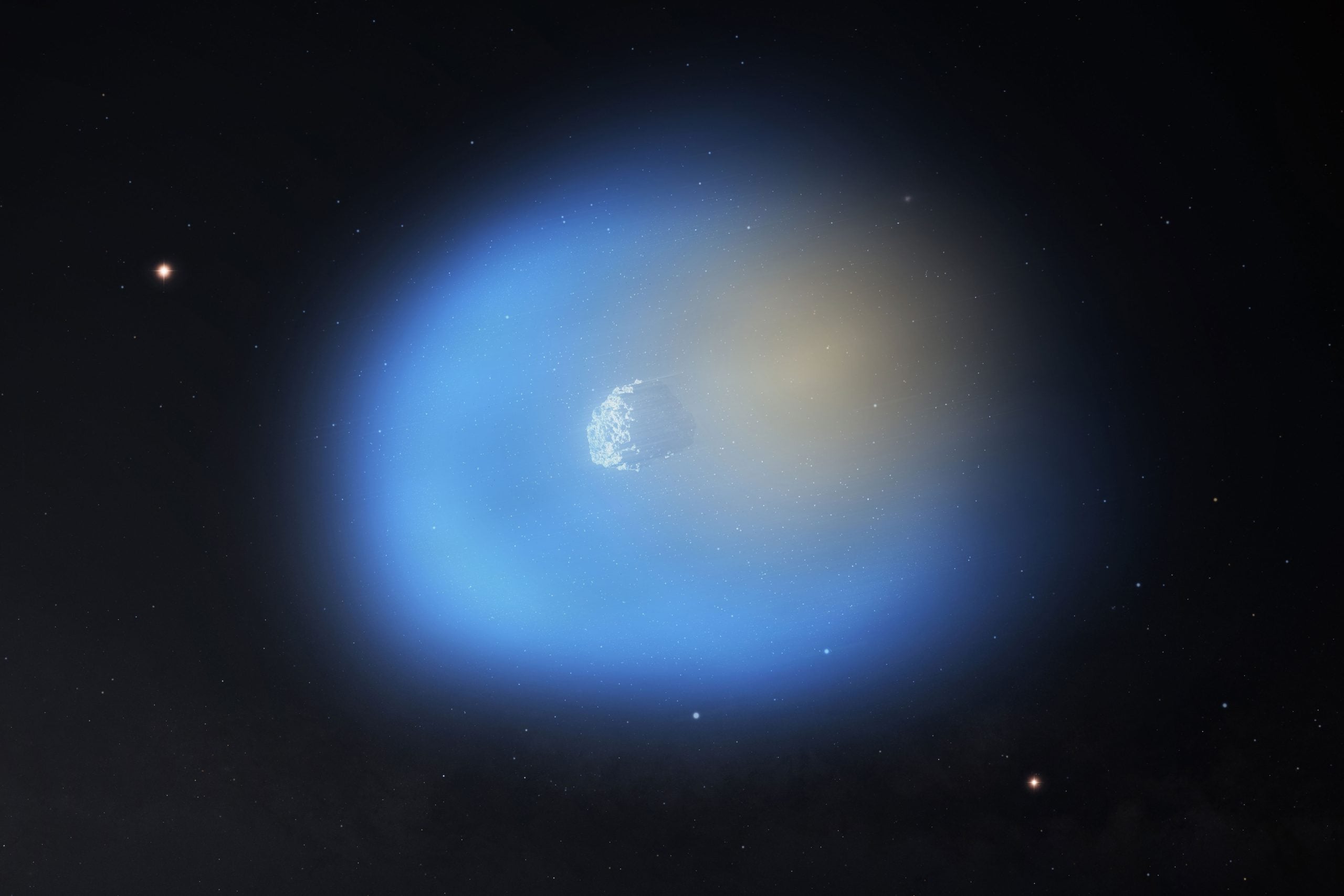
Astronomers have found that interstellar comet 3I/ATLAS contains an unusually large amount of methanol.
Every interstellar object that passes through our solar system offers a rare chance to sample material forged around another star.
Now, new observations of comet 3I/ATLAS using the Atacama Large Millimeter/submillimeter Array (ALMA) have revealed a chemical surprise: the comet is extraordinarily rich in methanol, an organic molecule found in comets but rarely in such abundance. The discovery could provide fresh clues about the conditions in a distant planetary system unlike our own.
“Observing 3I/ATLAS is like taking a fingerprint from another solar system,” shares Nathan Roth, lead author on this research and a professor with American University, “The details reveal what it’s made of, and it’s bursting with methanol in a way we just don’t usually see in comets in our own solar system.”
Chemistry reveals another system
The team used ALMA’s Atacama Compact Array in Chile to observe 3I/ATLAS on several dates in late 2025 as the comet moved closer to the Sun. Solar heating caused its icy surface to release gas and dust, producing a bright halo (or coma) around the nucleus.
By studying that coma, astronomers could read the chemical signatures of the comet’s material, giving them a rare way to examine how objects may form in another planetary system without traveling beyond our own.
Methanol marks an unusual comet
The observations centered on faint submillimeter signals from two molecules: methanol (CH3OH), a type of alcohol, and hydrogen cyanide (HCN), a nitrogen-bearing organic molecule often detected in comets. ALMA showed that 3I/ATLAS contains far more methanol relative to hydrogen cyanide than is normally seen in comets that formed in our solar system. Across two observing dates, the team found ratios of methanol to HCN of about 70 and 120, ranking 3I/ATLAS among the most methanol-rich comets ever studied in the solar system.
Those results suggest that the icy material in 3I/ATLAS either formed under, or later experienced, conditions very different from those that shaped most comets near our Sun. Earlier observations with the James Webb Space Telescope found that 3I/ATLAS had a coma dominated by carbon dioxide when it was farther from the Sun. The new ALMA measurements add another unusual feature to its chemical profile: an abundance of methanol.
Tiny grains release hidden chemistry
ALMA’s high-resolution imaging also showed that methanol and hydrogen cyanide do not leave the comet in the same way. Hydrogen cyanide appears to originate mainly from the comet’s nucleus, which is typical of comets in our solar system. Methanol, however, seems to come from both the nucleus and icy particles within the coma. These tiny ice grains behave like mini comets.
As 3I/ATLAS gets closer to the Sun and ice changes into gas, the grains release methanol as well. Similar activity has been seen in some comets from our own solar system, but this is the first time such detailed outgassing physics has been traced in an interstellar object.
Comet 3I/ATLAS is only the third confirmed object known to have entered our solar system from interstellar space, following 1I/‘Oumuamua and 2I/Borisov. Those earlier visitors also showed unusual traits. As astronomers find and study more objects from beyond our solar system, they are gaining a clearer and more complex picture of how planets and smaller icy bodies form around other stars.
Reference: “CH3OH and HCN in Interstellar Comet 3I/ATLAS Mapped with the ALMA Atacama Compact Array: Distinct Outgassing Behaviors and a Remarkably High CH3OH/HCN Production Rate Ratio” by Nathan X. Roth, Martin A. Cordiner, Dominique Bockelée-Morvan, Nicolas Biver, Jacques Crovisier, Stefanie N. Milam, Emmanuel Lellouch, Pablo Santos-Sanz, Dariusz C. Lis, Chunhua Qi, K. D. Foster, Jérémie Boissier, Kenji Furuya, Raphael Moreno, Steven B. Charnley, Anthony J. Remijan, Yi-Jehng Kuan and Lillian X. Hart, 6 March 2026, The Astrophysical Journal Letters.
DOI: 10.3847/2041-8213/ae433b
This work was supported by the Planetary Science Division Internal Scientist Funding Program through the Fundamental Laboratory Research (FLaRe) work package (N.X.R., S.N.M., M.A.C., S.B.C.), as well as the NASA Astrobiology Institute through the Goddard Center for Astrobiology (proposal 13-13NAI7-0032; S.N.M., M.A.C., S.B.C.).
Never miss a breakthrough: Join the SciTechDaily newsletter.
Follow us on Google and Google News.
1 Comment
there have been, to my knowledge, only three of these interstellar visitors, so for all we know it may be the norm for them to have this unexpected chemical.