
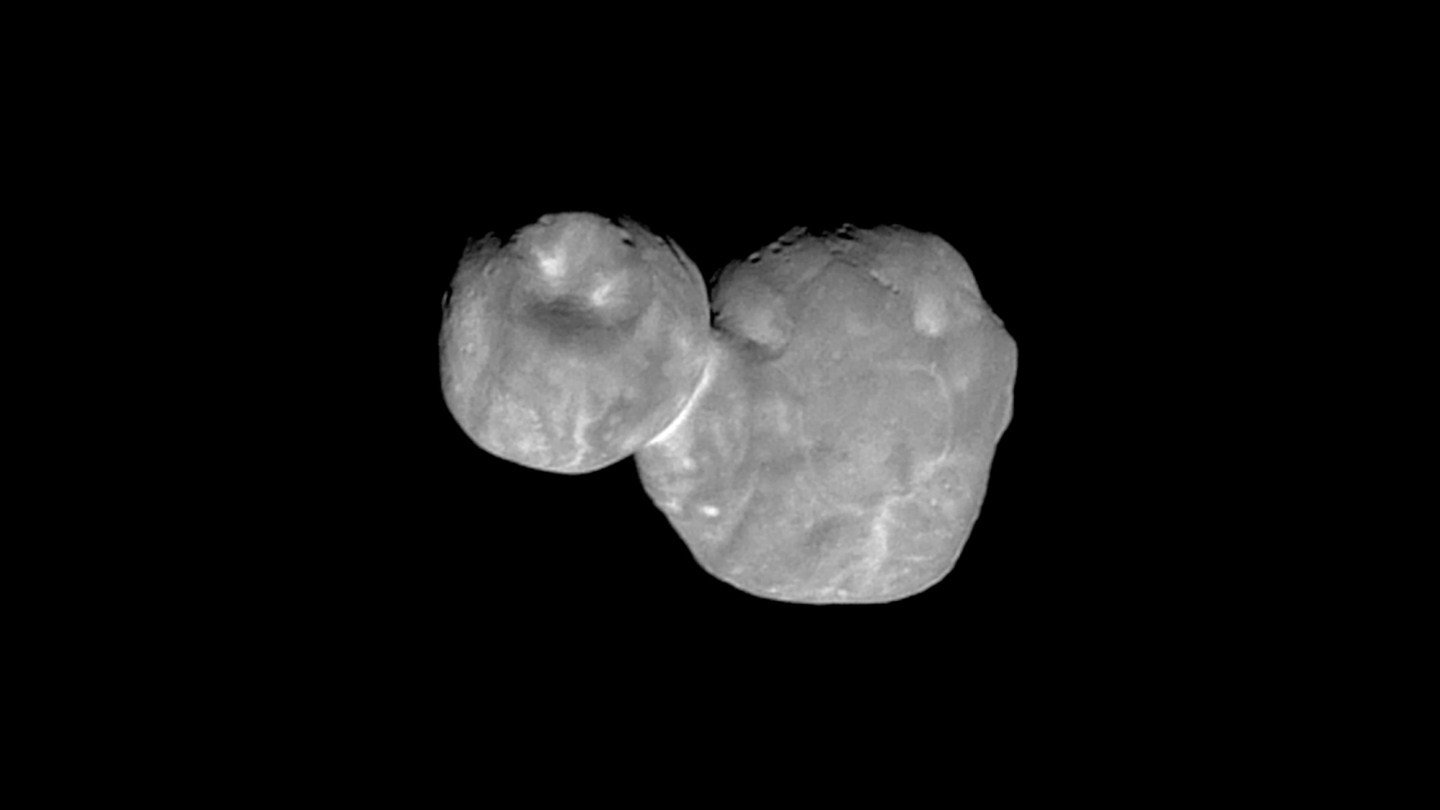
A recent study exploring the development of comets suggests that objects in deep space, such as the Kuiper Belt Object 486958 Arrokoth, might act as time capsules, preserving ancient ices from billions of years in the past.
A new study is shaking up what scientists thought they knew about distant objects in the far reaches of the solar system, starting with an object called the space snowman.
Researchers from Brown University and the SETI Institute found that the double-lobed object, which is officially named Kuiper Belt Object 486958 Arrokoth and resembles a snowman, may have ancient ices stored deep within it from when the object first formed billions of years ago. But that’s just the beginning of their findings.
Using a new model they developed to study how comets evolve, the researchers suggest this feat of perseverance isn’t unique to Arrokoth but that many objects from the Kuiper Belt — which lies at the outermost regions of the solar system and dates back to the early formation of the solar system around 4.6 billion years ago — may also contain the ancient ices they formed with.
“We’ve shown here in our work, with a rather simple mathematical model, that you can keep these primitive ices locked deep within the interiors of these objects for really long times,” said Sam Birch, a planetary scientist at Brown and one of the paper’s co-authors. “Most of our community had thought that these ices should be long lost, but we think now that may not be the case.”
Birch describes the work in the journal Icarus with co-author Orkan Umurhan, a senior research scientist at the SETI Institute.
Reevaluation of Thermal Evolutionary Models
Until now, scientists had a hard time figuring out what happens to ices on these space rocks over time. The study challenges widely used thermal evolutionary models that have failed to account for the longevity of ices that are as temperature-sensitive as carbon monoxide. The model the researchers created for the study accounts for this change and suggests that the highly volatile ices in these objects stick around much longer than was previously thought.
“We are basically saying that Arrokoth is so super cold that for more ice to sublimate — or go directly from solid to a gas, skipping the liquid phase within it — that the gas it sublimates into first has to have travel outwards through its porous, sponge-like interior,” Birch said. “The trick is that to move the gas, you also have to sublimate the ice, so what you get is a domino effect: it gets colder within Arrokoth, less ice sublimates, less gas moves, it gets even colder, and so on. Eventually, everything just effectively shuts off, and you’re left with an object full of gas that is just slowly trickling out.”
The work suggests that Kuiper Belt objects can act as dormant “ice bombs,” preserving volatile gases within their interiors for billions of years until orbital shifts bring them closer to the sun and the heat makes them unstable. This new idea could help explain why these icy objects from the Kuiper Belt erupt so violently when they first get closer to the sun. All of a sudden, the cold gas inside them rapidly gets pressurized and these objects evolve into comets.
“The key thing is that we corrected a deep error in the physical model people had been assuming for decades for these very cold and old objects,” said Umurhan, Birch’s co-author on the paper. “This study could be the initial mover for reevaluating the comet interior evolution and activity theory.”
Altogether, the study challenges existing predictions and opens up new avenues for understanding the nature of comets and their origins. Birch and Umurhan are co-investigators in NASA’s Comet Astrobiology Exploration Sample Return (CAESAR) mission to acquire at least 80 grams of surface material from the comet 67P/Churyumov-Gerasimenko and return it to Earth for analysis.
The results from this study could help guide CAESAR’s exploration and sampling strategies, helping to deepen our understanding of cometary evolution and activity.
“There may well be massive reservoirs of these primitive materials locked away in small bodies all across the outer solar system — materials that are just waiting to erupt for us to observe them or sit in deep freeze until we can retrieve them and bring them home to Earth,” Birch said.
Reference: “Retention of CO ice and gas within 486958 Arrokoth” by Samuel P.D. Birch and Orkan M. Umurhan, 2 March 2024, Icarus.
DOI: 10.1016/j.icarus.2024.116027
The study was funded by the Heising-Simons Foundation.
Never miss a breakthrough: Join the SciTechDaily newsletter.
Follow us on Google and Google News.
3 Comments
OK, just rename it Frosty.
Very”Cool” info!
“We’ve shown here in our work, with a rather simple mathematical model, that you can keep these primitive ices locked deep within the interiors of these objects for really long times”
Well, there it is, the dumbest thing I’ve read all day.
And the ppl that publish this pap, yes that’s right, pap
Soft food for infants.
How about, growing a pair, and publish a real discovery that will change the history of all mankind.
Second thought, don’t bother.
You wouldn’t be able to understand its importance.
Cheers Steve.