
Ultra-low-energy electronics ‘straight out of the fridge’?
Could a stack of 2D materials allow for supercurrents at ground-breakingly warm temperatures, easily achievable in the household kitchen?
An international study published in August opens a new route to high-temperature supercurrents at temperatures as ‘warm’ as inside a kitchen fridge.
The ultimate aim is to achieve superconductivity (i.e., electrical current without any energy loss to resistance) at a reasonable temperature.
Towards room-temperature superconductivity
Previously, superconductivity has only been possible at impractically low temperatures, less than -170°C below zero – even the Antarctic would be far too warm!
For this reason, the cooling costs of superconductors have been high, requiring expensive and energy-intensive cooling systems.
Superconductivity at everyday temperatures is the ultimate goal of researchers in the field.
This new semiconductor superlattice device could form the basis of a radically new class of ultra-low energy electronics with vastly lower energy consumption per computation than conventional, silicon-based (CMOS) electronics.
Such electronics, based on new types of conduction in which solid-state transistors switch between zero and one (i.e., binary switching) without resistance at room temperature, is the aim of the FLEET Centre of Excellence.

Exciton supercurrents in energy-efficient electronics
Because oppositely charged electrons and holes in semiconductors are strongly attracted to each other electrically, they can form tightly-bound pairs. These composite particles are called excitons, and they open up new paths towards conduction without resistance at room temperature.
Excitons can in principle form a quantum, ‘superfluid’ state, in which they move together without resistance. With such tightly bound excitons, the superfluidity should exist at high temperatures—even as high as room temperature.
But unfortunately, because the electron and hole are so close together, in practice excitons have extremely short lifetimes—just a few nanoseconds, not enough time to form a superfluid.
As a workaround, the electron and hole can be kept completely apart in two, separated atomically-thin conducting layers, creating so-called ‘spatially indirect’ excitons. The electrons and holes move along separate but very close conducting layers. This makes the excitons long-lived, and indeed superfluidity has recently been observed in such systems.
Counterflow in the exciton superfluid, in which the oppositely charged electrons and holes move together in their separate layers, allows so-called ‘supercurrents’ (dissipationless electrical currents) to flow with zero resistance and zero wasted energy. As such, it is clearly an exciting prospect for future, ultra-low-energy electronics.
Stacked layers overcome 2D limitations
Sara Conti who is a co-author on the study, notes another problem however: atomically-thin conducting layers are two-dimensional, and in 2D systems there are rigid topological quantum restrictions discovered by David Thouless and Michael Kosterlitz (2016 Nobel prize), that eliminate the superfluidity at very low temperatures, above about –170°C (–274°F).
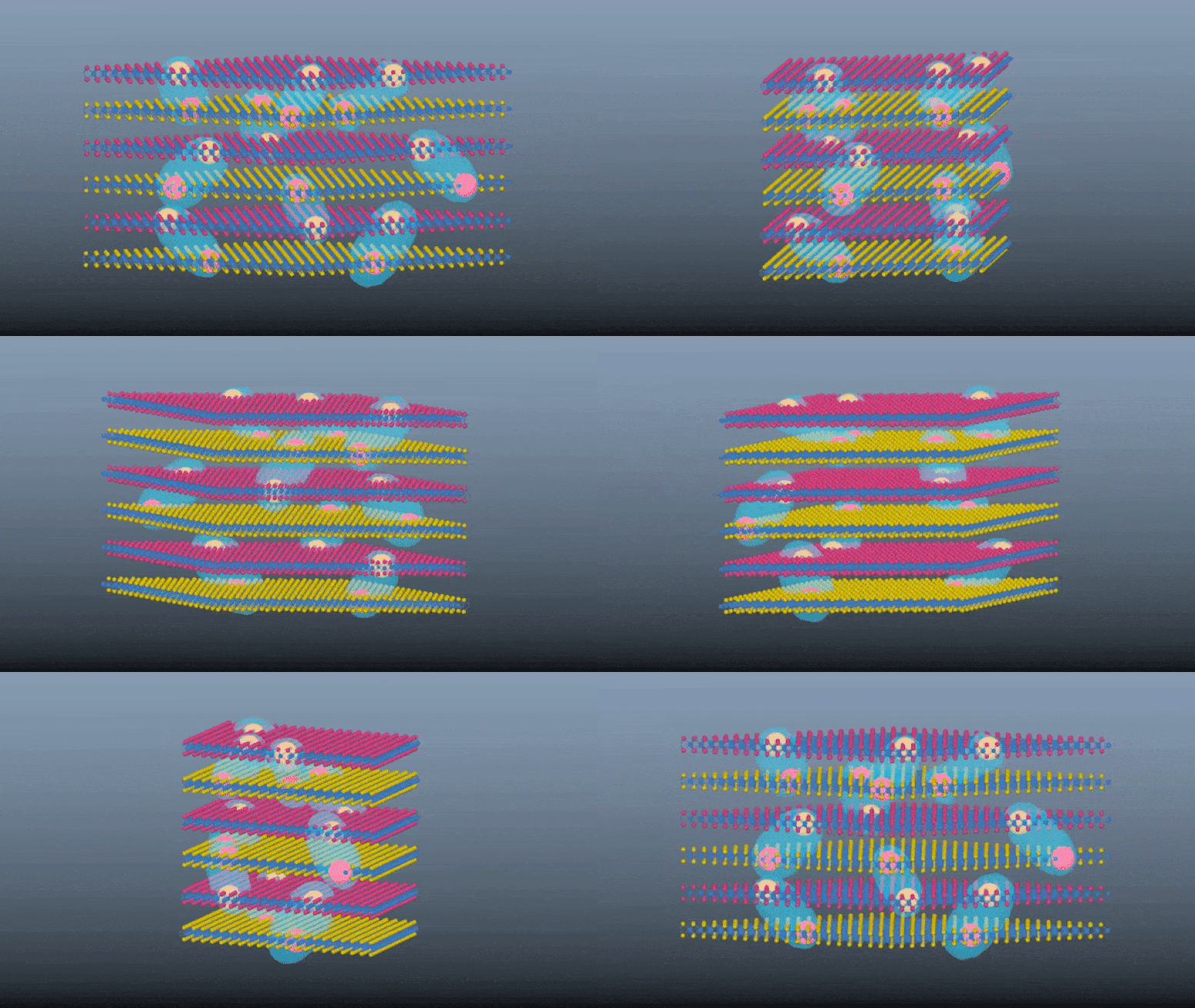
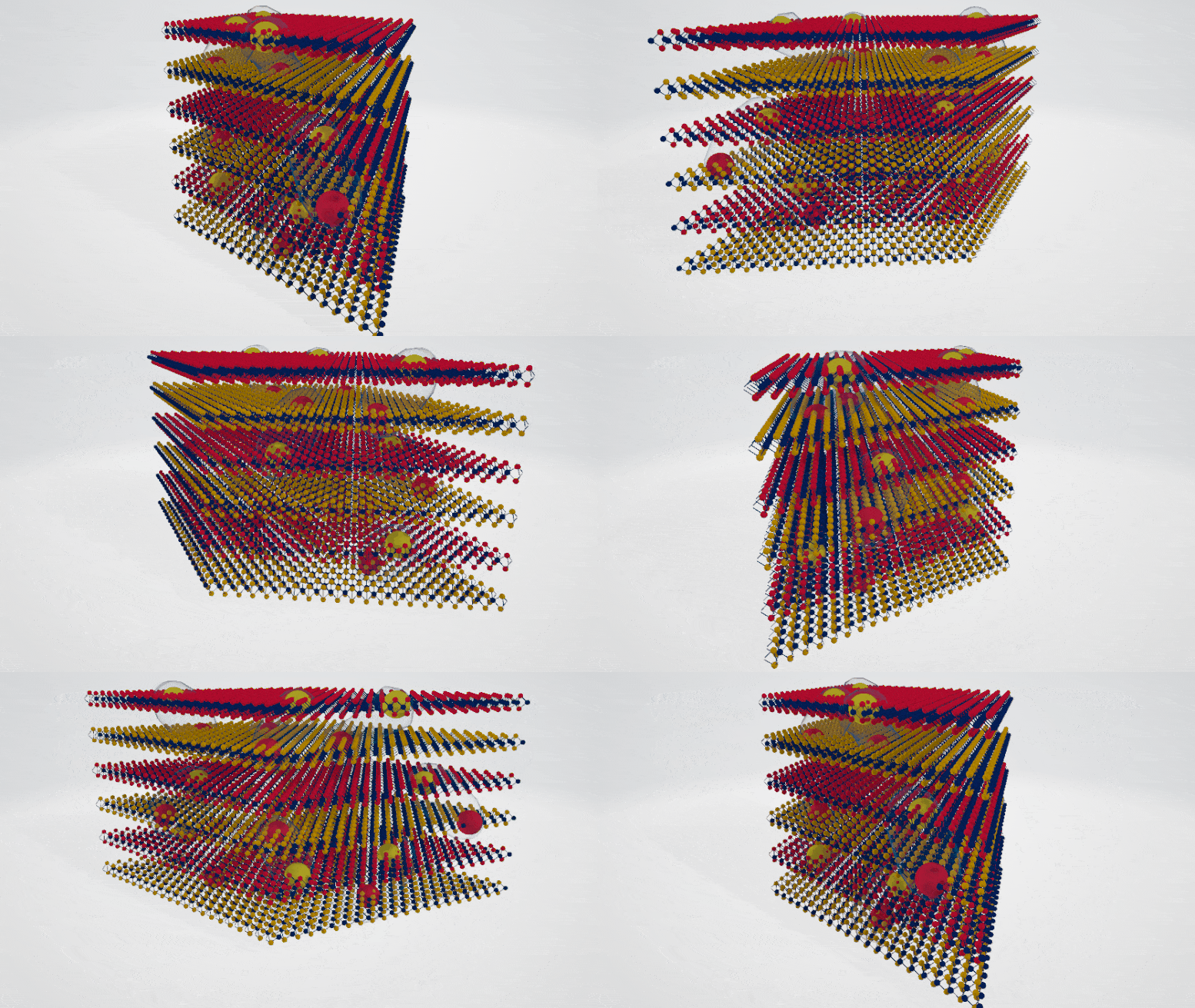
The key difference with the new proposed system of stacked atomically-thin layers of transition metal dichalcogenide (TMD) semiconducting materials, is that it is three dimensional.
The topological limitations of 2D are overcome by using this 3D `superlattice’ of thin layers. Alternate layers are doped with excess electrons (n-doped) and excess holes (p-doped) and these form the 3D excitons.
The study predicts exciton supercurrents will flow in this system at temperatures as warm as –3°C (27°C).
David Neilson, who has worked for many years on exciton superfluidity and 2D systems, says “The proposed 3D superlattice breaks out from the topological limitations of 2D systems, allowing for supercurrents at –3°C. Because the electrons and holes are so strongly coupled, further design improvements should carry this right up to room temperature.”
“Amazingly, it is becoming routine today to produce stacks of these atomically-thin layers, lining them up atomically, and holding them together with the weak van der Waals atomic attraction,” explains Prof Neilson. “And while our new study is a theoretical proposal, it is carefully designed to be feasible with present technology.”
The study
The study looked at superfluidity in a stack made of alternating layers of two different monolayer materials (n- and p-doped TMDC transition metal dichalcogenides WS2 and WSe2).
Reference: “Three-dimensional electron-hole superfluidity in a superlattice close to room temperature” by M. Van der Donck, S. Conti, A. Perali, A. R. Hamilton, B. Partoens, F. M. Peeters and D. Neilson, 25 August 2020, Physical Review B.
DOI 10.1103/PhysRevB.102.060503
The study was led by FLEET PI Prof David Neilson, working with collaborators at the University of Antwerp (Belgium), University of Camerino (Italy), and UNSW Sydney (Australia).
The work was supported by the Research Foundation of Flanders, the European Research Area’s Future and Emerging Technologies Flagships program, and the Australian Research Council (Centre of Excellence program).
Never miss a breakthrough: Join the SciTechDaily newsletter.
Follow us on Google and Google News.
2 Comments
There are more than 40 room temperature superconductors although none are recognized by the mainstream scientific community. Most can be found at superconductors.org At least two are close to commercialization. One is a polymer, discovered in Moscow, Russia in 1982. The other is graphene based and was invented in Japan. More information can be found at aesopinstitute.org
“Kitchen Temperature” A new expression just made up to describe when scientist once again fall short of room temperature or higher superconductivity