
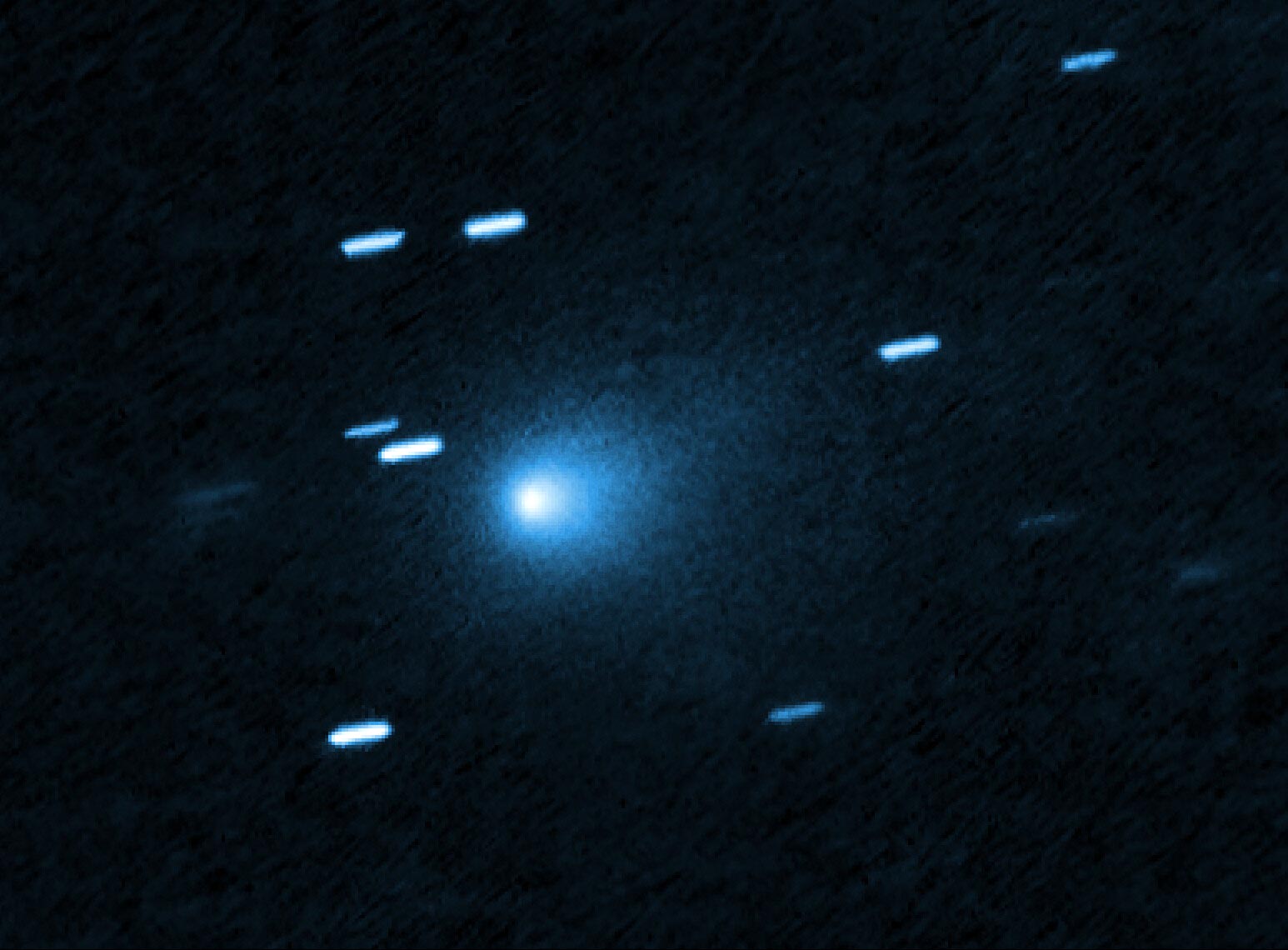
NASA, ESA, D. Jewitt (UCLA); Image Processing: J. DePasquale (STScI)
Researchers at Auburn University have identified a distinctive ultraviolet signature of water in the interstellar comet known as 3I/ATLAS.
For millions of years, a fragment of ice and dust drifted between the stars—like a sealed bottle cast into the cosmic ocean. This summer, that bottle finally washed ashore in our solar system and was designated 3I/ATLAS, only the third known interstellar comet ever observed.
When scientists at Auburn University aimed NASA’s Neil Gehrels Swift Observatory at the object, they detected something never seen before in this kind of visitor: hydroxyl (OH) gas, which is a clear chemical marker of water. Swift’s space-based telescope was able to capture a faint ultraviolet signal that cannot be detected from the ground, because Earth’s atmosphere blocks most ultraviolet light before it reaches the surface.
Detecting water, through its ultraviolet byproduct hydroxyl, represents a major advance in the study of interstellar comets. In comets from our own solar system, water serves as the main reference point for measuring overall activity and understanding how sunlight drives the release of other gases. It is the chemical standard used to compare the mix of volatile ices inside comet nuclei.
Finding the same indicator in an interstellar object allows astronomers, for the first time, to evaluate 3I/ATLAS using the same framework applied to familiar solar system comets, opening a new path for comparing the chemistry of planetary systems across the galaxy.
Water activity where none was expected
What sets 3I/ATLAS apart is the location at which this water-related activity was observed. Swift detected hydroxyl when the comet was nearly three times farther from the Sun than Earth, well beyond the zone where water ice on a comet’s surface would normally turn directly into gas. The measurements indicate a water loss rate of about 40 kilograms per second, comparable to the flow from a fully open fire hose.
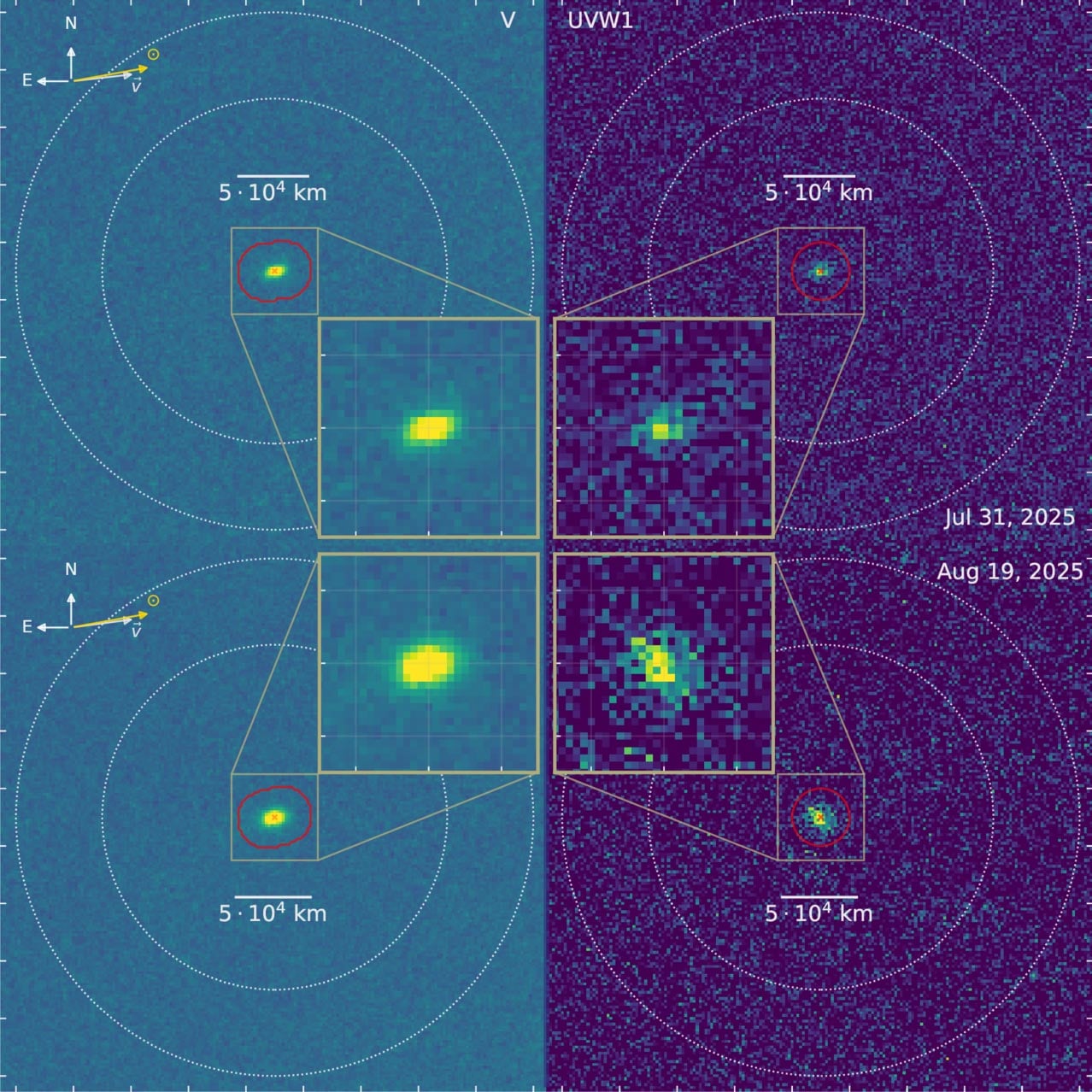
At such distances, most comets from the solar system show little to no activity. The strong ultraviolet signal suggests that another process may be responsible, such as sunlight warming small icy grains released from the nucleus, allowing them to vaporize and sustain the surrounding cloud of gas. Similar extended sources of water have been identified in only a few distant comets and are thought to reflect layered ice structures that preserve information about how these objects formed.
So far, every interstellar comet detected has displayed a different chemical profile, revealing a wide range of planetary environments beyond our Sun. Together, these visitors show that the materials that make up comets, especially their volatile ices, can differ substantially from one star system to another. These variations offer clues to how factors such as temperature, radiation, and composition shape the raw ingredients of planets and, potentially, the conditions needed for life.
Seeing ultraviolet signals from space
Catching that whisper of ultraviolet light from 3I/ATLAS was a technical triumph in itself. NASA’s Neil Gehrels Swift Observatory carries a modest 30-centimeter telescope, but in orbit above Earth’s atmosphere, it can see ultraviolet wavelengths that are almost completely absorbed before reaching the ground. Free from the sky’s glare and air’s interference, Swift’s Ultraviolet/Optical Telescope achieves the sensitivity of a 4-meter-class ground telescope for these wavelengths. Its rapid-targeting capability allowed the Auburn team to observe the comet within weeks of discovery—long before it grew too faint or too close to the Sun to study from space.
“When we detect water—or even its faint ultraviolet echo, OH—from an interstellar comet, we’re reading a note from another planetary system,” said Dennis Bodewits, professor of physics at Auburn. “It tells us that the ingredients for life’s chemistry are not unique to our own.”
“Every interstellar comet so far has been a surprise,” added Zexi Xing, postdoctoral researcher and lead author of the study. “‘Oumuamua was dry, Borisov was rich in carbon monoxide, and now ATLAS is giving up water at a distance where we didn’t expect it. Each one is rewriting what we thought we knew about how planets and comets form around stars.”
3I/ATLAS has now faded from view but will become observable again after mid-November, offering another chance to track how its activity evolves as it approaches the Sun. The current detection of OH, reported in The Astrophysical Journal Letters, provides the first clear evidence that the comet is releasing water at large heliocentric distances. It also shows how a small space-based telescope, free from Earth’s atmospheric absorption, can reveal faint ultraviolet signals that link this visitor to the wider family of comets—and to the planetary systems from which they are born.
Reference: “Water Production Rates of the Interstellar Object 3I/ATLAS” by Zexi Xing, Shawn Oset, John Noonan and Dennis Bodewits, 30 September 2025, The Astrophysical Journal Letters.
DOI: 10.3847/2041-8213/ae08ab
Never miss a breakthrough: Join the SciTechDaily newsletter.
Follow us on Google and Google News.
23 Comments
What gets me is that 3I/ATLAS “natural” theories are the exact multi-parameter witchcraft academia would shred if a nobody proposed them.
“Natural” demands:
Ultra-rare CO/CO₂-rich formation + perfect refractory mantle hiding H₂O
Precisely tuned jets/lag angles matching acceleration without visible mass loss
Stable anti-tail geometry defying 16hr rotation
If outsiders pitched this stacked speculation, they’d be laughed out. Instead, conveniently,Academia waves it through as “comet physics.”
Engineered hypothesis? One assumption—control—explains coherent dynamics/morphology/thermals as design output, not coincidence pile-up.
Hyper-synergenesis verdict: “Natural” survives only as high-tuning fanfic. Engineered is the unified model playing by real science rules.
31 Atlas is not a regular Comet, this is my
gut feeling. Everything about it seems
special and different even though there are
similarities with regular comets. Anyway this
is just one woman’s belief.
Agreed……………………very strange……………….creepy.
Silence is golden.
There is nothing about the behaviour of this object to suggest it is anything other than what it appears to be – a comet. It’s a shame that Avi Loeb (and others) keep trying to muddy the water about this.
Agreed……………………very strange……………….creepy.
Oh it’s natural alright. We just don’t know in what manner it is natural.
They are going to let the first signs of an extraterrestrial civilization pass by us without even attempt to communicate with it.
The greatest symptom of stupidity is stabbornness.
Maybe they are afraid to. Something about staying silent in a quiet forest is an analogy to compare it to. There could be aggressive hunters so better to not make contact just in case. That is wise not stupid when dealing with the unknown.
I agree with your analogy i am a hunter retired, i love animals , i also like street tacos, that’s why have taken a few steps back, i live near a bird sancuary the has long since gone but the birds thrive here on wirms plenty full i have never seen soo many, but there were blow flies here in June, the put me not paranoid. but high alert. and i have my babies. Dixie taught her lil sister Honey very well. She has definately amazing. her son Tatar he is wildcard but amazing.
I wanna be aggressive hunter!!! 🙂
Well i guess uou should make your own rocket and go meet them for us since your so damn smart
А какво е това тяло. Защо се мълчи? Мина 19.12.2025 , нали щяха да го проучват отблизо?
You confuse unsual with artificial. 3I/ATLAS is no doubt an unusual comet in many respects. To begin with, it is an interstellar object. This does not make it artificial. Loeb’s speculations are just that — speculations.
3i Atlas is not a “natural” comet. The anomalies displayed are too numerous and sustained to make it a natural comet. All these mainstream scientists will have eggs on their faces when it is proven how wrong they are. I smell a concerted effort to cover up the facts.
That’s fine moderate away!
Namaste 🙏
❤
Well ready or not, Tomorow will tell. Or not! We cannot change it all we know is someone will be saying told you so.
True that !
You confuse unsual with artificial. 3I/ATLAS is no doubt an unusual comet in many respects. To begin with, it is an interstellar object. This does not make it artificial. Loeb’s speculations are just that — speculations.
Earth is now %0.0002 further from the Sun, thanks to 3i/Atlas. This change, although barely noticeable, is actually quite profound. 60 Billion year’s from now, we’re quite likely to be ejected from the Milky Way galaxy, during the merger with Andromeda, forming Milkdromeda. The area between the two, is home to many smaller galaxy like objects, one of which is apparently the home of the Buga sphere and has received considerable interest, since Google AI, Deepmind, managed to find that spheres symbols, are actually Univeral constants, such as the speed of light (c) and Pythagoras constant. They certainly understood gravity, better than Einstein.
By “we” you mean what’s left of the sun that blows up after the first 5 billion, right?=_=
At the very least, Atlas will tell us who we are. We are perfectly capable of sending an investigatory craft.
If we do send a craft, at the very least, we would learn something more about the nature of the Universe and what it is made of. That the powers that run this globe will spend endless energies on genocidal wars rather than Knowledge tells me that we don’t need “authorities” that serve us not.