
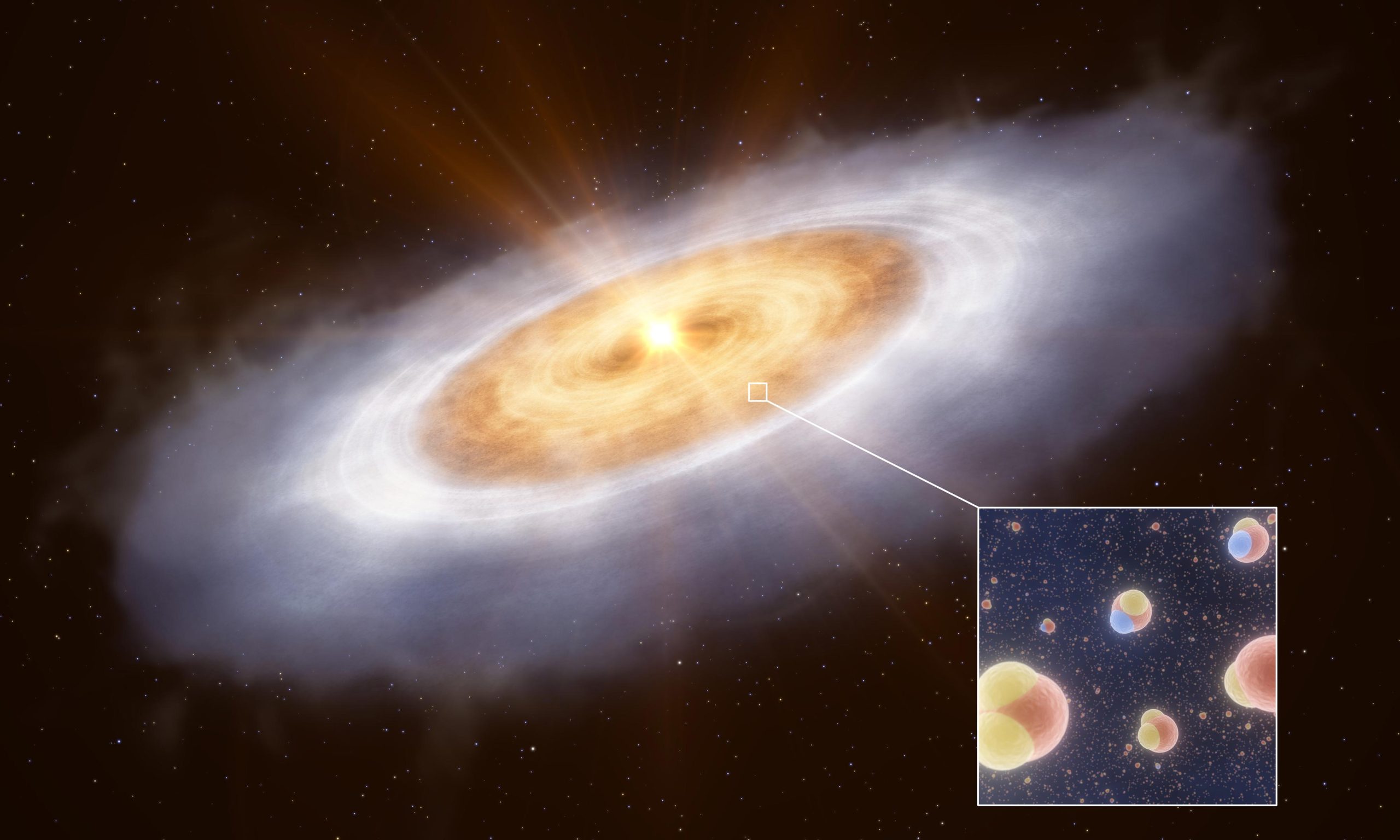
The inset image shows the two kinds of water molecules studied in this disc: normal water, with one oxygen atom and two hydrogen atoms, and a heavier version where one hydrogen atom is replaced with deuterium, a heavy isotope of hydrogen.
Credit: ESO/L. Calçada
Tracing Water’s Origins in the Universe
Using the Atacama Large Millimeter/submillimeter Array (ALMA), astronomers have detected gaseous water in the planet-forming disc around the star V883 Orionis. This water carries a chemical signature that explains the journey of water from star-forming gas clouds to planets, and supports the idea that water on Earth is even older than our Sun.
“We can now trace the origins of water in our Solar System to before the formation of the Sun,” says John J. Tobin, an astronomer at the National Radio Astronomy Observatory (NRAO), USA and lead author of the study published today (March 8) in the journal Nature.
This discovery was made by studying the composition of water in V883 Orionis, a planet-forming disc about 1300 light-years away from Earth. When a cloud of gas and dust collapses it forms a star at its center. Around the star, material from the cloud also forms a disc. Over the course of a few million years, the matter in the disc clumps together to form comets, asteroids, and eventually planets. Tobin and his team used ALMA, in which the European Southern Observatory (ESO) is a partner, to measure chemical signatures of the water and its path from the star-forming cloud to planets.
Water usually consists of one oxygen atom and two hydrogen atoms. Tobin’s team studied a slightly heavier version of water where one of the hydrogen atoms is replaced with deuterium — a heavy isotope of hydrogen. Because simple and heavy water form under different conditions, their ratio can be used to trace when and where the water was formed. For instance, this ratio in some Solar System comets has been shown to be similar to that in water on Earth, suggesting that comets might have delivered water to Earth.
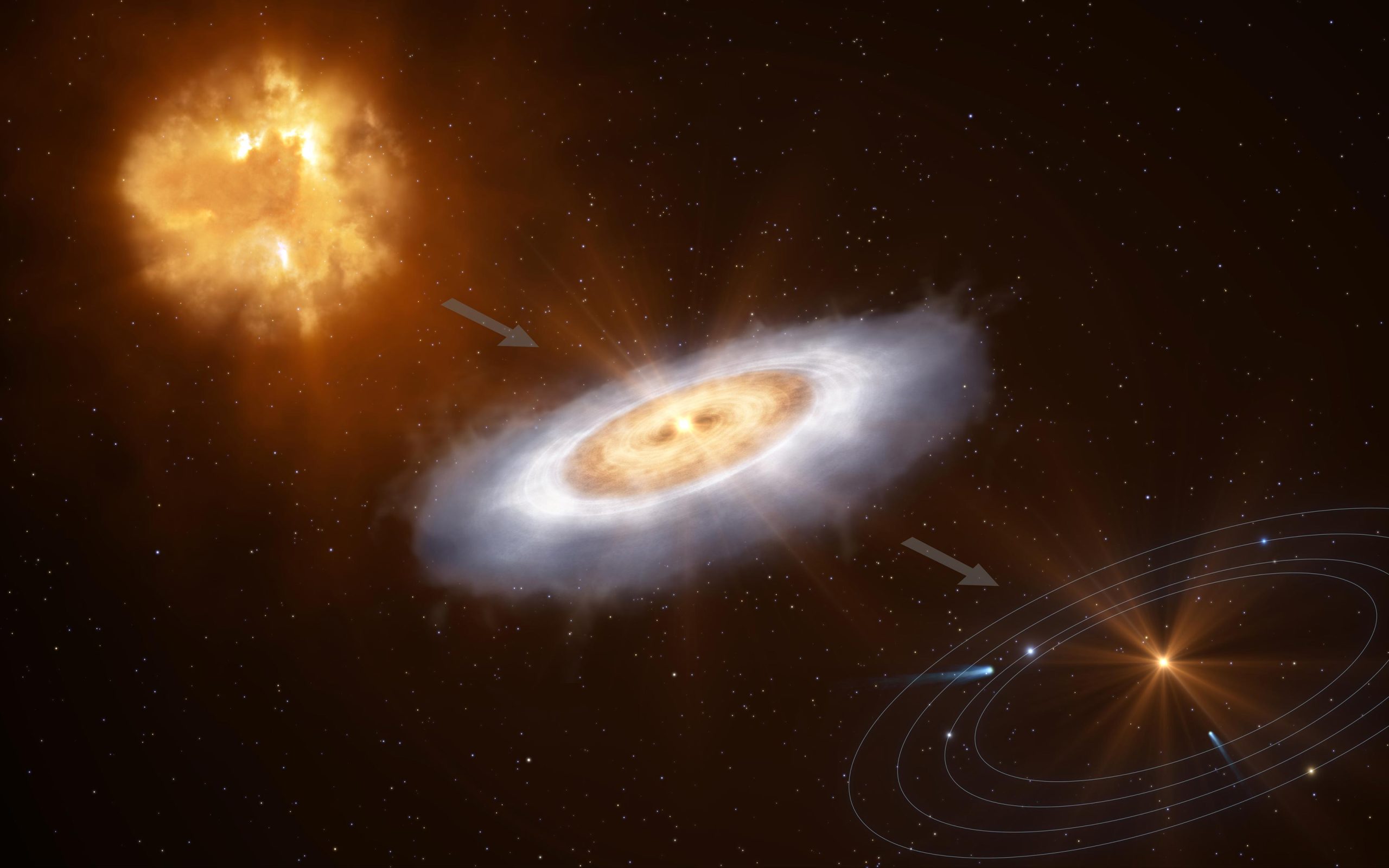
The journey of water from clouds to young stars, and then later from comets to planets has previously been observed, but until now the link between the young stars and comets was missing. “V883 Orionis is the missing link in this case,” says Tobin. “The composition of the water in the disc is very similar to that of comets in our own Solar System. This is confirmation of the idea that the water in planetary systems formed billions of years ago, before the Sun, in interstellar space, and has been inherited by both comets and Earth, relatively unchanged.”
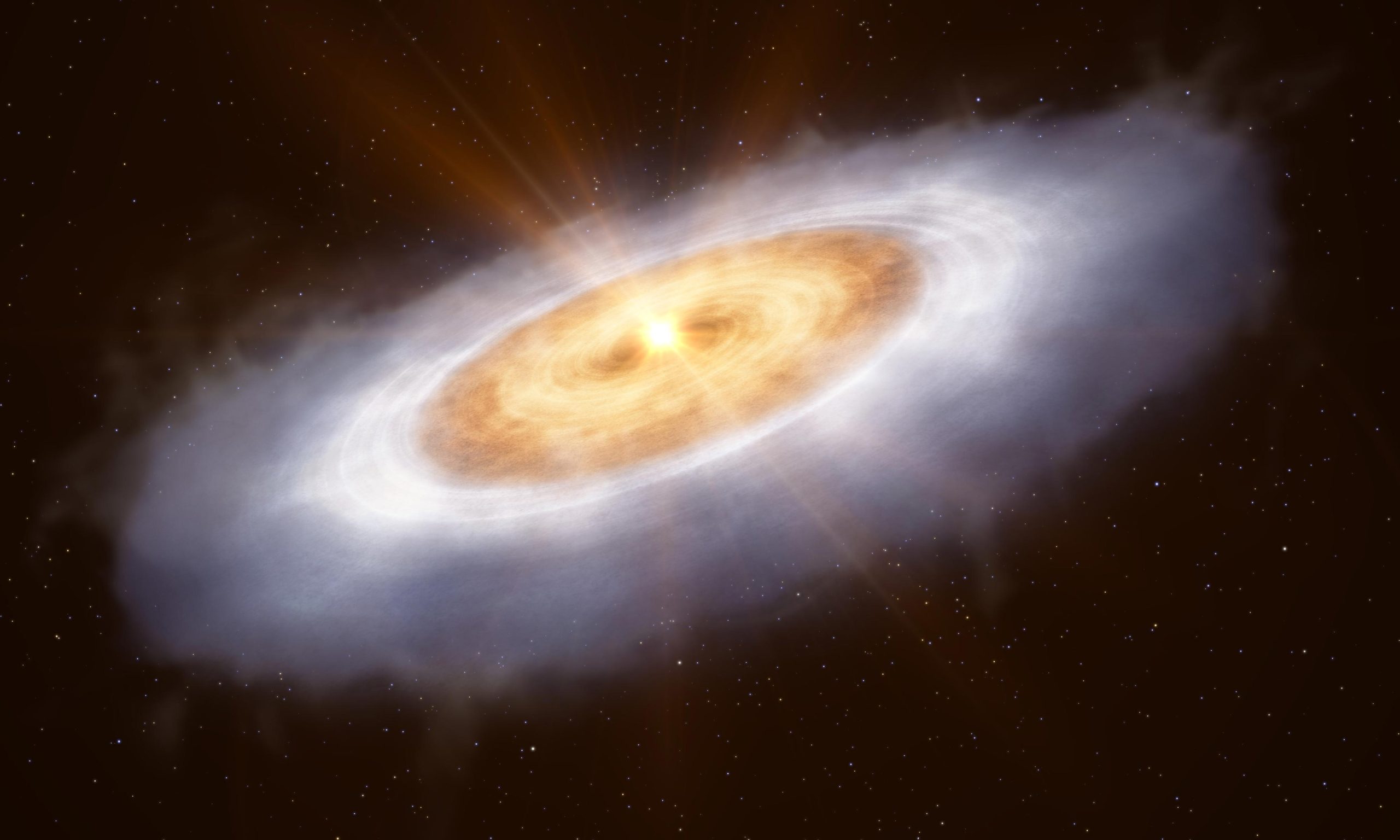
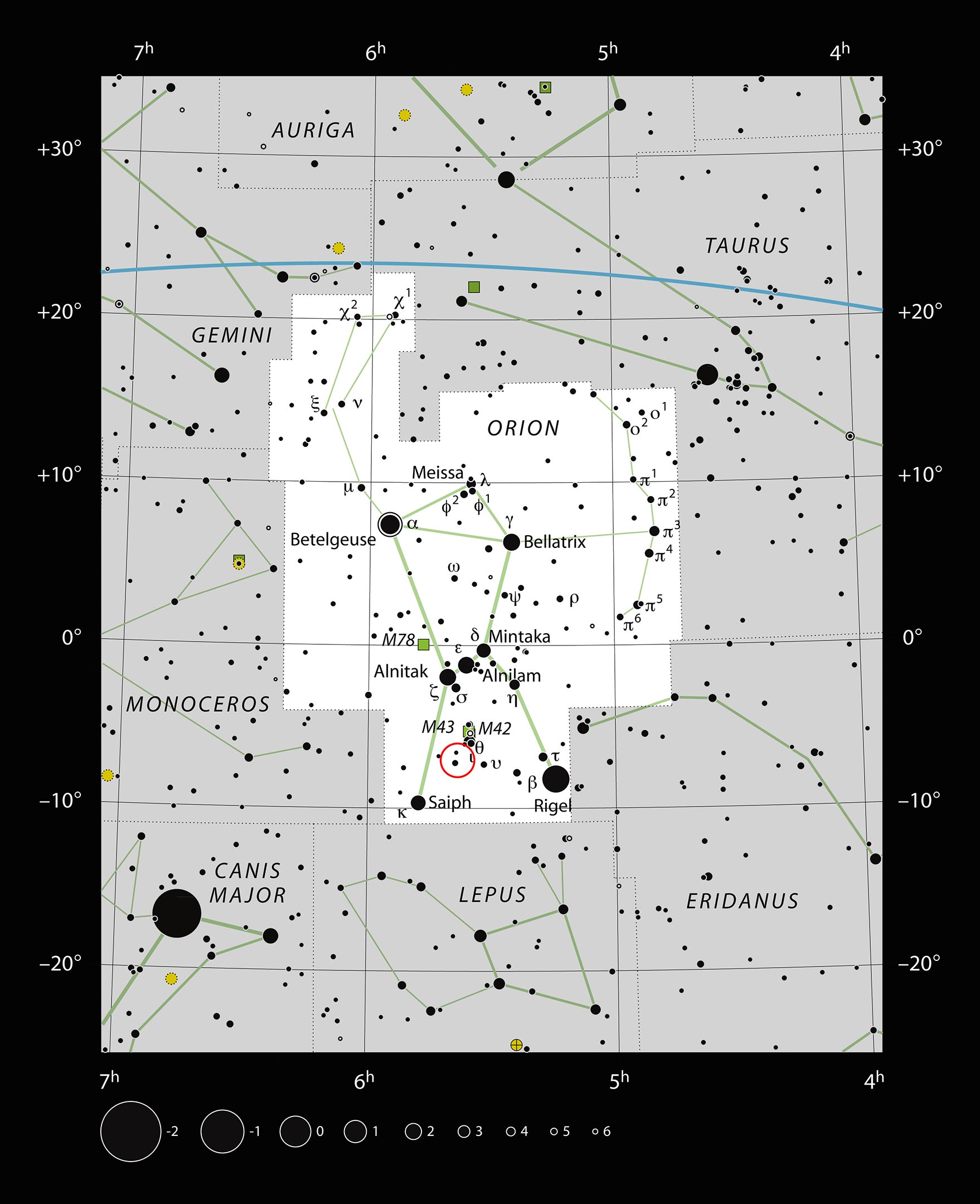
Zooming on the young star V883 Orionis. This star is currently in outburst, which has pushed the water snow line further from the star and allowed it to be detected for the first time with ALMA.
But observing the water turned out to be tricky. “Most of the water in planet-forming discs is frozen out as ice, so it’s usually hidden from our view,” says co-author Margot Leemker, a PhD student at Leiden Observatory in the Netherlands. Gaseous water can be detected thanks to the radiation emitted by molecules as they spin and vibrate, but this is more complicated when the water is frozen, where the motion of molecules is more constrained. Gaseous water can be found towards the centre of the discs, close to the star, where it’s warmer. However, these close-in regions are hidden by the dust disc itself, and are also too small to be imaged with our telescopes.
Fortunately, the V883 Orionis disc was shown in a recent study to be unusually hot. A dramatic outburst of energy from the star heats the disc, “up to a temperature where water is no longer in the form of ice, but gas, enabling us to detect it,” says Tobin.
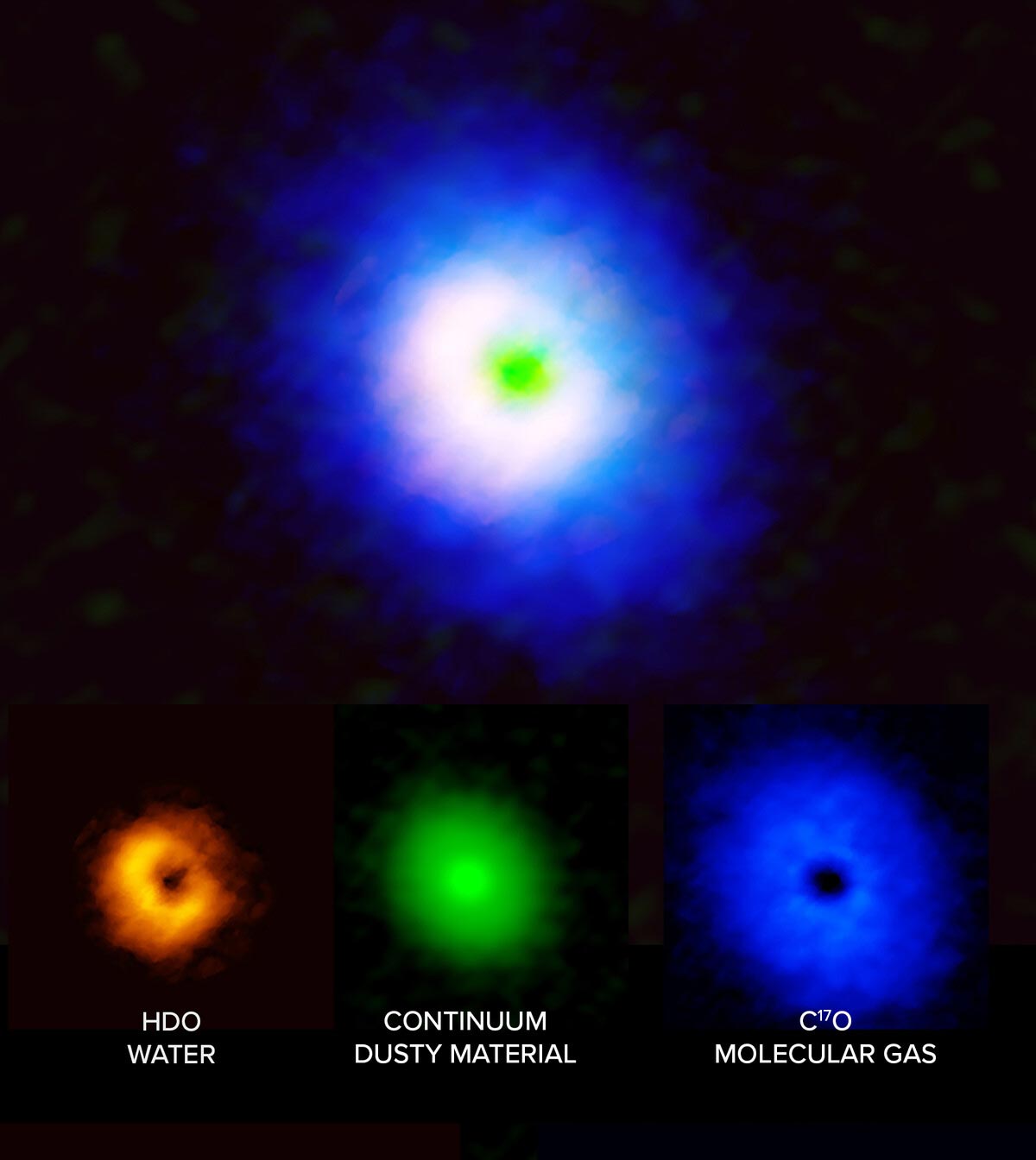
The team used ALMA, an array of radio telescopes in northern Chile, to observe the gaseous water in V883 Orionis. Thanks to its sensitivity and ability to discern small details they were able to both detect the water and determine its composition, as well as map its distribution within the disc. From the observations, they found this disc contains at least 1200 times the amount of water in all Earth’s oceans.
In the future, they hope to use ESO’s upcoming Extremely Large Telescope and its first-generation instrument METIS. This mid-infrared instrument will be able to resolve the gas-phase of water in these types of discs, strengthening the link of water’s path all the way from star-forming clouds to solar systems. ”This will give us a much more complete view of the ice and gas in planet-forming discs,” concludes Leemker.
Reference: “Deuterium-enriched water ties planet-forming disks to comets and protostars” by John J. Tobin, Merel L. R. van ’t Hoff, Margot Leemker, Ewine F. van Dishoeck, Teresa Paneque-Carreño, Kenji Furuya, Daniel Harsono, Magnus V. Persson, L. Ilsedore Cleeves, Patrick D. Sheehan and Lucas Cieza, 8 March 2023, Nature.
DOI: 10.1038/s41586-022-05676-z
The team is composed of John J. Tobin (National Radio Astronomy Observatory, USA), Merel L. R. van’t Hoff (Department of Astronomy, University of Michigan, USA), Margot Leemker (Leiden Observatory, Leiden University, the Netherlands [Leiden]) , Ewine F. van Dishoeck (Leiden), Teresa Paneque-Carreño (Leiden; European Southern Observatory, Germany), Kenji Furuya (National Astronomical Observatory of Japan, Japan), Daniel Harsono (Institute of Astronomy, National Tsing Hua University, Taiwan), Magnus V. Persson (Department of Space, Earth and Environment, Chalmers University of Technology, Onsala Space Observatory, Sweden), L. Ilsedore Cleeves (Department of Astronomy, University of Virginia, USA), Patrick D. Sheehan (Center for Interdisciplinary Exploration and Research in Astronomy, Northwestern University, USA) and Lucas Cieza (Núcleo de Astronomía, Facultad de Ingeniería, Millennium Nucleus on Young Exoplanets and their Moons, Universidad Diego Portales, Chile).
Never miss a breakthrough: Join the SciTechDaily newsletter.
Follow us on Google and Google News.
3 Comments
The second sentence in the Bible states this exactly. Moses beat them by 3,384 years. And it was published worldwide, in hundreds of languages. How do you like dem apples?
I can Bible thump as hard as anyone else, but no, Chux. If that’s true then so are the Hindus who also have theology that by chance matches up with a theory of a cyclical universe that stems from the big crunch theory. Means nothing. The Bible also says earth was created before the sun, so lucky guesses that are right mean nothing. God doesn’t require science to operate so stop trying to shoehorn Him into it. This article is clickbait because it’s obvious there was water in the dust and gas cloud that formed the sun and earth. Doesn’t mean God or aliens did it.
One drink every time you hear “millions and millions of years”. ). Give God 6 days and He’ll create everything you see, feel, and hear.