
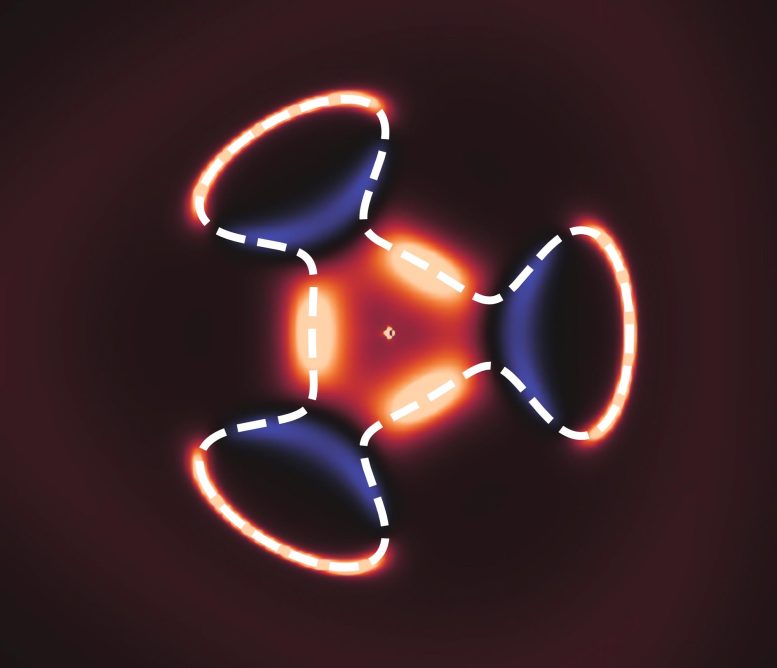
New Topological Superconductivity in Multilayered Graphene Sheets
Graphene is a strange material. Understanding its properties is both a fundamental question of science and a promising avenue for new technologies. A team of researchers from the Institute of Science and Technology Austria (ISTA) and the Weizmann Institute of Science has studied what happens when they layer four sheets of it on top of each other and how this can lead to new forms of exotic superconductivity.
Imagine a sheet of material just one layer of atoms thick—less than a millionth of a millimeter. While this may sound fantastical, such a material exists: it is called graphene, and it is made from carbon atoms in a honeycomb arrangement. First synthesized in 2004 and then soon hailed as a substance with wondrous characteristics, scientists are still working on understanding it. Postdoc Areg Ghazaryan and Professor Maksym Serbyn at the Institute of Science and Technology Austria (ISTA) together with colleagues Dr. Tobias Holder and Professor Erez Berg from the Weizmann Institute of Science in Israel have been studying graphene for years and have now published their newest findings on its superconducting properties in a research paper published on March 2 in the journal Physical Review B.
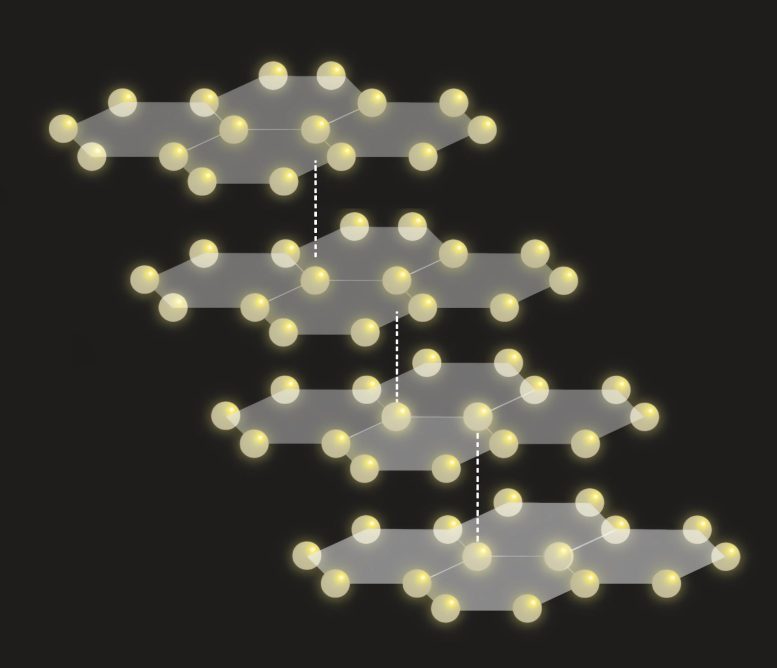
“Multilayered graphene has many promising qualities, ranging from widely tunable band structure and special optical properties to new forms of superconductivity—meaning being able to conduct electrical current without resistance,” Ghazaryan explains. “In our theoretical model, we are continuing our work on multilayer graphene and are looking at various possible arrangements of different graphene sheets on top of each other. There, we found new possibilities for creating so-called topological superconductivity.” In their study, the researchers simulated on a computer what happens when you stack a few layers of graphene sheets on top of each other in certain ways.
A Contest of Electron Beauty
“It is like a big beauty contest among the different configurations of stacked sheets of graphene to find the best one,” Serbyn adds. “In it, we are looking at how the electrons that move in the multilayer graphene behave.” Depending on how the different layers of graphene are shifted with respect to each other and on how many layers there are, the positively charged nuclear cores of the carbon atoms in the honeycomb lattice create different environments for the electrons around them. The negatively charged electrons are attracted by the nuclei and repelled by each other. “We started by investigating realistic models considering just a single electron interacting with the nuclei of the graphene. Once we found a promising approach, we added the more complicated interactions between many electrons,” Ghazaryan explains. With this approach, the researchers confirmed the occurrence of the exotic form of topological superconductivity.
Looking for Nature’s Feedback
This kind of theoretical research lays the foundations for future experiments that will create the simulated graphene systems in a laboratory to see if they really behave as predicted. “Our work helps the experimentalists to design new setups without having to try out every configuration of graphene layers,” Ghazaryan says. “Now, theoretical research will continue while experiments will give us feedback from nature.”
While graphene has slowly found applications in research and technologies—for example as carbon nanotubes—its potential as a topological superconductor for electricity is just starting to be understood. Serbyn adds, “We hope to one day be able to fully describe this kind of material on a quantum mechanical level, both for the inherent value of scientific inquiry into the fundamental characteristics of matter and the many potential applications of graphene.”
Reference: “Multilayer graphenes as a platform for interaction-driven physics and topological superconductivity” by Areg Ghazaryan, Tobias Holder, Erez Berg and Maksym Serbyn, 2 March 2023, Physical Review B.
DOI: 10.1103/PhysRevB.107.104502
This research was supported by the European Research Council (ERC) under grant HQMAT (Grant Agreement No. 817799), by the Israel-USA Binational Science Foundation (BSF), and by a research grant from Irving and Cherna Moskowitz.
Never miss a breakthrough: Join the SciTechDaily newsletter.
Follow us on Google and Google News.