
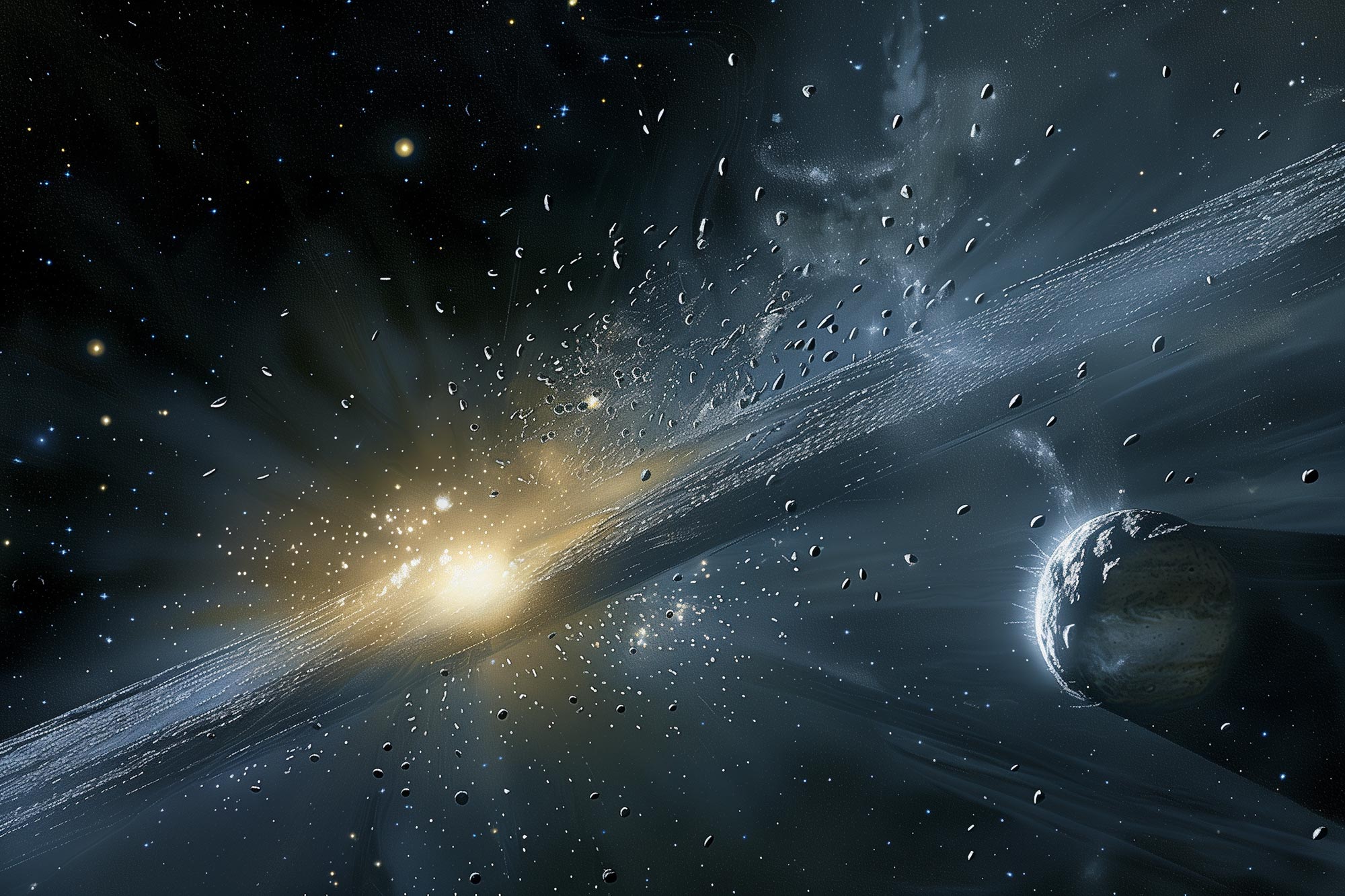
The Subaru Telescope has discovered new objects beyond the known Kuiper Belt, suggesting a more complex structure at the edge of the Solar System. This finding could reshape our understanding of planet formation and boost the search for life outside Earth.
Using the Subaru Telescope to observe the outer Solar System, astronomers have uncovered new objects in regions where none were previously expected. These newly found bodies likely belong to a much larger, yet-to-be-discovered population. This finding has significant implications for our understanding of the Solar System’s structure and history. Most notably, it suggests that the Solar System may share more similarities with other planetary systems than previously thought, which could influence the ongoing search for life beyond our Solar System.
The Subaru Telescope has been conducting observations of the outer Solar System to help support NASA’s New Horizons spacecraft, the first mission to observe the Kuiper Belt on the outer edge of the Solar System beyond Neptune while flying through it.
The Subaru Telescope has been looking for interesting Kuiper Belt Objects (KBO) for New Horizons to observe up close since before the spacecraft was launched in 2006. These ongoing observations have already discovered 263 KBOs. Among them, 11 objects lay out beyond the accepted edge of the Kuiper Belt.

Discovery of a Possible New Class of Objects
There has been mounting evidence in recent years for objects beyond the outer edge of the known Kuiper Belt, but this study is significant in that the large number of objects found in a relatively small search area can’t be dismissed as flukes or false positives. The 11 objects discovered this time appear to represent a new class of objects orbiting in a “ring” separated from the known Kuiper Belt by an empty “gap” where very few objects are found. This kind of ring and gap structure has been well documented on the outskirts of many nascent planetary systems observed by the ALMA (Atacama Large Millimeter/submillimeter Array) radio telescope array in Chile.
Dr. Fumi Yoshida (University of Occupational and Environmental Health Sciences; Planetary Exploration Research Center, Chiba Institute of Technology) comments on the possibility of a second ring of KBOs beyond the known one, “If this is confirmed, it would be a major discovery. The primordial solar nebula was much larger than previously thought, and this may have implications for studying the planet formation process in our Solar System.”

Dr. Wes Fraser of the National Research Council of Canada, a co-investigator on the New Horizons mission science team and the study’s lead author, explains, “Our Solar System’s Kuiper Belt long appeared to be very small in comparison with many other planetary systems, but our results suggest that idea might just have arisen due to an observational bias.” He adds, “So maybe, if this result is confirmed, our Kuiper Belt isn’t all that small and unusual after all compared to those around other stars.”
Broader Impact on the Search for Life
Our search for life in the Universe is hindered by the fact that we have only one confirmed example of a planet where life arose: Earth in the Solar System. With only one example, we can not determine which idiosyncrasies were important for the appearance of life, and which were irrelevant. So anything we can do to rule out a possible prerequisite moves us closer to finding the true prerequisites for life.
If it is confirmed that the Solar System formed from a solar nebula that was much larger, and therefore much less unusual than we thought, it not only eliminates “small parent nebula” from the list of possible prerequisites, it greatly increases the possibilities of finding another planetary system that meets all of the true prerequisites for life, thus increasing the probability of finding alien life.
Groundbreaking Discovery and Future Prospects
New Horizons mission Principal Investigator Dr. Alan Stern says, “This is a groundbreaking discovery revealing something unexpected, new, and exciting in the distant reaches of the Solar System; this discovery probably would not have been possible without the world-class capabilities of Subaru Telescope.”
The number and distribution of objects at the edge of the Solar System is a question for future study. But at the very least, the Subaru Telescope’s results indicate that new discoveries await in what was thought to be a cold, empty, boring void beyond the known Kuiper Belt.
Reference: “The New Horizons Extended Mission Target: Arrokoth Search and Discovery” by Marc W. Buie, John R. Spencer, Simon B. Porter, Susan D. Benecchi, Alex H. Parker, S. Alan Stern, Michael Belton, Richard P. Binzel, David Borncamp, Francesca DeMeo, S. Fabbro, Cesar Fuentes, Hisanori Furusawa, Tetsuharu Fuse, Pamela L. Gay, Stephen Gwyn, Matthew J. Holman, H. Karoji, J. J. Kavelaars, Daisuke Kinoshita, Satoshi Miyazaki, Matt Mountain, Keith S. Noll, David J. Osip, Jean-Marc Petit, Neill I. Reid, Scott S. Sheppard, Mark Showalter, Andrew J. Steffl, Ray E. Sterner, Akito Tajitsu, David J. Tholen, David E. Trilling, Harold A. Weaver, Anne J. Verbiscer, Lawrence H. Wasserman, Takuji Yamashita, Toshifumi Yanagisawa, Fumi Yoshida and Amanda M. Zangari, 11 September 2024, The Planetary Science Journal.
DOI: 10.3847/PSJ/ad676d
Never miss a breakthrough: Join the SciTechDaily newsletter.
Follow us on Google and Google News.
7 Comments
The solar system has had a strange history. There are few people who know the exact history of this system. As far as I know, the existence of life and the revival of life on earth is very, very complicated. I said before that if the earth had been next to the sun from the beginning of its formation, all the noble substances would have been destroyed in oxygen. The earth experienced life next to the stars for a few times until it finally came to be next to the sun
this is good news for scientist dreamers.i hope one day i meet you.
Here we go again. Edge of our solar system reveals by telescope
Structures. Big deal! What brilliant mind concludes they are a source of planet formation? Immediately, one throws out the creator in favor of random happenstance and left over rubble drift.
Well, there’s not much evidence for a creator now is there? At least, considerably less than the rubble we found at the edge of deep space.
” Immediately, one throws out the creator ”
🤣🙃🤣🙃
Who or what created the creator?
Why couldn’t a Creator have used this method to create planets? God is the greatest mathematician and the greatest physicist. He created the laws and the elements and use them as he saw fit!