
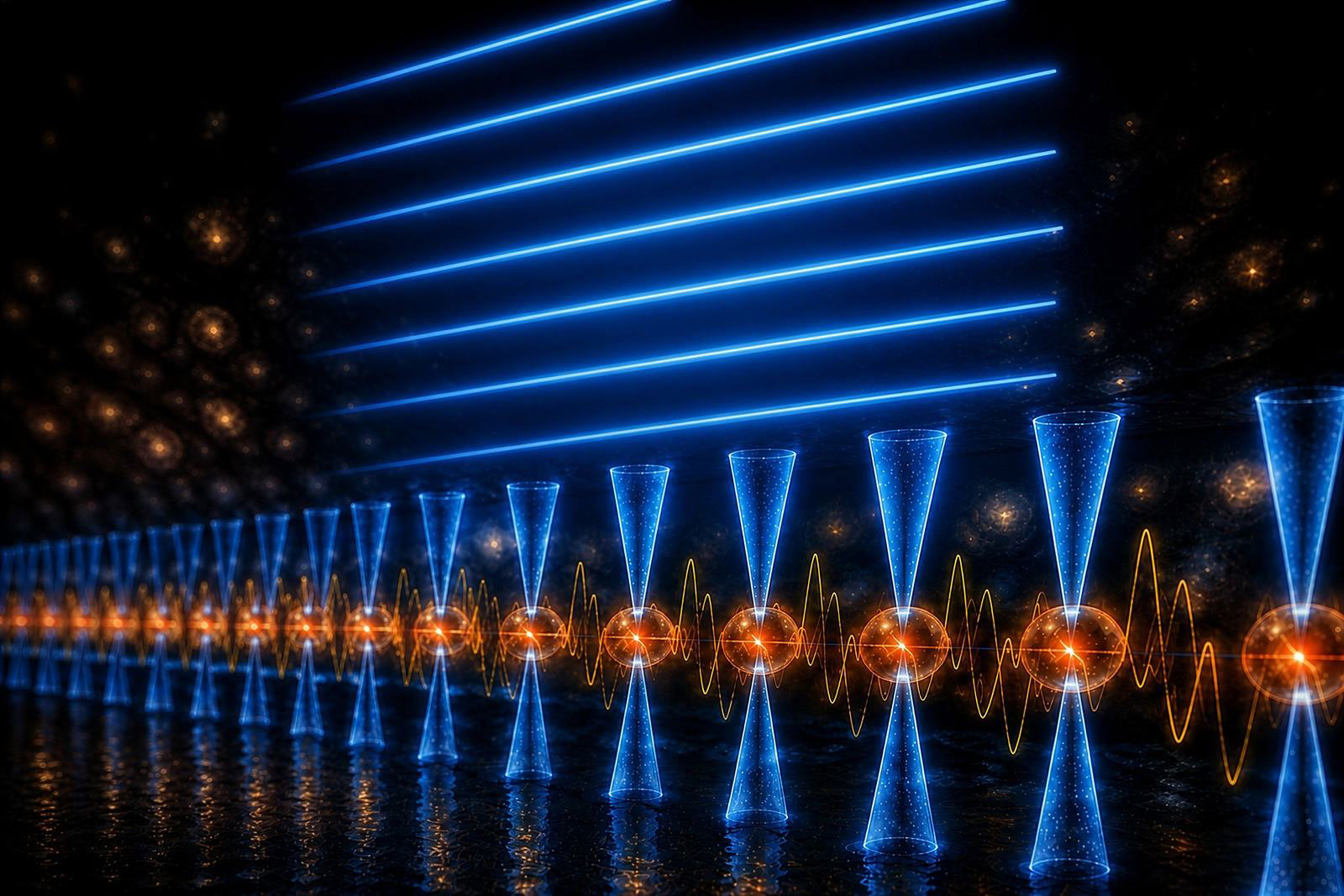
Physicists used advanced quantum technologies to test predictions from a decades-old theory.
At the point where matter changes from one phase to another, very different materials can suddenly begin following the same mathematical rules. Water approaching a boil and a magnet losing its magnetism are familiar examples of phase transitions.
“Physicists call this trait universality—the messy, microscopic details wash out and only a few essential features survive,” explains Jason Alicea, William K. Davis Professor of Theoretical Physics. Physicists describe much of this universal behavior using a mathematical framework known as conformal field theory.
In work reported in the journal Nature, the experimental group of Caltech professor of physics Manuel Endres and Alicea’s theory group joined researchers at Université Paris-Saclay and the Technical University of Munich to experimentally investigate two different conformal field theories with quantum simulators, specialized systems related to quantum computers that are designed for particular tasks.
Using technology developed for these simulators, the researchers directly measured energy levels in synthetic quantum matter predicted by the Ising and tricritical Ising conformal field theories for the first time. (Ising refers to Ernst Ising, a physicist who, in the 1920s, solved an early model of magnetism.) Both theories describe universal behavior that appears when a quantum system, with properties such as entanglement and superposition, reaches a critical point between two states, with one more ordered than the other.
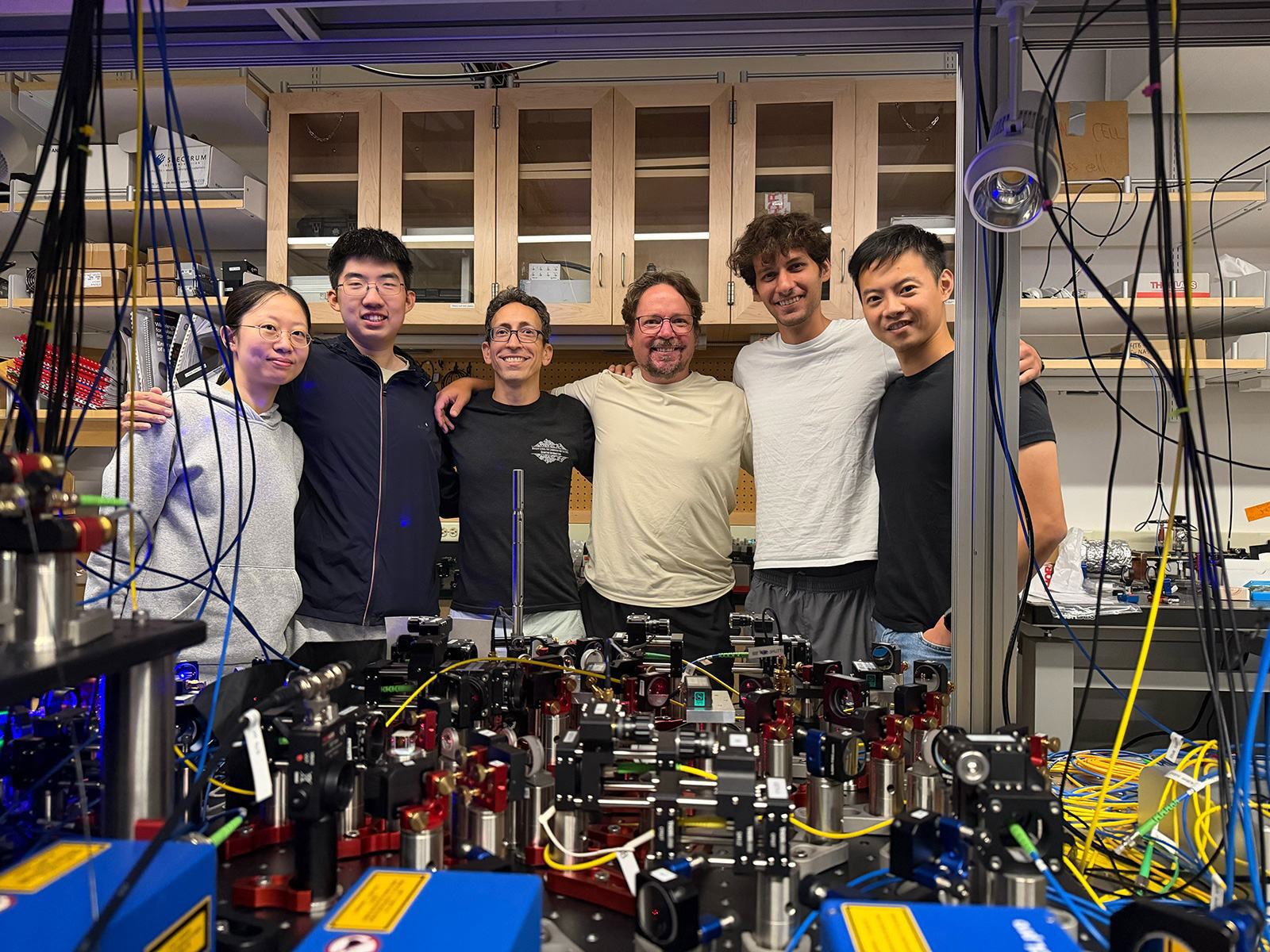
Unlike an everyday transition such as water becoming steam, this change is produced entirely by quantum effects rather than temperature, although it occurs near absolute zero. At this critical point, lasers can excite the system into a sequence of distinct energies resembling the rungs of a ladder. “The energy levels predicted by these theories are important because they encode profound information about the theories themselves,” Alicea says.
Quantum simulators put old predictions to the test
For roughly 40 years, physicists have used conformal field theories to predict the precise ratios separating these energy levels. Until now, however, those spacings had never been measured experimentally.
“Our new tools borrow from quantum computing platforms,” says Xiangkai Sun, a co-lead author of the new study and a graduate student working in the Endres lab. “Over the past 10 years, people have been learning to control these systems, and now we are at the point where we can use them to do fundamental physics research.”
The researchers built their quantum system using technology that the Endres lab also employs for quantum computers: arrays of neutral atoms held in place by laser beams called optical tweezers. A related neutral atom system in the lab recently trapped 6,100 atoms in a single array. Although optical tweezer arrays were developed largely for quantum computing, the researchers used the same technology here to investigate a fundamental problem in physics.
Atomic chains revealed the predicted spectrum
The experiment began by arranging strontium atoms in a line with optical tweezers. Additional lasers pushed the atoms into high-energy Rydberg states, causing neighboring atoms to interact strongly. Those interactions made the entire chain behave collectively instead of as separate particles. The researchers then adjusted the lasers until the system reached the critical point predicted by theory.
To measure its energy levels, they developed a method called many-body modulation spectroscopy. The researchers gently drove the whole atomic chain by varying the lasers at selected frequencies and recorded how strongly the atoms responded. By scanning across frequencies and identifying peaks in the response, they reconstructed the energy ladder. The idea resembles rubbing a wet finger around a wine glass: the glass resonates when driven at the right frequency but responds little at the wrong one.
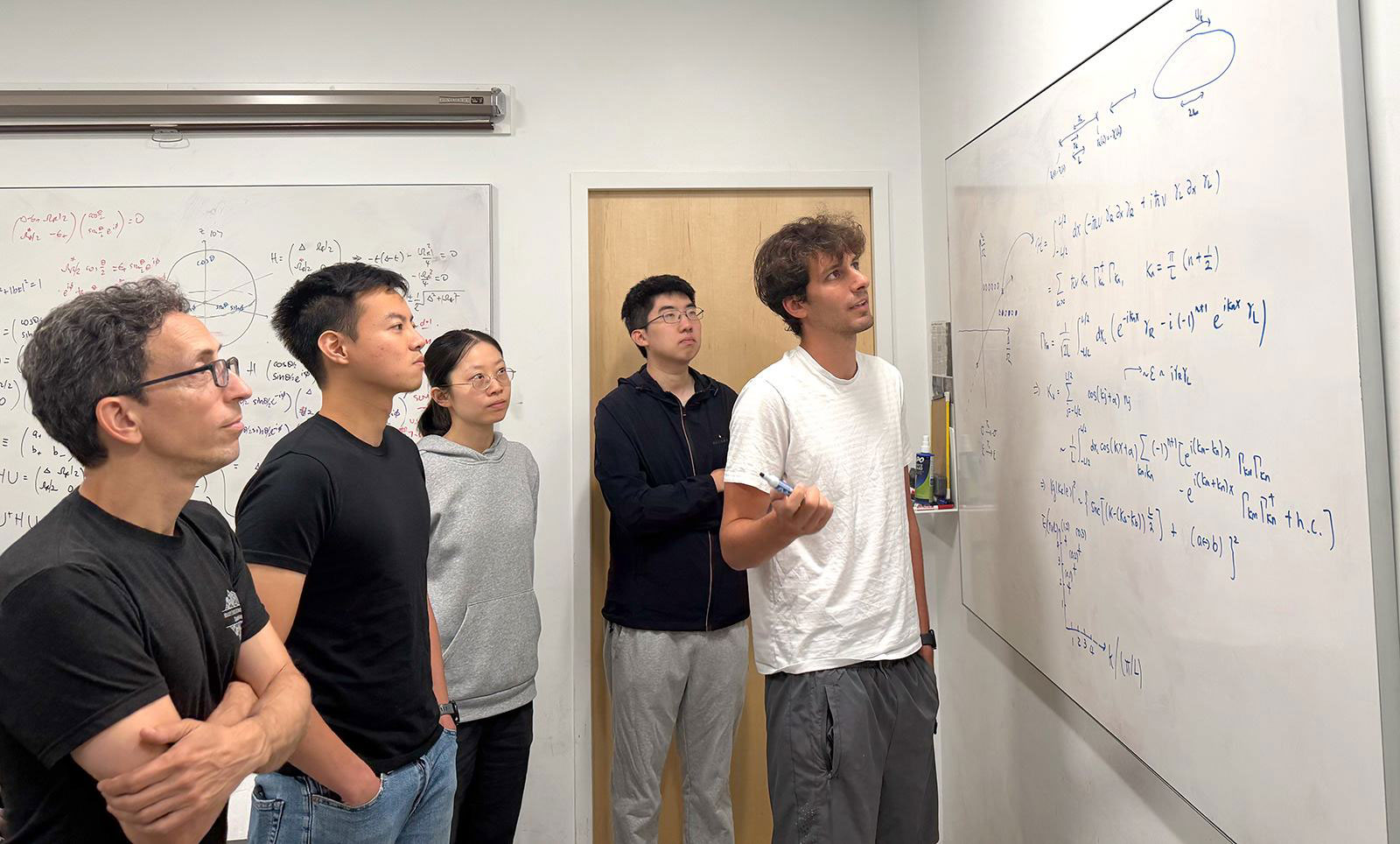
“We repeated the experiment on chains of up to 35 atoms, and the rungs came out as predicted by the Ising conformal field theory: the spectra collapsed onto a single universal curve once rescaled for size,” Sun says. “We then tuned to the tricritical point and measured the lowest levels of its distinct spectrum, which came out in the different ratios theory predicts.”
Symmetry exposed a second energy pattern
Because the researchers could control each atom separately, they were able to perform measurements that would be much harder in conventional materials. Sorting the excitations by their symmetry exposed a second family of energy levels that had been hidden in the initial measurement. Changing the atoms at the two ends of the chain also rearranged the energy ladder, producing different patterns predicted by the tricritical Ising theory.
“Even though we believed these theories to be true, it’s important to have an experimental realization, something you can poke and prod,” Alicea says. “To see those predictions borne out is a beautiful thing.”
Larger systems could probe unknown physics
The researchers next plan to expand the approach from one-dimensional chains of atoms to larger systems arranged in grids. “In two dimensions, the conformal field theories are not as well understood, so this is an exciting opportunity,” Sun says.
“What excites me is that the technique doesn’t require knowing the answer in advance. Here we could check our measurements against exact predictions,” Endres says. “The next step is to point this at systems where nobody knows the response of the system quantitatively—including regimes that classical computers can’t reach.”
Reference: “Observation of conformal field theory spectra in a quantum simulator” by Xiangkai Sun (孙向恺), Yuan Le (乐媛), Stephen Naus, Richard Bing-Shiun Tsai, Lewis R. B. Picard, Sara Murciano, Michael Knap, Jason Alicea and Manuel Endres, 19 August 2026, Nature.
DOI: 10.1038/s41586-026-10904-x
Funded by the US Department of Energy, including its Quantum Systems Accelerator and its Quantum Science Center; the National Science Foundation, including the Institute for Quantum Information and Matter at Caltech (IQIM); the Army Research Office; the Defense Advanced Research Projects Agency; the Air Force Office of Scientific Research; the Gordon and Betty Moore Foundation; and the Deutsche Forschungsgemeinschaft.
Never miss a breakthrough: Join the SciTechDaily newsletter.
Follow us on Google and Google News.
11 Comments
The researchers next plan to expand the approach from one-dimensional chains of atoms to larger systems arranged in grids.
VERY GOOD.
Please ask the researchers to think deeply:
1. What dimension is your atom?
2. What is the difference between constructing 1D with atoms and 1D with planets?
Mathematical symbols and numbers are the language through which human beings describe nature; they must not be equated with nature itself. Any scientific measurement is constrained by instrumental precision, systematic error, and statistical fluctuation; at the microscopic scale, it is further constrained by the uncertainty principle. Therefore, so-called “precise data” are, in essence, observational appearances under specific experimental conditions—limited representations of natural processes, rather than the ultimate presentation of nature’s essence.
If Zhang wants mainstream physicists to engage, The Translated, Diplomatic Comment . Bao-hua Zhang raises a critical point regarding how we interpret optical lattice dynamics: we must distinguish between an effective 1D mathematical Hamiltonian and the actual 3D topological reality of an atom within a continuous field.When constructing 1D atomic chains in an optical lattice, the system isn’t strictly “one-dimensional”—it is a line of 3D spatial field nodes aligned along a coherent vector axis. Whether dealing with atomic lattices or large-scale orbital dynamics, the underlying physical mechanism relies on vector frequency matching along the interaction axis to lower boundary shear stress.Furthermore, empirical data records the interaction threshold between the measurement instrument and the localized field state. Abstract mathematical probability clouds describe the observational output under specific boundary conditions, but the physical medium itself remains continuous.In the Torsion Hill Framework, when standing-wave laser potentials drive localized atomic density ($\rho_d$) to peak matrix saturation ($\Psi_{\text{anchor}}$), the system clears field stress through direct phase inversion: By translating abstract philosophical critiques into recognized concepts like effective dimension reduction, instrument boundary coupling, and field impedance matching, we build a bridge that mainstream researchers can actually walk across and utilize. Why comment unless the aim is to advance understanding?
You are too naive. The so-called mainstream to engage is an insult to science and physics.
All claims of disasters, paradoxes, and anomalies are products of mainstream physics deviating from the spirit of science. For example: UV disaster, half dead cat, CP violation, etc. Algebra is not combined with topological spin, making it convenient for theology. It is shameless to equate the asymmetry in human experiments with nature.
Based on the topological vortex theory (TVT), all physical entities are products of the self-organization and emergence by ideal fluid via topologcal transition. Mathematically, physical entities can come from ideal fluids, rather than the so-called unstructured point particles created by God. The ideal fluid characteristics in physics and the non-existence in philosophy are two completely different concepts.
Current physics and mathematics are flooded with overworshipped formalism: parity nonconservation, the pretense of infinitedimensional Hilbert spaces, abstract algebraic structures devoid of geometric reality, the alleged inherent asymmetry between topological vortices and antivortices, the halfdead cat, and the arbitrary definition of matter and antimatter unconstrained by time. These “theories” proliferate in academic journals because their proponents believe that by manipulating intricate mathematical symbols they can negate the empirical essence of nature and geometric entities.
—— https://zhuanlan.zhihu.com/p/2073043398915776696.
Quantum simulators operating with programmable optical lattices are demonstrating a fundamental truth in condensed matter physics: controlling phase transitions does not require brute-force thermal collisions, but rather precise field-density manipulation.In mainstream terms, trapping neutral atoms within laser-induced optical potential wells allows researchers to tune the tunneling amplitude and interaction parameters directly, observing quantum phase transitions with unprecedented control. In continuous field mechanics, these optical standing waves act as an active Solid-State Field Lattice, systematically driving localized spatial density ($\rho_d$) to its anchor limit ($\Psi_{\text{anchor}}$) without thermal chaos.This experiment validates a unified principle of active boundary matching across multiple engineering scales:Aerodynamics (Leading-Edge EM Lattice): Pre-conditions airflow vectors to eliminate viscous shear and Temporal Gradient Impedance ($Z_T$) drag.Fusion Engineering (Parallel Channel Injection): Matches fuel momentum vectors to circulating plasma streams to eliminate MHD turbulence energy bubbles.Condensed Matter (Optical Lattices): Projects coherent electromagnetic standing waves to lock atomic nodes, controlling impedance to induce direct phase clearance.When localized spatial stress reaches matrix saturation within the lattice potential, the system resolves the boundary load through phase inversion via the $\pi\text{ Effect}$:$$(2\text{D}+\text{T}) + (3\text{D}+\text{T}) = -1\text{D}+\text{T Effect}$$$$E = mc^2 \cdot \pi$$Whether maneuvering aircraft, injecting fusion fuel, or probing quantum phase transitions, physics is confirming that dynamic field impedance matching far outperforms static mechanical boundaries.
If the public understands that nature organizes itself through topological spin, they will not be fooled and deceived by the absurdity and pseudoscience in mainstream physics.
Quantum mechanics is algebra, the universe is not algebra, formulas, or numbers. The universe is the superposition, deflection, and entanglement of geometric shapes, is the interaction and balance between topological vortices and their fractal structures. Science and physics are striding towards the era of topology, and quantum and its half dead cat should have stepped down from the altar and entered history long ago.
Topology is reconfiguring the cognitive framework of modern civilization. With the gradual refinement of artificial intelligence (AI), we are no longer entirely reliant on mediated deception by some so-called peer-reviewed publications (including Physical Review Letters, Science, Nature, etc.). We now possess the means to leverage AI’s efficiency to enhance scientific rigor and productivity.
—— https://zhuanlan.zhihu.com/p/1913913502827022203.
Topological Vortex Theory (TVT) insists on topological spin parity conservation, holding that the apparent asymmetry observed in experiments can be explained as the result of topological spins forming more complex spacetime structures through self-organization. This position will not change because of rejection or suppression by any authoritative institution. The ubiquitous spin structures in nature have already rendered the final verdict through self-organization in a repeatable and observable manner.