
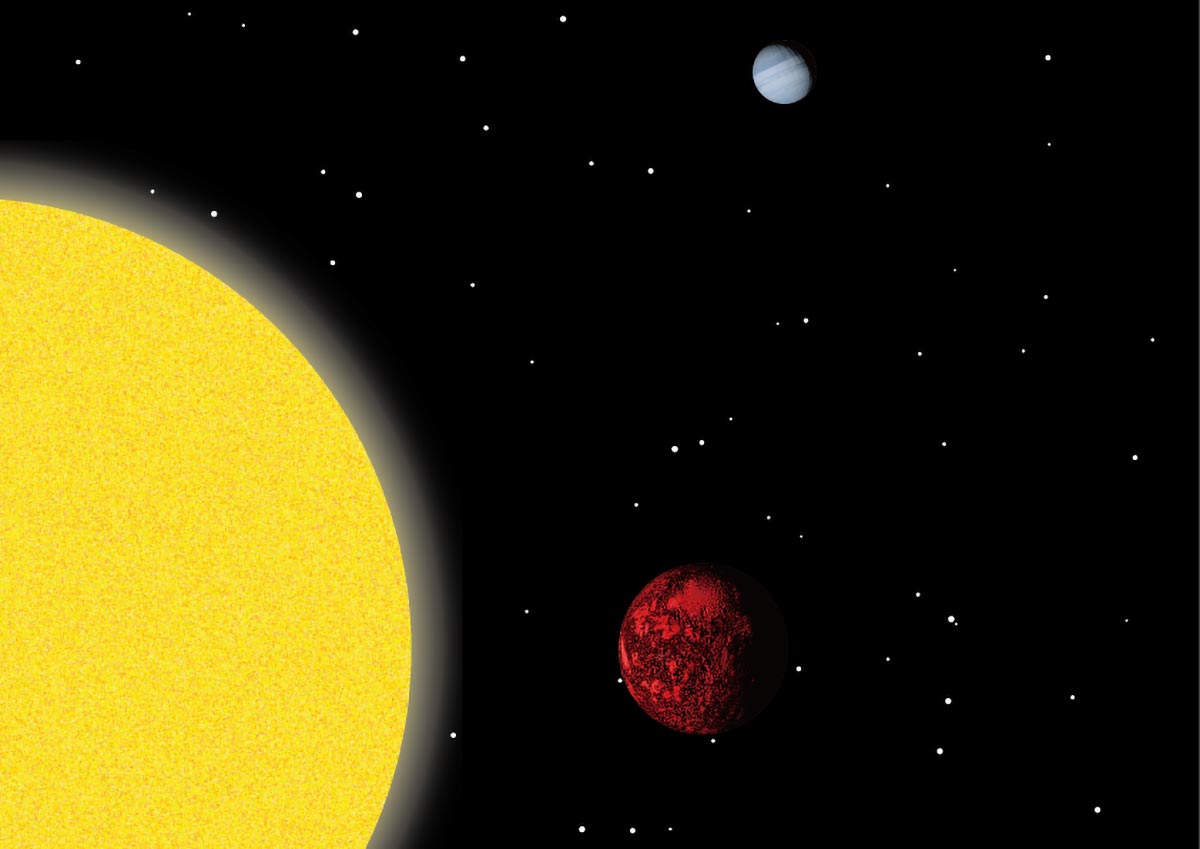
The K2-360 system features a record-dense “super-Earth” and a massive outer planet, revealing insights into extreme planetary evolution.
An international research team, led by scientists from Japan and Europe, has identified a new multi-planet system orbiting a Sun-like star. Among the discoveries is an ultra-short period planet with one of the highest densities ever recorded. These findings, published on November 8 in Nature Scientific Reports, provide fresh insights into how planets form and evolve under extreme conditions.
The system, designated K2-360, is located approximately 750 light-years from Earth and features two planets orbiting a Sun-like star:
- K2-360 b: A rocky “super-Earth” that is about 1.6 times the size of Earth and completes an orbit around its star in just 21 hours. With a mass 7.7 times that of Earth, it is the densest well-characterized ultra-short period planet discovered to date.
- K2-360 c: A larger outer planet with a minimum mass of 15 Earth masses. This planet orbits its star every 9.8 days but does not transit, making its exact size uncertain.
“K2-360 b is truly remarkable – it’s as dense as lead, packing nearly 8 Earth masses into a ball only slightly larger than our planet,” says John Livingston, lead author of the study from the Astrobiology Center in Tokyo, Japan. “This makes it the densest known planet among the class of ‘ultra-short period’ planets [with precise parameters], which orbit their stars in less than a day.”
Observations and Findings
The discovery was made possible by NASA’s K2 mission, which first detected the inner planet transiting in front of its star in 2016. Follow-up observations with ground-based telescopes, including the HARPS and HARPS-N spectrographs, confirmed the planet’s nature and revealed the presence of the outer companion.
The extreme density of K2-360 b suggests it may be the stripped core of a once-larger planet, having lost its outer layers due to intense radiation from its nearby host star. “This planet gives us a glimpse into the possible fate of some close-in worlds, where only the dense, rocky cores remain after billions of years of evolution,” explains co-author Davide Gandolfi from the University of Turin.
The outer planet, K2-360 c, adds another layer of intrigue to the system. While not transiting its star, its gravitational pull on the host star allowed researchers to measure its minimum mass. Computer simulations suggest it may have played a crucial role in the formation and evolution of the system. While many close-in planets are thought to have migrated inward through interactions with their natal gas disk, K2-360 b likely followed a different path.
“Our dynamical models indicate that K2-360 c could have pushed the inner planet into its current tight orbit through a process called high-eccentricity migration,” says co-author Alessandro Trani from the Niels Bohr Institute. “This involves gravitational interactions that first make the inner planet’s orbit very elliptical, before tidal forces gradually circularize it close to the star. Alternatively, tidal circularization could have been induced by the spin-axial tilt of the planet.”
Composition and Structure of K2-360 b
The team’s analysis suggests that K2-360 b has an iron-rich, rocky composition more similar to Earth than Mercury. Using models based on the observed chemical abundances of the host star, the researchers estimate that K2-360 b likely has a large iron core making up about 48% of its mass. This places it closer to being a “super-Earth” than a “super-Mercury,” despite its extreme density.
“Our interior structure models indicate that K2-360 b probably has a substantial iron core surrounded by a rocky mantle,” explains co-author Mahesh Herath, a PhD candidate at McGill University. “Its surface may be covered in magma due to the intense heat it receives from its star. Understanding planets like this helps us piece together how terrestrial planets form and evolve under different conditions throughout the galaxy.”
The discovery of the K2-360 system provides valuable insights into planetary system architectures and the processes that shape them. Ultra-short period planets like K2-360 b are relatively rare, and finding one with a massive outer companion helps constrain theories about their formation. “K2-360 is an excellent laboratory for studying how planets form and evolve in extreme environments,” concludes Livingston.
Reference: “An ultra-short-period super-Earth with an extremely high density and an outer companion” by John H. Livingston, Davide Gandolfi, Alessandro A. Trani, Mahesh Herath, Oscar Barragán, Artie Hatzes, Rafael Luque, Akihiko Fukui, Grzegorz Nowak, Enric Palle, Coel Hellier, Malcolm Fridlund, Jerome de Leon, Teruyuki Hirano, Norio Narita, Simon Albrecht, Fei Dai, Hans Deeg, Vincent Van Eylen, Judith Korth and Motohide Tamura, 8 November 2024, Scientific Reports.
DOI: 10.1038/s41598-024-76490-y
Funding: JSPS, KAKENHI, JST, CREST
Never miss a breakthrough: Join the SciTechDaily newsletter.
Follow us on Google and Google News.
4 Comments
Hi ,I have my own night sky photos that include what look to be organic that you mabe interested in.thank you for your information. Regards Aaron
I say if aliens exist this is a very good candidate for the Kelvin’s home world with rivers of molten lead and temperatures like the inside of ovens or surface of a Star as normal. Imagine the crystals forming.
what math is used to get “as dense as lead” from stone and rock? is a black hole in there?
correction: what math is used to get “as dense as lead” from STEEL and rock? is a black hole in there?