
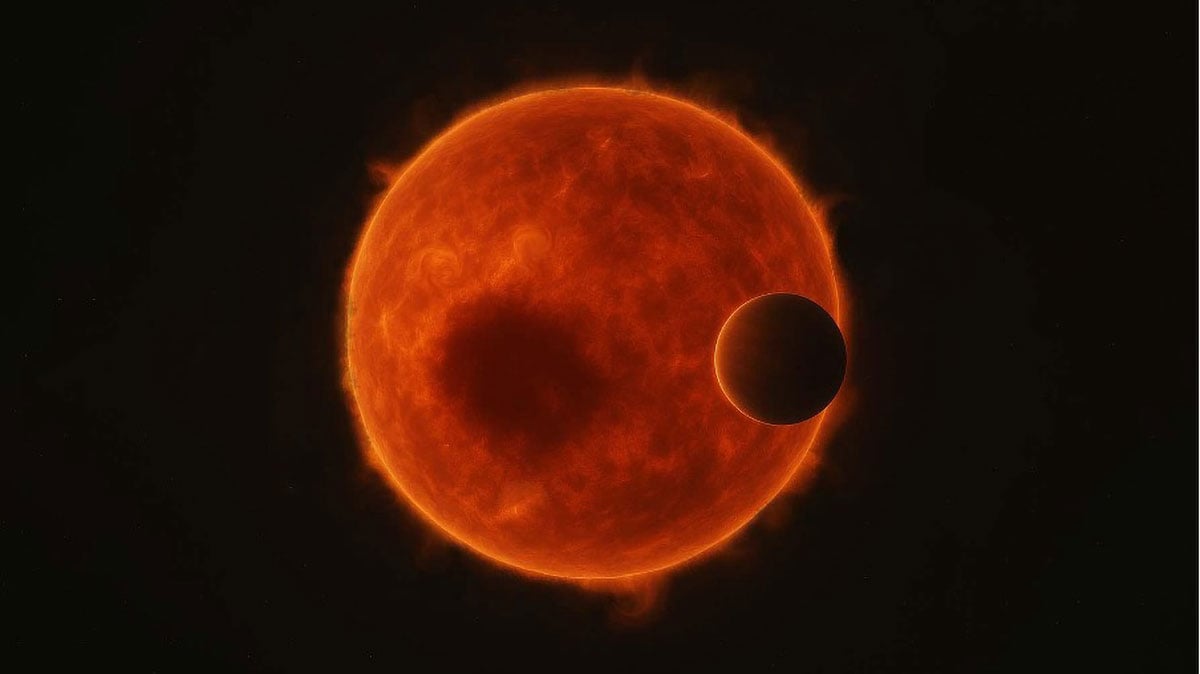
A new study of the red dwarf system TOI-3884 has uncovered rare, persistent spot-crossing signals that reveal unusually detailed information about the star’s magnetic activity and the planet’s orbital geometry.
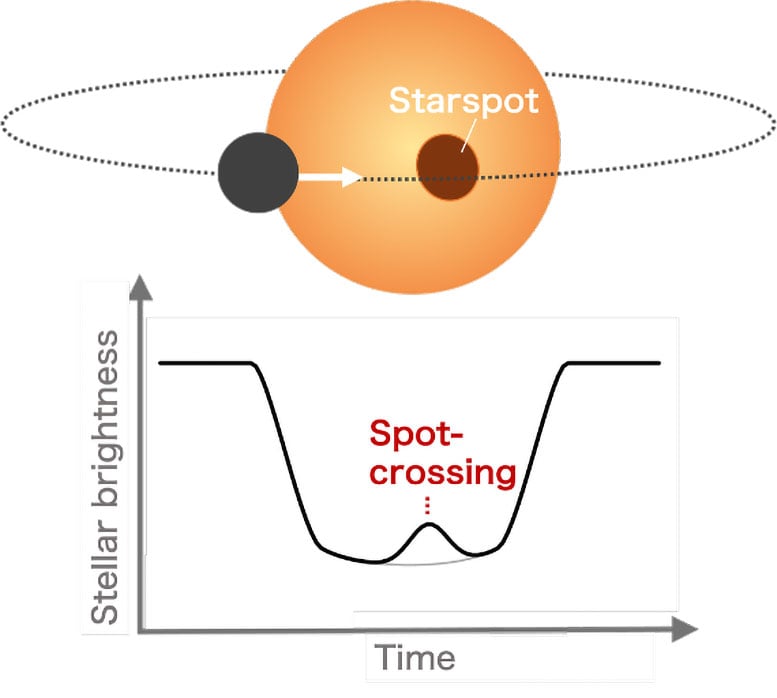
As astronomers achieve increasingly precise measurements of exoplanet atmospheres, accounting for the influence of starspots on their host stars has become essential. One of the best chances to examine these dark, cooler regions arises when a planet moves across the face of its star and passes directly over a spot, an event known as a spot-crossing transit.
A team of researchers from multiple countries, led by scientists at the Astrobiology Center (Tokyo, Japan), used a series of ground-based observations to uncover the characteristics of the starspots and the orbital layout of the TOI-3884 system.
NASA’s James Webb Space Telescope (JWST) has transformed the way scientists investigate exoplanet atmospheres. Most atmospheric studies rely on transits, the moments when a planet travels in front of its star and blocks part of its light. By examining how much light is blocked at various wavelengths, researchers can determine which atoms and molecules surround the planet.
JWST is capable of measuring extremely small differences in transit depth, down to about 0.01%. This level of detail, however, also means that features once buried in noise must now be considered carefully. Starspots, which appear as darker and cooler patches on stellar surfaces, can imitate or conceal real atmospheric signals, making it vital to understand how they affect observations.
The Unusual TOI-3884 System
TOI-3884, a red dwarf located roughly 140 light-years from Earth, hosts a planet called TOI-3884b, a “super-Neptune” with a radius about six times that of Earth. The planet’s transits repeatedly show a clear spot-crossing feature. Such consistently detectable events are unusual and offer a rare chance to investigate both the nature of the starspots and the system’s orbital structure at the same time.
Earlier analyses (Almenara et al. 2022; Libby-Roberts et al. 2023) disagreed on several important properties of the TOI-3884 system, including the star’s rotation rate and inclination. The new study set out to clarify these differences using higher quality ground-based data.
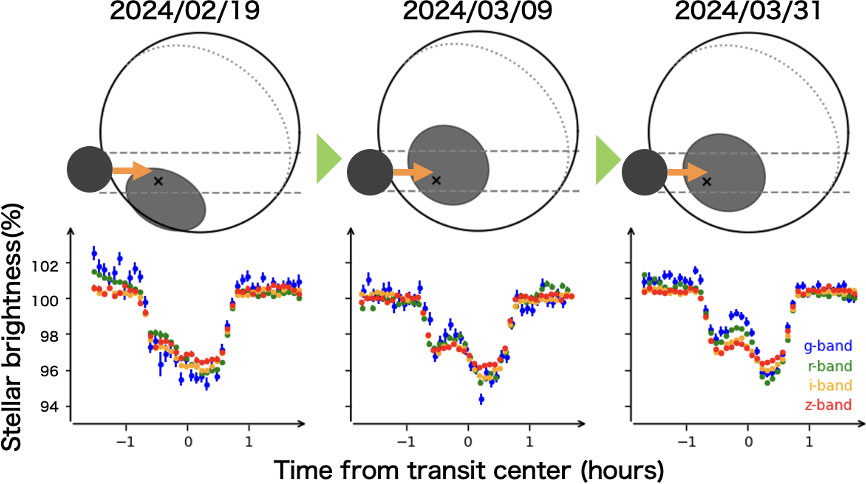
To capture the spot-crossing transits, the team used the multicolor MuSCAT3 and MuSCAT4 instruments mounted on the Las Cumbres Observatory (LCO) 2-meter telescopes. Between February and March 2024, they observed three transits and successfully detected clear spot-crossing signals. The color dependence of the signal provides critical information about starspot temperature.
Light curve analysis revealed that the starspots are about 200 K cooler than the stellar surface (3150 K) and cover roughly 15% of the visible stellar disk. Also, the three transit light curves show changes in the shape of the spot-crossing signal. Because these variations occurred over a short timescale, they are more likely caused by stellar rotation than by spot evolution.
Measuring the Star’s Rotation
To confirm this, the team carried out a photometric monitoring campaign using the global network of LCO 1-meter telescopes. From December 2024 to March 2025, they measured the star’s brightness variations several times per night and detected clear periodic fluctuations. This revealed, for the first time, that the stellar rotation period is 11.05 days.
The measured rotation period was consistent with the spot position shifts inferred from the transit observations, enabling the team to obtain a unique solution for the system geometry. They found that the stellar spin axis and the planet’s orbital axis are misaligned by about 62°, revealing that TOI-3884 is a highly tilted planetary system. Such large tilts are typically attributed to past gravitational interactions with massive planets or stellar companions—yet no such companions are known to exist, making this system particularly intriguing.
Implications for Atmospheric Studies and Stellar Magnetism
TOI-3884b is one of the prime targets for atmospheric studies with JWST and other telescopes. The detailed characterization of its starspots and orbital geometry from this study will be critical for correctly interpreting the results of atmospheric observations.
Moreover, the findings also provide new insights into stellar magnetic activity. Large polar starspots are often thought to be linked to strong magnetic fields on rapidly rotating stars. However, TOI-3884 does not rotate particularly fast, yet it still hosts a giant polar spot. This suggests that polar spots may be especially common among red dwarfs. In addition to continuing detailed observations of TOI-3884, it will also be important to deepen our understanding of the general properties of starspots.
Reference: “Multiband, Multiepoch Photometry of the Spot-crossing System TOI-3884: Refined System Geometry and Spot Properties” by Mayuko Mori, Akihiko Fukui, Teruyuki Hirano, Norio Narita, John H. Livingston, Khalid Barkaoui, Karen A. Collins, Jerome P. de Leon, Kai Ikuta, Yugo Kawai, Richard P. Schwarz, Avi Shporer and Gregor Srdoc, 8 September 2025, The Astronomical Journal.
DOI: 10.3847/1538-3881/ade2df
Never miss a breakthrough: Join the SciTechDaily newsletter.
Follow us on Google and Google News.