
A team of astronomers led by Macquarie University has monitored the orbital decay of an extreme exoplanet to gain new insights into how stars dissipate energy.
The exoplanet TOI-2109b, found 870 light-years away in the Hercules constellation of the Milky Way, stands out as one of the most extreme planets ever identified.
This massive world belongs to a rare category known as “hot Jupiters,” which are giant gas planets that orbit extremely close to their stars, heating up to intense temperatures. These types of planets are uncommon, making up only about two out of every thousand discovered.
“This is an ultra-hot Jupiter, and orbits much closer to its star than any other hot Jupiter ever discovered,” says Dr. Jaime A. Alvarado-Montes, a Macquarie Research Fellow who led the international study published on 15 July in The Astrophysical Journal.
TOI-2109b completes a full orbit around its star in just 16 hours, making its “year” one of the shortest ever recorded for a gas giant. With a mass nearly five times greater than Jupiter’s and a diameter almost twice as large, the planet orbits far closer to its star than Mercury does to our Sun.
“Just to put it into context – Mercury’s mass is almost 6000 times smaller than Jupiter, but it still takes 88 days to orbit our Sun. For a huge gas giant such as TOI-2109b to fully orbit in 16 hours – it tells us that this is a planet located super-close to its star.”
Because of its extreme location, TOI-2109b presents a rare chance to observe a phenomenon known as “orbital decay.” While this process has long been predicted by scientists, it has only been observed in a few planetary systems, making TOI-2109b an ideal subject for further study.
Tracking the Planet’s Slow Demise
By analyzing transit timing data from multiple ground-based telescopes, NASA’s TESS mission and the European Space Agency’s CHEOPS satellite spanning 2010 to 2024, the team detected subtle changes in the planet’s orbit.
Both theoretical models and observations independently calculated that the planet’s orbital period would decrease by at least 10 seconds over the next three years – confirming the planet may be spiraling towards its star.
The researchers identified three possible fates for TOI-2109b: it could be torn apart by tidal forces, plunge directly into its star, or have its gaseous envelope stripped away by intense radiation, leaving only a rocky core.
In the first scenario, as the planet approaches the Roche limit – the point where ‘tidal forces’ between planet and star overcome the planet’s own gravity – it will be literally torn apart.
The second possibility is even more dramatic. If orbital decay accelerates, the planet could plunge directly into its star. “The star will absorb it and kill it, of course, in the process – completely burn it, and the planet will disappear,” says Dr. Alvarado-Montes.
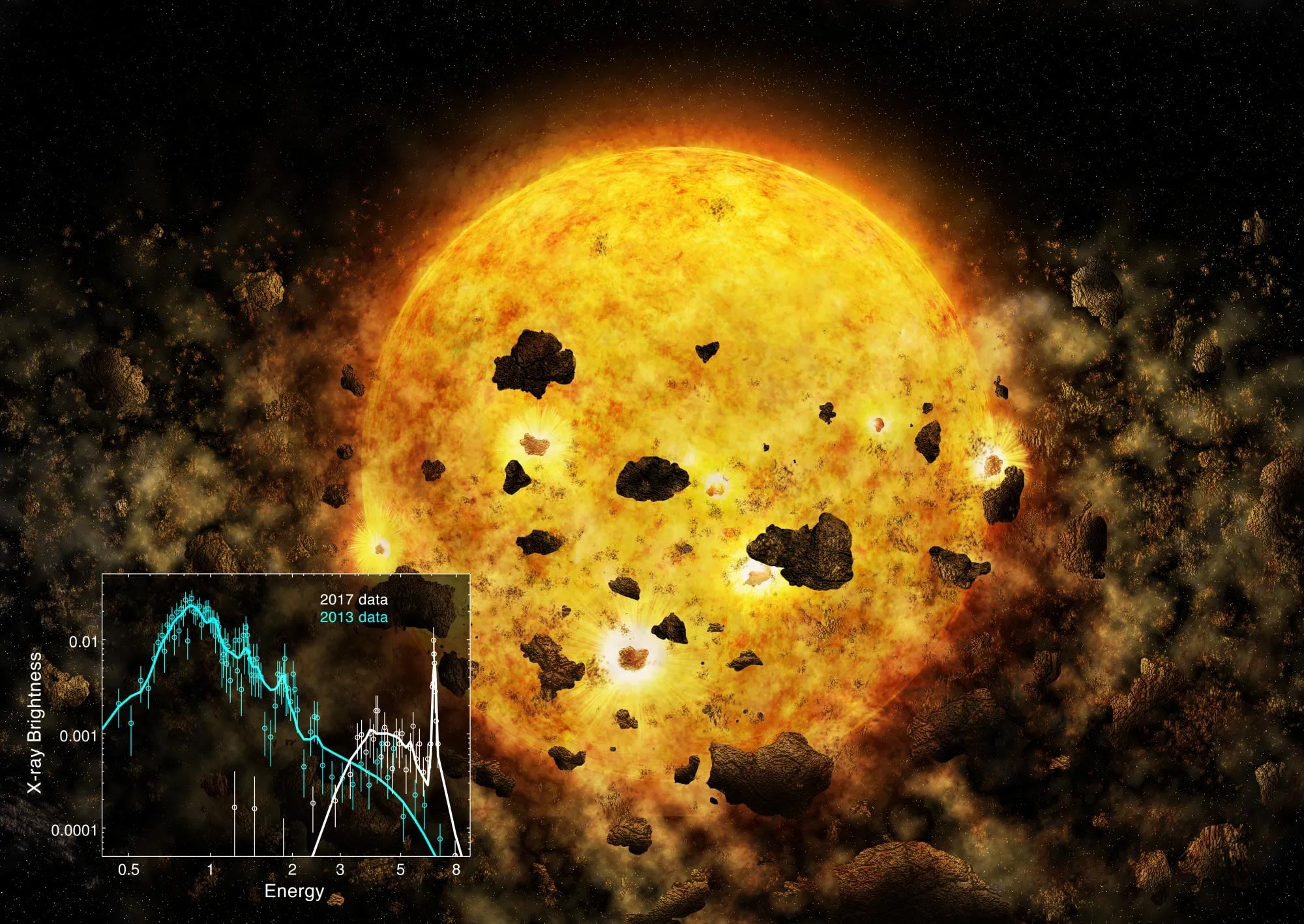
Such an event would create a detectable flash, similar to or bigger than the one observed in 2020, when a rocky planet was consumed by its host star.
The third scenario offers an unexpected twist. The intense stellar radiation could strip away the planet’s gaseous envelope through a process called photoevaporation, leaving only its rocky core.
“This planet and its interesting situation could help us figure out some mysterious astronomical phenomena that so far we really don’t have much evidence to explain,” Dr. Alvarado-Montes says. “It could tell us the story of many other solar systems.”
The findings suggest some rocky planets in other solar systems might be the stripped cores of former gas giants – a possibility that could reshape our understanding of planetary evolution.
With continued monitoring over the next three to five years, astronomers will detect the predicted orbital changes, providing real-time observation of a planetary system in its death throes.
Reference: “Orbital Decay of the Ultra-hot Jupiter TOI-2109b: Tidal Constraints and Transit-timing Analysis” by Jaime A. Alvarado-Montes, Mario Sucerquia, Jorge I. Zuluaga and Christian Schwab, 15 July 2025, The Astrophysical Journal.
DOI: 10.3847/1538-4357/ade057
Funding: European Union Horizon Europe research and innovation program, Minciencias, NASA Exoplanet Science Institute
Never miss a breakthrough: Join the SciTechDaily newsletter.
Follow us on Google and Google News.