
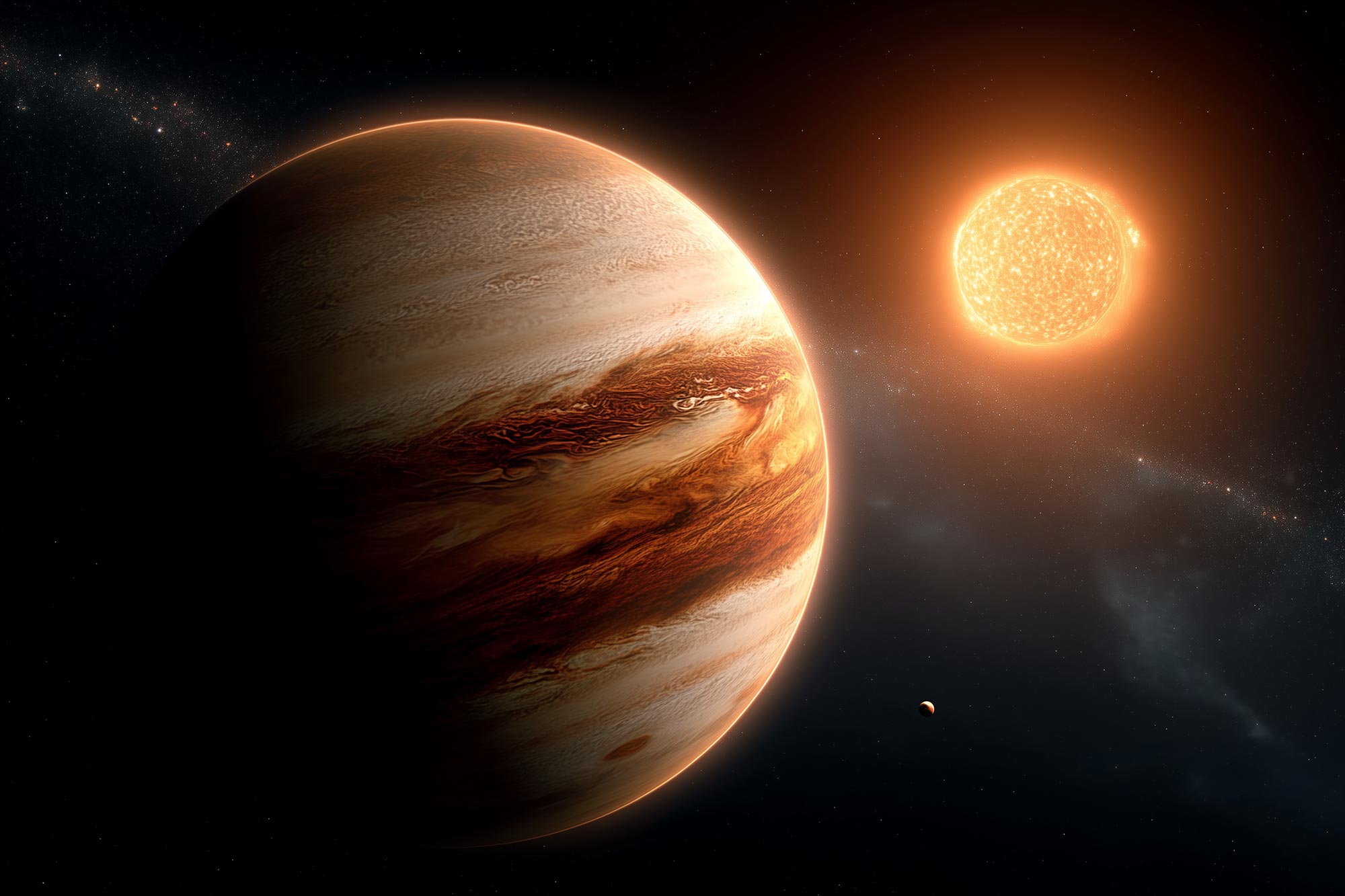
Researchers are studying eccentric warm Jupiters, giant exoplanets that follow odd, elongated orbits unlike anything in our solar system.
These strange worlds seem to obey rules no existing model can explain. By collecting new data and developing advanced simulations, scientists hope to uncover how such planets form, and what their behavior might reveal about the birth of our own solar system.
Investigating Eccentric Warm Jupiters
What do scientists do when they encounter an unexpected cosmic mystery, a collection of data from planets thousands of light-years away, and theories that fail to explain what they see?
For an astronomer at Northern Arizona University’s Department of Astronomy and Planetary Science, the solution is straightforward: create better models.
Backed by the National Science Foundation and working with colleagues at Indiana University Bloomington, he is leading a three-year research project focused on understanding eccentric warm Jupiters. These are giant gas planets located beyond our solar system that follow unusually stretched orbits around their stars.
By the time the project concludes in 2028, the goal is to uncover not only how these strange planets formed but also whether the same processes could have influenced the birth of our own solar system.
Exploring Planetary Extremes: How Unique Are We?
“The variability of extrasolar planets is just enormous,” Muñoz said. “Extrasolar systems can look like our solar system, but in some cases, they look entirely different and exotic. We’re very interested in seeing how the solar system forms in context by understanding systems that look like ours and ones that look completely different. We can get a sense of what the extremes are, how average our planet formation history is and how average our solar system is.”
Among the most intriguing examples of these extreme planetary systems are those that contain eccentric warm Jupiters.
For years, scientists thought warm Jupiters formed the same way as their better-known counterparts, the hot Jupiters, which share similar size and mass but orbit much closer to their stars. As technology advanced and telescope data became more precise, however, astronomers began to realize that warm Jupiters might have far more complicated and unique origins.
Challenging Old Models With New Data
While hot Jupiters can orbit their stars in almost any orientation, warm Jupiters are almost universally aligned with their hosts’ equators. Data also suggest that the more eccentric, or oval-shaped, a warm Jupiter’s orbit, the more aligned it is with its star, a phenomenon no existing model of planet formation could have predicted.
Muñoz hopes to change that by building a small but growing sample of eccentric warm Jupiters using NASA’s Transiting Exoplanet Survey Satellite and basing new models and existing model updates on what he finds.
“The data tells us that warm Jupiters are not just the tail end of hot Jupiters,” Muñoz said. “It tells us they may have a different history. We need to understand if this is just a quirk—if these are pathological cases that happen maybe once every million cases—or if there is an additional physical process that we have ignored in the past that we might be able to unveil.”
Seeking Clues to Our Own Solar Origins
Knowing what processes are at work during an eccentric warm Jupiter’s formation could help astronomers uncover hidden truths about our solar system’s evolution and the creation of countless others just like it. But before diving into the implications, Muñoz has to interrogate multiple hypotheses until he can find one that is practical and plausible.
One possibility is that these eccentric warm Jupiters have companion planets that somehow alter their orbits without misaligning them relative to their stars’ equator. Having varying eccentricities and varying inclinations simultaneously is well understood from a modeling perspective, but having one and not the other is not as easily explained.
Another concerns the gaseous nebulae in which the planets and their stars formed. Muñoz reasons that these planets could have interacted with their surroundings in ways astronomers could never have anticipated as they were developing. Discoveries of this nature could permanently change the way astronomers map planet formation.
Last, and Muñoz’s favorite, is the idea that the stars in these systems are responsible. Because stars are fluid bodies, they can develop internal waves that can sometimes crash and extract energy from a planet’s orbit in peculiar ways. He said it’s mathematically feasible that these waves could also be the reason warm Jupiters align so closely with their host stars’ equators.
Modeling the Mystery: Creativity Meets Computation
The answer to which theory is correct, as of now, is a mystery, but it’s one Muñoz will be hard at work solving with myriad modeling techniques.
“I’m a theorist, so I work on models using heavy-duty computers, pencil-and-paper calculations and anything in between,” Muñoz said. “We don’t have a model that predicted this to begin with, so we’re going to go crazy and dive into the most creative ways we can think about this problem. But once you have a mathematical model, that is just the beginning.”
Next year, Muñoz will hire a graduate student who excels in creative puzzle solving to assist him throughout his modeling study. In the meantime, he said his research into his host star hypothesis has been promising, and he hopes to publish his findings in the near future.
Never miss a breakthrough: Join the SciTechDaily newsletter.
Follow us on Google and Google News.