
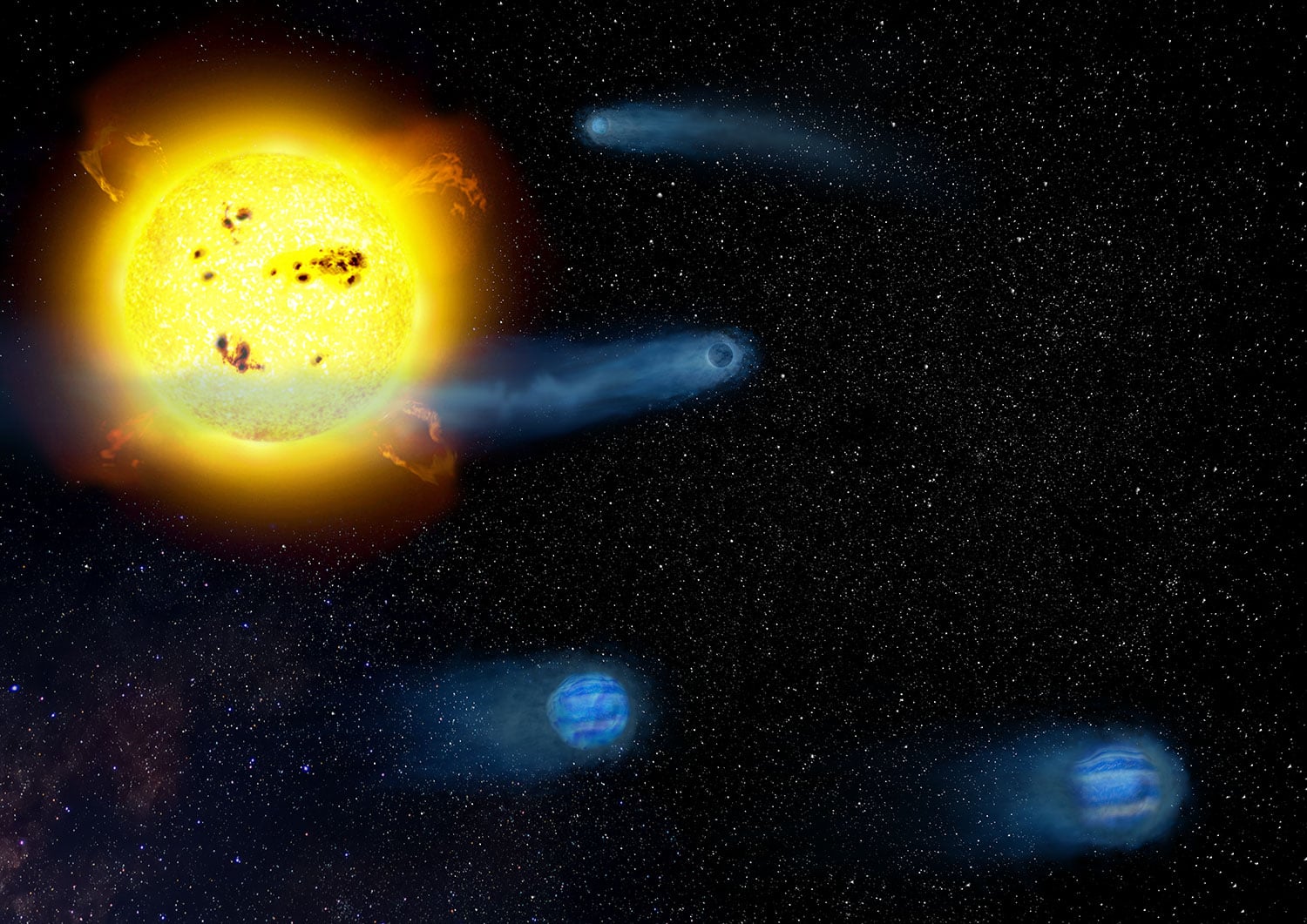
Astronomers have captured an exceptionally rare view of young planets in mid-transformation, revealing how bloated, giant worlds may shrink into the most common planets in the galaxy.
Astronomers have been startled in recent years by a striking pattern around Sun-like stars. Many of them host a planet that falls between Earth and Neptune in size, and it orbits closer to its star than Mercury orbits the Sun. Our own solar system has no worlds with this combination of sizes and tight orbits.
These objects, known as ‘super-Earths and sub-Neptunes,’ turn out to be the most common planets in the galaxy, yet how they form has remained uncertain.
A new study offers an important clue. An international research team has identified what they call a missing link by measuring the masses of four very young planets in the V1298 Tau system. Those measurements provide a rare look at planets that appear to be in the middle of changing into the same kinds of worlds that dominate planetary systems across the Milky Way.
“What’s so exciting is that we’re seeing a preview of what will become a very normal planetary system,” says John Livingston, the study’s lead author from the Astrobiology Center in Tokyo, Japan. “The four planets we studied will likely contract into ‘super-Earths’ and ‘sub-Neptunes’—the most common types of planets in our galaxy, but we’ve never had such a clear picture of them in their formative years.”
A Young Star and an Ancient Mystery
The team centered its work on V1298 Tau, a star that is only about 20 million years old, far younger than our 4.5-billion-year-old Sun. Four large planets circle this energetic star, each ranging in size from Neptune to Jupiter. Because the system is so young, the planets are likely being observed during a short-lived period when they can change quickly. Researchers think V1298 Tau may represent an early stage of the compact, multi-planet systems commonly found elsewhere in the galaxy. In that sense, the system serves as a kind of key for interpreting how the galaxy’s most common planets emerge.
To determine the planets’ masses, the team tracked the system for a decade using multiple telescopes on the ground and in space. They monitored the moments when each planet crossed in front of the star, an event called a transit. Over time, the transit schedule revealed small irregularities. The planets’ gravity subtly pulls on one another, causing their orbits to run slightly ahead of or behind a perfectly repeating pattern. These timing offsets, known as Transit-Timing Variations (TTVs), enabled the researchers to calculate the planets’ masses for the first time.
“For astronomers, our go-to ‘Doppler’ method for weighing planets involves making careful measurements of the star’s velocity as it’s tugged by its retinue of planets.” said Erik Petigura, a co-author from UCLA. “But young stars are so extremely spotty, active, and temperamental, that the Doppler method is a non-starter.” By using TTVs, we essentially used the planets’ own gravity against each other. Precisely timing how they tug on their neighbors allowed us to calculate their masses, and sidestep the issues with this young star.”
Surprisingly Light, Extremely Puffy Worlds
What the team found was unexpected. Even though the planets measure about 5 to 10 times Earth’s radius, their masses are only about 5 to 15 times Earth’s mass. That combination means they are extremely low in density, more comparable to fluffy, inflated worlds than to compact, rocky planets.
“The unusually large radii of young planets led to the hypothesis that they have very low densities, but this had never been measured,” said Trevor David, a co-author from the Flatiron Institute who led the initial discovery of the system in 2019. “By weighing these planets for the first time, we have provided the first observational proof. They are indeed exceptionally ‘puffy,’ which gives us a crucial, long-awaited benchmark for theories of planet evolution.”
Their swollen size also points to a broader lesson about how planets evolve. If a planet simply formed and then slowly cooled, it would be much smaller and denser than these worlds appear to be. Instead, the team’s analysis suggests the planets experienced major early changes, quickly losing a large fraction of their original atmospheres and cooling sharply once the gas-rich disk around their young star dispersed.
“These planets have already undergone a dramatic transformation, rapidly losing much of their original atmospheres and cooling faster than what we’d expect from standard models,” explains James Owen, a co-author from Imperial College London who led the theoretical modeling. “But they’re still evolving. Over the next few billion years, they will continue to lose their atmosphere and shrink significantly, transforming into the compact worlds we see throughout the galaxy.”
A Planetary “Missing Link”
“I’m reminded of the famous ‘Lucy’ fossil, one of our hominid ancestors that lived 3 million years ago and was one of the key ‘missing links’ between apes and humans,” added Petigura. “V1298Tau is a critical link between the star/planet-forming nebulae we see all over the sky, and the mature planetary systems that we have now discovered by the thousands.”
The V1298 Tau system now serves as a crucial laboratory for understanding the origins of the most abundant planets in the Milky Way, giving scientists an unprecedented glimpse into the turbulent and transformative lives of young worlds. Understanding systems like V1298 Tau may also help explain why our own solar system lacks the super-Earths and sub-Neptunes that are so abundant elsewhere in the galaxy.
“This discovery fundamentally changes how we think about planetary systems,” adds Livingston. “V1298 Tau shows us that today’s super-Earths and sub-Neptunes start out as giant, puffy worlds that contract over time. We’re essentially watching the universe’s most successful planetary architecture in the making.”
Reference: “A young progenitor for the most common planetary systems in the Galaxy” by John H. Livingston, Erik A. Petigura, Trevor J. David, Kento Masuda, James Owen, David Nesvorný, Konstantin Batygin, Jerome de Leon, Mayuko Mori, Kai Ikuta, Akihiko Fukui, Noriharu Watanabe, Jaume Orell Miquel, Felipe Murgas, Hannu Parviainen, Judith Korth, Florence Libotte, Néstor Abreu García, Pedro Pablo Meni Gallardo, Norio Narita, Enric Pallé, Motohide Tamura, Atsunori Yonehara, Andrew Ridden-Harper, Allyson Bieryla, Alessandro A. Trani, Eric E. Mamajek, David R. Ciardi, Varoujan Gorjian, Lynne A. Hillenbrand, Luisa M. Rebull, Elisabeth R. Newton, Andrew W. Mann, Andrew Vanderburg, Guðmundur Stefánsson, Suvrath Mahadevan, Caleb Cañas, Joe Ninan, Jesus Higuera, Kamen Todorov, Jean-Michel Désert and Lorenzo Pino, 7 January 2026, Nature.
DOI: 10.1038/s41586-025-09840-z
Funding: JSPS KAKENHI, JSPS Bilateral Program, JSPS Grant-in-Aid for JSPS Fellows
Never miss a breakthrough: Join the SciTechDaily newsletter.
Follow us on Google and Google News.