

Researchers discovered four mini-Neptunes with volatile-rich compositions around red dwarfs, using both space and ground-based telescopes.
- Researchers discovered mini-Neptunes[1] around four red dwarfs[2], which are named TOI-782, TOI-1448, TOI-2120, and TOI-2406, using observations from a global network of ground-based telescopes with MuSCATs and the TESS space telescope.[3]
- These four mini-Neptunes are close to their parent stars, and the three of them are likely to be in eccentric orbits (TOI-782 b, TOI-2120 b, TOI-2406 b).
- These mini-Neptunes are not rocky planets like Earth but may be Neptune-like planets.
Mini-Neptunes Discovery
Astronomers discovered mini-Neptunes around four red dwarfs using observations from a global network of ground-based telescopes and the TESS space telescope. These four mini-Neptunes are close to their parent stars, and the three of them are likely to be in eccentric orbits.
Characteristics of Mini-Neptunes
Planets between the size of Earth and Uranus/Neptune, known as mini-Neptunes, are not found in our Solar System. However, mini-Neptunes are relatively common outside the Solar System and are promising targets for atmospheric characterization by the James Webb Space Telescope. What do mini-Neptunes look like?
Detailed Observations and Findings
This study discovered four transiting[4] short-period mini-Neptunes (TOI-782 b, TOI-1448 b, TOI-2120 b, and TOI-2406 b) orbiting red dwarfs through follow-up observations with ground-based telescopes with MuSCATs (a series of Multicolor Simultaneous Camera for studying Atmospheres of Transiting exoplanets).[5]
These mini-Neptunes have radii about 2-3 times that of Earth and orbital periods of less than eight days. In addition, these radial velocity measurements[6] of their parent stars, obtained with the IRD (InfraRed Doppler) on the Subaru telescope, indicate that the upper limit on the masses of these four planets is less than 20 times the mass of Earth.
The relationship between the measured radii and the upper mass limits of these mini-Neptunes suggests that they are not rocky planets like Earth. Their interiors likely contain volatiles such as icy materials like H2O and atmospheres.
Orbital Dynamics and Future Research
The research team also discovered that at least three (TOI-782 b, TOI-2120 b, TOI-2406 b) of these four mini-Neptunes are likely to be in eccentric orbits. In general, the orbit of a short-period planet around a red dwarf should be circular due to tidal dissipation. However, three short-period mini-Neptunes around red dwarfs have maintained non-zero eccentricities for billions of years.
One possible interpretation is that their interiors are not susceptible to tidal effects. The mass-radius relationship of these four mini-Neptunes suggests they are not rocky planets. Thus, the interiors of these mysterious mini-Neptunes may be similar to those of Neptune. Short-period mini-Neptunes are promising targets for atmospheric observations with the James Webb Space Telescope.
Further detailed follow-up observations are expected to improve our understanding of the internal compositions and atmospheres of short-period mini-Neptunes.
Notes
- Mini-Neptunes or sub-Neptunes are planets between the size of Earth and Neptune (about 4 times the radius of Earth).
- M-type stars with effective temperatures below ~3,800K.
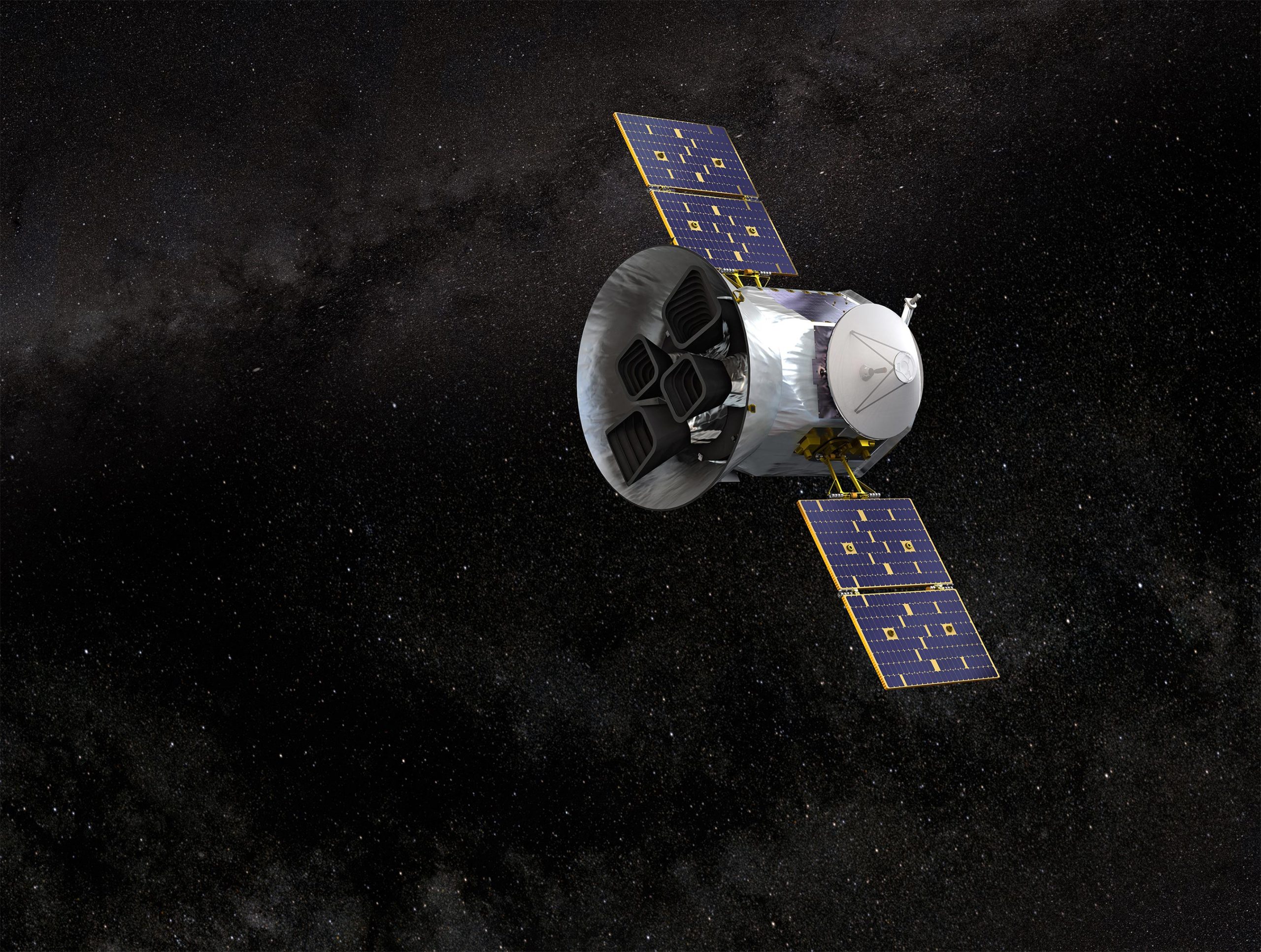
- NASA’s space telescope, the Transiting Exoplanet Survey Satellite (TESS).
- Transit is a phenomenon caused by a planet partially blocking starlight as it passes in front of the star.
- MuSCAT series are multi-color cameras mounted on 1~2m class grand-based telescopes.
- The gravitational pull of a planet causes its parent star to wobble. The radial velocity method (or the Doppler method) uses the apparent variations in the velocity of a star in the direction of the line of sight to detect an unseen planet.
Reference: “The Discovery and Follow-up of Four Transiting Short-period Sub-Neptunes Orbiting M Dwarfs” by Yasunori Hori, Akihiko Fukui, Teruyuki Hirano, Norio Narita, Jerome P. de Leon, Hiroyuki Tako Ishikawa, Joel D. Hartman, Giuseppe Morello, Nestor Abreu García, Leticia Álvarez Hernández, Víctor J. S. Béjar, Yéssica Calatayud-Borras, Ilaria Carleo, Gareb Enoc, Emma Esparza-Borges, Izuru Fukuda, Daniel Galán, Samuel Geraldía-González, Yuya Hayashi, Masahiro Ikoma, Kai Ikuta, Keisuke Isogai, Taiki Kagetani, Yugo Kawai, Kiyoe Kawauchi, Tadahiro Kimura, Takanori Kodama, Judith Korth, Nobuhiko Kusakabe, Andrés Laza-Ramos, John H. Livingston, Rafael Luque, Kohei Miyakawa, Mayuko Mori, Felipe Murgas, Jaume Orell-Miquel, Enric Palle, Hannu Parviainen, Alberto Peláez-Torres, Marta Puig-Subirà, Manuel Sánchez-Benavente, Paula Sosa-Guillén, Monika Stangret, Yuka Terada, Sara Muñoz Torres, Noriharu Watanabe, Gaspar Á. Bakos, Khalid Barkaoui, Charles Beichman, Zouhair Benkhaldoun, Andrew W. Boyle, David R. Ciardi, Catherine A. Clark, Karen A. Collins, Kevin I. Collins, Dennis M. Conti, Ian J.M. Crossfield, Mark E. Everett, Elise Furlan, Mourad Ghachoui, Michaël Gillon, Erica J. Gonzales, Jesus Higuera, Keith Horne, Steve B. Howell, Emmanuël Jehin, Kathryn V. Lester, Michael B. Lund, Rachel Matson, Elisabeth C. Matthews, Francisco J. Pozuelos, Boris S. Safonov, Joshua E. Schlieder, Richard P. Schwarz, Ramotholo Sefako, Gregor Srdoc, Ivan A. Strakhov, Mathilde Timmermans, William C. Waalkes, Carl Ziegler, David Charbonneau, Zahra Essack, Natalia M. Guerrero, Hiroki Harakawa, Christina Hedges, Masato Ishizuka, Jon M. Jenkins, Mihoko Konishi, Takayuki Kotani, Tomoyuki Kudo, Takashi Kurokawa, Masayuki Kuzuhara, Jun Nishikawa, Masashi Omiya, George R. Ricker, Sara Seager, Takuma Serizawa, Stephanie Striegel, Motohide Tamura, Akitoshi Ueda, Roland Vanderspek, Sébastien Vievard and Joshua N. Winn, 30 May 2024, The Astronomical Journal.
DOI: 10.3847/1538-3881/ad4115
Never miss a breakthrough: Join the SciTechDaily newsletter.
Follow us on Google and Google News.