
Close Menu
    Facebook X (Twitter) Instagram
    SciTechDaily
    • Biology
    • Chemistry
    • Earth
    • Health
    • Physics
    • Science
    • Space
    • Technology
    Facebook X (Twitter) Pinterest YouTube RSS
    SciTechDaily
    Home»Space»Water Vapor Found in Atmosphere of Ultra-Hot “Saturn” Exoplanet 250 Light Years Away
    Space

    Water Vapor Found in Atmosphere of Ultra-Hot “Saturn” Exoplanet 250 Light Years Away

    By National Institutes of Natural SciencesAugust 28, 20242 Comments3 Mins Read
    Facebook Twitter Pinterest Telegram LinkedIn WhatsApp Email Reddit
    Share
    Facebook Twitter LinkedIn Pinterest Telegram Email Reddit
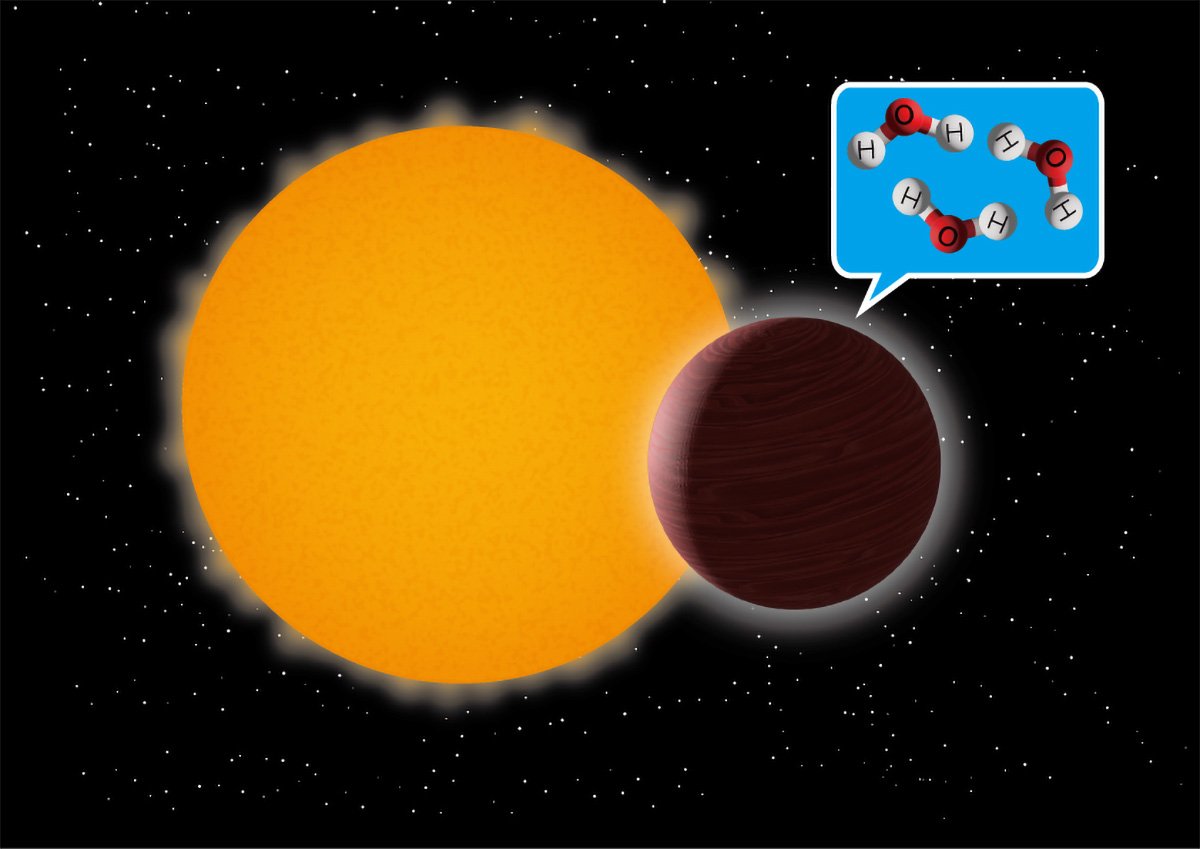
    Artist’s Conception of the HD 149026 b
    Artist’s conception of the HD 149026 b. Evidence of water vapor in this Hot Saturn’s atmosphere has been discovered. Credit: Astrobiology Center

    Water vapor has been detected in the atmosphere of a hot Saturn.

    New research has identified water vapor in the atmosphere of HD 149026 b, a hot Saturn-like exoplanet located approximately 250 light years away in the constellation of Hercules. Similar in size to Saturn, this hot gas giant orbits its host star at an extremely close distance.

    It orbits a metal-rich evolved star, HD 149026, nearly 10 times closer than Mercury’s orbit around the Sun, resulting in a year that lasts only about 2.9 days. This proximity causes the temperatures of such hot gas giants to soar above 1500 Kelvin. Specifically, HD 149026 b has an equilibrium temperature of approximately 1700 Kelvin, hot enough to melt even the strongest steel.

    Transmission Spectroscopy and Atmospheric Detection

    To detect atmospheric signatures from the planet, the team used a technique called transmission spectroscopy. When the planet transits or passes in front of its host star relative to the observer on Earth, some of the star’s light passes through the planet’s atmosphere.

    This starlight is absorbed by various gases in the atmosphere, creating a planetary absorption spectrum that is imprinted on the stellar spectrum. By separating the stellar spectrum from the planetary spectrum, such as by subtracting the spectrum observed outside of transit (where there’s no atmospheric absorption from the planet), the atmospheric signatures of the planet can be identified.

    Challenges in Observing Exoplanetary Atmospheres

    One major challenge in observing exoplanetary atmospheres is the extremely high contrast between the bright star and the dim planet. This makes the planet’s atmospheric signatures difficult to detect, often buried below the stellar photon noise.

    The strength of the planet’s signatures would be stronger if we observed planets with either higher temperatures (resulting in more extended atmospheres and easier detection), closer distances to their host stars (making it easier to separate the stellar and planet spectra), or a combination of both. Hot gas giants possess both these properties, making them ideal targets for transmission spectroscopy observations, though their atmospheric signatures remain challenging to detect.

    Reference: “Evidence of Water Vapor in the Atmosphere of a Metal-rich Hot Saturn with High-resolution Transmission Spectroscopy” by Sayyed A. Rafi, Stevanus K. Nugroho, Motohide Tamura, Lisa Nortmann and Alejandro Sánchez-López, 5 August 2024, The Astronomical Journal.
    DOI: 10.3847/1538-3881/ad5be9

    Never miss a breakthrough: Join the SciTechDaily newsletter.
    Follow us on Google and Google News.

    Astronomy Astrophysics Exoplanet National Institutes of Natural Sciences Water
    Share. Facebook Twitter Pinterest LinkedIn Email Reddit

    Related Articles

    Astronomers Weigh “Cotton Candy” Planets and Solve a Cosmic Mystery

    Giant Planet 18 Times Jupiter’s Mass Discovered in Distant Star System

    This Bizarre Exoplanet’s Orbit Is Wildly Tilted and Astronomers Don’t Know Why

    Unlocking Alien Worlds: Scientists Develop New Technique To Detect Water on Exoplanets

    “Truly Remarkable” – Scientists Discover Record-Breaking Super-Earth That Is As Dense as Lead

    Eccentric Oddities: Surprise Discovery of Mysterious Mini-Neptune Exoplanets

    Astronomers Uncover New Details About the Remarkable Seven Rocky Planets of TRAPPIST-1

    Astronomers Discover First Cloudless, Jupiter-Like Planet – “Smoking Gun Evidence”

    A ‘Super-Puff’ Planet Like No Other – As Big as Jupiter but 10 Times Lighter

    2 Comments

    1. Boba on August 28, 2024 5:59 pm

      Are they suggesting that planet is also running a global warming?

      Reply
      • Torbjörn Larsson on August 31, 2024 12:06 pm

        It could be. like Venus, but not of our man made type here on Earth.

        Reply
    Leave A Reply Cancel Reply

    • Facebook
    • Twitter
    • Pinterest
    • YouTube

    Don't Miss a Discovery

    Subscribe for the Latest in Science & Tech!

    Trending News

    Monster Storms on Jupiter Unleash Lightning Beyond Anything on Earth

    Scientists Create “Liquid Gears” That Spin Without Touching

    The Simple Habit That Could Help Prevent Cancer

    Millions Take These IBS Drugs, But a New Study Finds Serious Risks

    Scientists Unlock Hidden Secrets of 2,300-Year-Old Mummies Using Cutting-Edge CT Scanner

    Bread Might Be Making You Gain Weight Even Without Eating More Calories

    Scientists Discover Massive Magma Reservoir Beneath Tuscany

    Europe’s Most Active Volcano Just Got Stranger – Here’s Why Scientists Are Rethinking It

    Follow SciTechDaily
    • Facebook
    • Twitter
    • YouTube
    • Pinterest
    • Newsletter
    • RSS
    SciTech News
    • Biology News
    • Chemistry News
    • Earth News
    • Health News
    • Physics News
    • Science News
    • Space News
    • Technology News
    Recent Posts
    • Scientists Were Wrong About This Strange “Rule-Breaking” Particle
    • Webb Space Telescope Uncovers Unexpected Ice Clouds on a Jupiter-Like World
    • 289-Million-Year-Old Reptile Mummy Reveals Origin of Human Breathing System
    • New Brain Discovery Challenges Long-Held Theory of Teenage Brain Development
    • Sharks Are Overheating as Warming Oceans Push Them to the Edge
    Copyright © 1998 - 2026 SciTechDaily. All Rights Reserved.
    • Science News
    • About
    • Contact
    • Editorial Board
    • Privacy Policy
    • Terms of Use

    Type above and press Enter to search. Press Esc to cancel.