

Using a powerful combination of space-based measurements and Subaru’s advanced imaging, astronomers have discovered two rare companions, one of which enables a key test for NASA’s Roman Space Telescope.
Using the Subaru Telescope in Hawaiʻi, astronomers have identified two distant companions: a giant planet and a brown dwarf, each orbiting its own star. These objects are the first discoveries from OASIS (Observing Accelerators with SCExAO Imaging Survey), a project that combines measurements from space with the Subaru Telescope’s advanced imaging to reveal otherwise hidden worlds. Together, these findings provide essential targets for NASA’s upcoming Roman Space Telescope, which will use them to test critical technologies needed to image Earth-like planets.
At present, only about 1% of stars are known to host massive planets and brown dwarfs that can be directly photographed with existing telescopes. Even in young planetary systems where these objects are still glowing with the leftover heat from their formation, making them brighter and somewhat easier to spot, they remain far dimmer than the stars they orbit and are easily overwhelmed by the starlight. As a result, a central challenge for astronomers has been figuring out where to search for these faint companions in the first place.
How OASIS Targets the Best Candidates
That is where OASIS comes in. The program analyzes precise measurements from two European Space Agency missions, Hipparcos and Gaia, to find stars whose motions indicate the gravitational pull of unseen companions. Once such stars are identified, OASIS observes them with the Subaru Coronagraphic Extreme Adaptive Optics (SCExAO) system, which delivers the extraordinary precision and image quality required to directly capture these hidden objects.
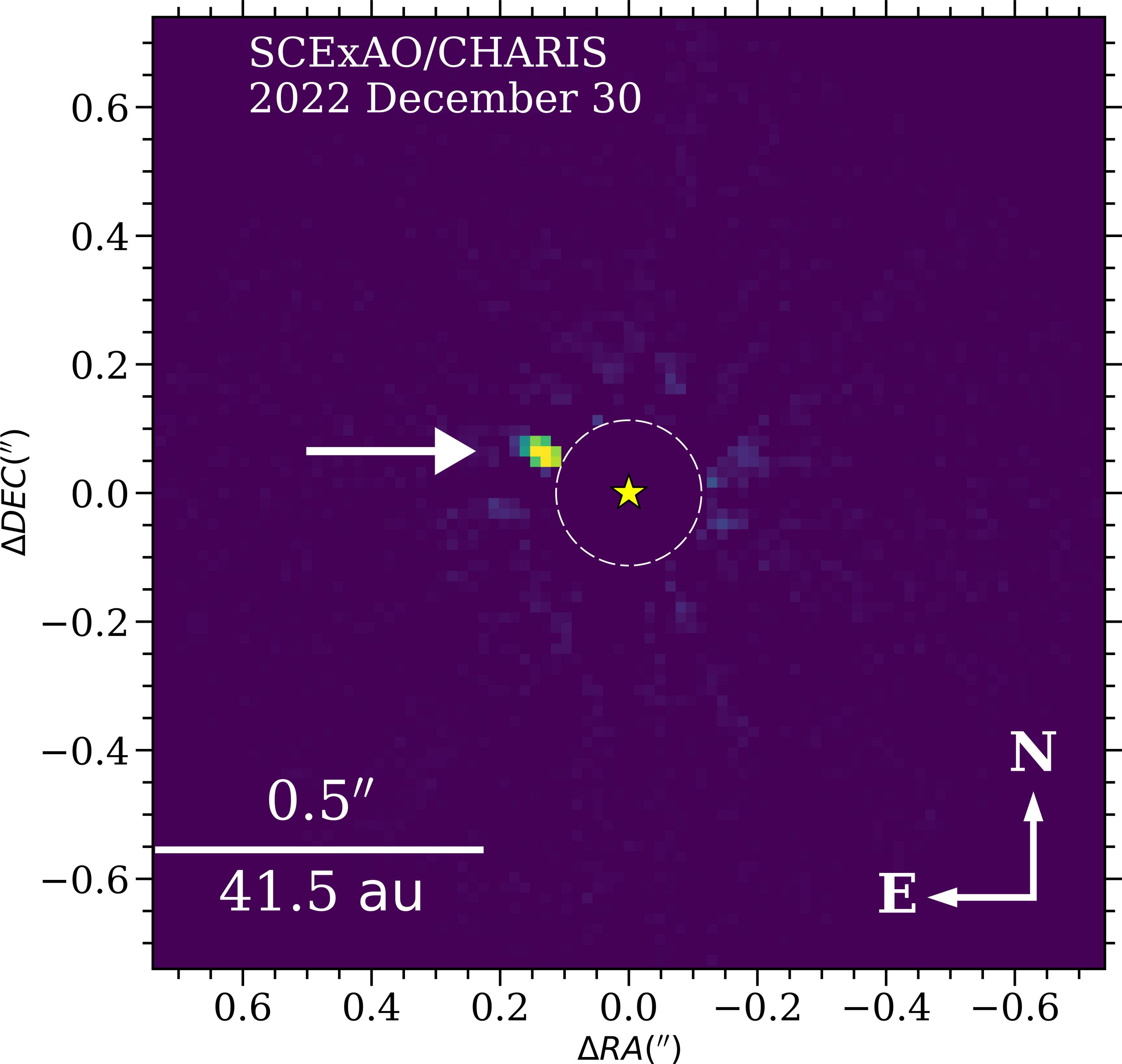
A Massive Planet in Leo
The newly discovered planet, HIP 54515 b, orbits a star 271 light-years away in the constellation Leo. With nearly 18 times Jupiter’s mass, it circles its star at about Neptune’s distance from our Sun.
But the star and planet appear very close when seen from Earth; roughly the size that a baseball seen 100 km away would appear. The SCExAO system produced extremely sharp images, allowing us to see the planet.
A Brown Dwarf in Bootes
The second discovery, HIP 71618 B, is a 60 Jupiter mass brown dwarf located 169 light-years away in the constellation Bootes. Brown dwarfs are sometimes called “failed stars”—because they form like stars but never become massive enough to sustain nuclear fusion.
A Crucial Target for NASA’s Roman Telescope
What makes HIP 71618 B special is its highly suitable properties for observations with NASA’s Roman Space Telescope. Roman will carry out a technology demonstration to test coronagraph systems that future telescopes will need to photograph Earth-like planets around other stars—planets that are ten billion times fainter than their host stars.
Before this discovery, astronomers didn’t have a single confirmed target meeting all the strict requirements for this demonstration. HIP 71618 B changes that, checking off the boxes for being a suitable target: its star is bright and the brown dwarf is in the right location. At the Roman Coronagraph’s operating wavelengths, it will be faint enough compared to its star to validate these new technologies.
These discoveries from OASIS showcase how combining space-based precision star-tracking and ground-based direct imaging can reveal planets and brown dwarfs that would otherwise remain hidden. This type of tag-team observations leading to new discoveries shows that the Subaru Telescope will continue to be a world-leading observatory in astronomy even as new telescopes come online.
Reference: “SCExAO/CHARIS and Gaia Direct Imaging and Astrometric Discovery of a Superjovian Planet 3–4 λ/D from the Accelerating Star HIP 54515*” by Thayne Currie, Yiting Li, Mona El Morsy, Brianna Lacy, Maria Vincent, Taylor L. Tobin, Masayuki Kuzuhara, Jeffrey Chilcote, Olivier Guyon, Ziying Gu, Danielle Bovie, Dillon Peng, Qier An, Timothy D Brandt, Vincent Deo, Robert de Rosa, Tyler D Groff, Markus Janson, N. J. Kasdin, Julien Lozi, Christian Marois, Bertrand Mennesson, Naoshi Murakami, Eric Nielsen, Sabina Sagynbayeva, Nour Skaf, William Thompson, Motohide Tamura, Taichi Uyama, Sebastien Vievard and Alice Zurlo, 3 December 2025, The Astronomical Journal.
DOI: 10.3847/1538-3881/ae1a82
Never miss a breakthrough: Join the SciTechDaily newsletter.
Follow us on Google and Google News.