
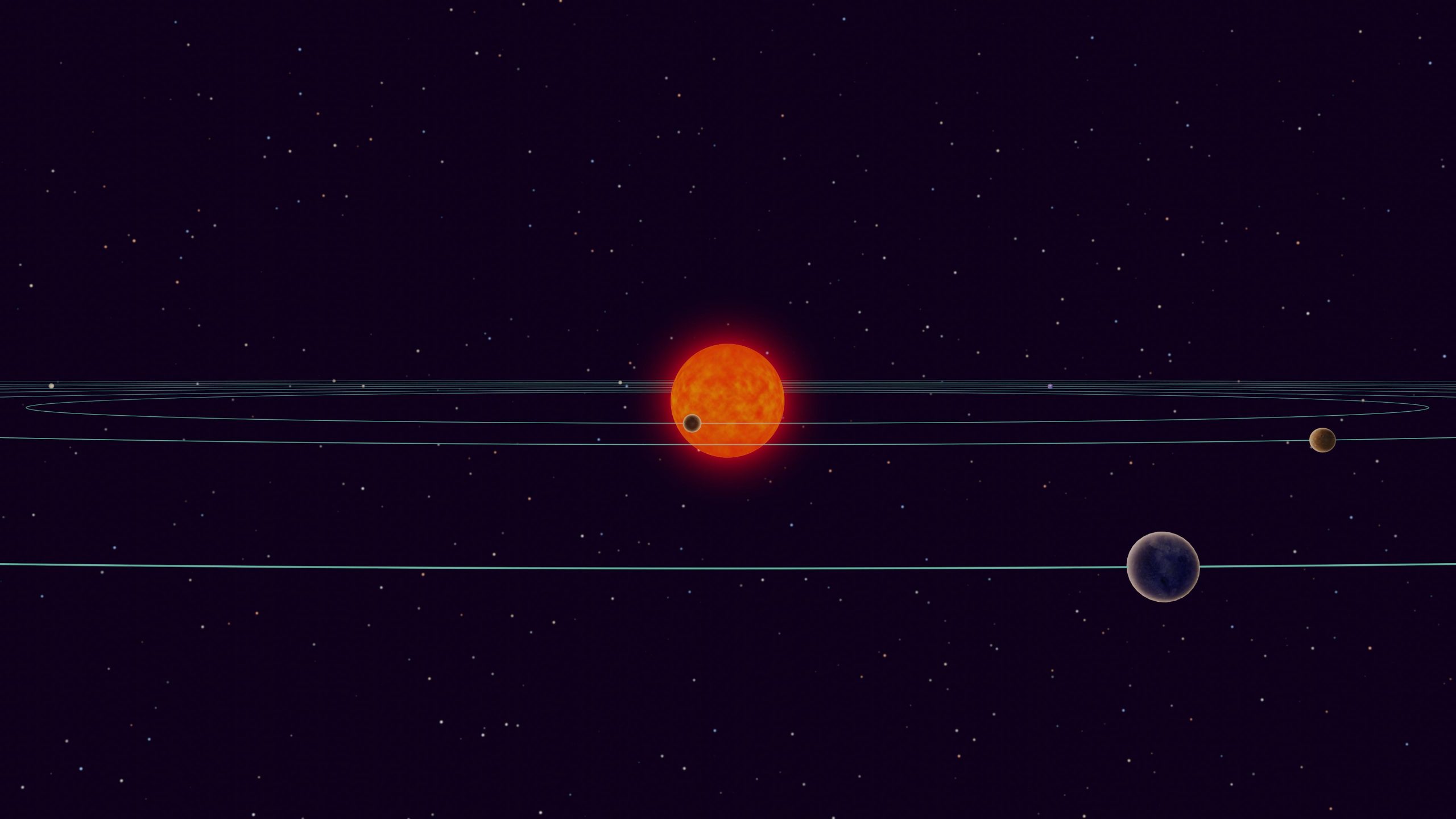
Astronomers using the Subaru Telescope have determined that the Earth-like planets of the TRAPPIST-1 system are not significantly misaligned with the rotation of the star. This is an important result for understanding the evolution of planetary systems around very low-mass stars in general, and in particular the history of the TRAPPIST-1 planets including the ones near the habitable zone.
Stars like the Sun are not static, but rotate about an axis. This rotation is most noticeable when there are features like sunspots on the surface of the star. In the Solar System, the orbits of all of the planets are aligned to within 6 degrees with the Sun’s rotation. In the past it was assumed that planetary orbits would be aligned with the rotation of the star, but there are now many known examples of exoplanet systems where the planetary orbits are strongly misaligned with the central star’s rotation.
This raises the question: can planetary systems form out of alignment, or did the observed misaligned systems start out aligned and were later thrown out of alignment by some perturbation?
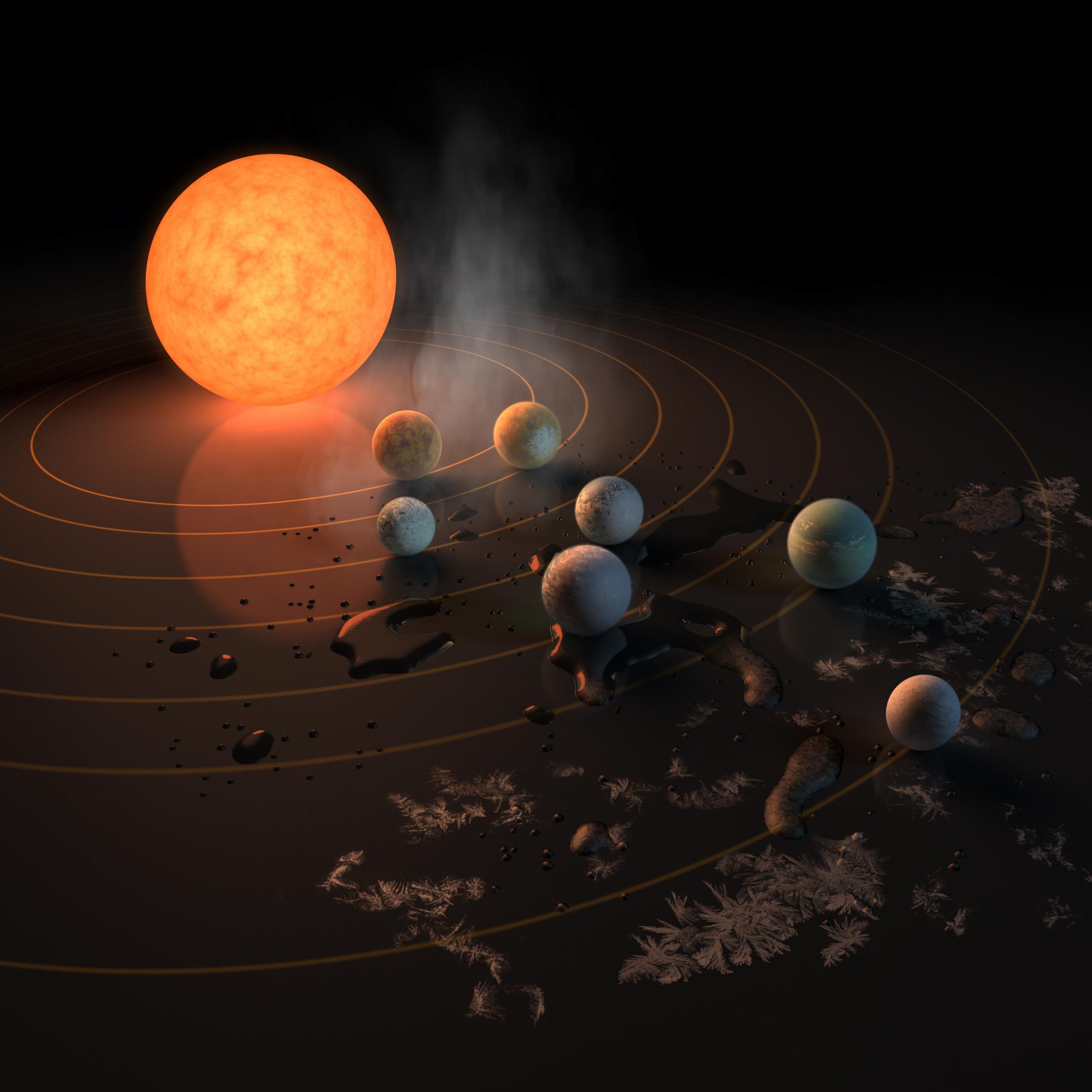
The TRAPPIST-1 system has attracted attention because it has three small rocky planets located in or near the habitable zone where liquid water can exist. The central star is a very low-mass and cool star, called an M dwarf, and those planets are situated very close to the central star. Therefore, this planetary system is very different from our Solar System.
Determining the history of this system is important because it could help determine if any of the potentially habitable planets are actually inhabitable. But it is also an interesting system because it lacks any nearby objects which could have perturbed the orbits of the planets, meaning that the orbits should still be located close to where the planets first formed. This gives astronomers a chance to investigate the primordial conditions of the system.
Because stars rotate, the side rotating into view has a relative velocity towards the viewer, while the side rotating out of view has a relative velocity away from the viewer. If a planet transits, passes between the star and the Earth and blocks a small portion of the light from the star, it is possible to tell which edge of the star the planet blocks first. This phenomenon is called the Rossiter-McLaughlin effect. Using this method, it is possible to measure the misalignment between the planetary orbit and the star’s rotation. However, until now those observations have been limited to large planets such as Jupiter-like or Neptune-like ones.
A team of researchers, including members from the Tokyo Institute of Technology and the Astrobiology Center in Japan, observed TRAPPIST-1 with the Subaru Telescope to look for misalignment between the planetary orbits and the star. The team took advantage of a chance on August 31, 2018, when three of the exoplanets orbiting TRAPPIST-1 transited in front of the star in a single night. Two of the three were rocky planets near the habitable zone. Since low-mass stars are generally faint, it had been impossible to probe the stellar obliquity (spin-orbit angle) for TRAPPIST-1. But thanks to the light gathering power of the Subaru Telescope and high spectral resolution of the new infrared spectrograph IRD, the team was able to measure the obliquity. They found that the obliquity was low, close to zero.
This is the first measurement of the stellar obliquity for a very low-mass star like TRAPPIST-1 and also the first Rossiter-McLaughlin measurement for planets in the habitable zone.
However the leader of the team, Teruyuki Hirano at the Tokyo Institute of Technology, cautions, “The data suggest alignment of the stellar spin with the planetary orbital axes, but the precision of the measurements was not good enough to completely rule out a small spin-orbit misalignment. Nonetheless, this is the first detection of the effect with Earth-like planets and more work will better characterize this remarkable exoplanet system.”
These results appeared as Hirano, T. et. al. “Evidence for Spin-Orbit Alignment in the TRAPPIST-1 System” in The Astrophysical Journal Letters on February 25, 2020.
Reference: “Evidence for Spin–Orbit Alignment in the TRAPPIST-1 System” by Teruyuki Hirano, Eric Gaidos, Joshua N. Winn, Fei Dai, Akihiko Fukui, Masayuki Kuzuhara, Takayuki Kotani, Motohide Tamura, Maria Hjorth, Simon Albrecht, Daniel Huber, Emeline Bolmont, Hiroki Harakawa, Klaus Hodapp, Masato Ishizuka, Shane Jacobson, Mihoko Konishi, Tomoyuki Kudo, Takashi Kurokawa, Jun Nishikawa, Masashi Omiya, Takuma Serizawa, Akitoshi Ueda and Lauren M. Weiss, 25 February 2020, The Astrophysical Journal Letters.
DOI: 10.3847/2041-8213/ab74dc
Never miss a breakthrough: Join the SciTechDaily newsletter.
Follow us on Google and Google News.
1 Comment
I like the efforts you have put in this, thankyou for all the great posts