
Close Menu
    Facebook X (Twitter) Instagram
    SciTechDaily
    • Biology
    • Chemistry
    • Earth
    • Health
    • Physics
    • Science
    • Space
    • Technology
    Facebook X (Twitter) Pinterest YouTube RSS
    SciTechDaily
    Home»Space»Atmosphere of Super-Earth GJ1214b Possibly Includes Abundant Water Vapor
    Space

    Atmosphere of Super-Earth GJ1214b Possibly Includes Abundant Water Vapor

    By Smithsonian Astrophysical ObservatoryMarch 5, 2012No Comments3 Mins Read
    Facebook Twitter Pinterest Telegram LinkedIn WhatsApp Email Reddit
    Share
    Facebook Twitter LinkedIn Pinterest Telegram Email Reddit
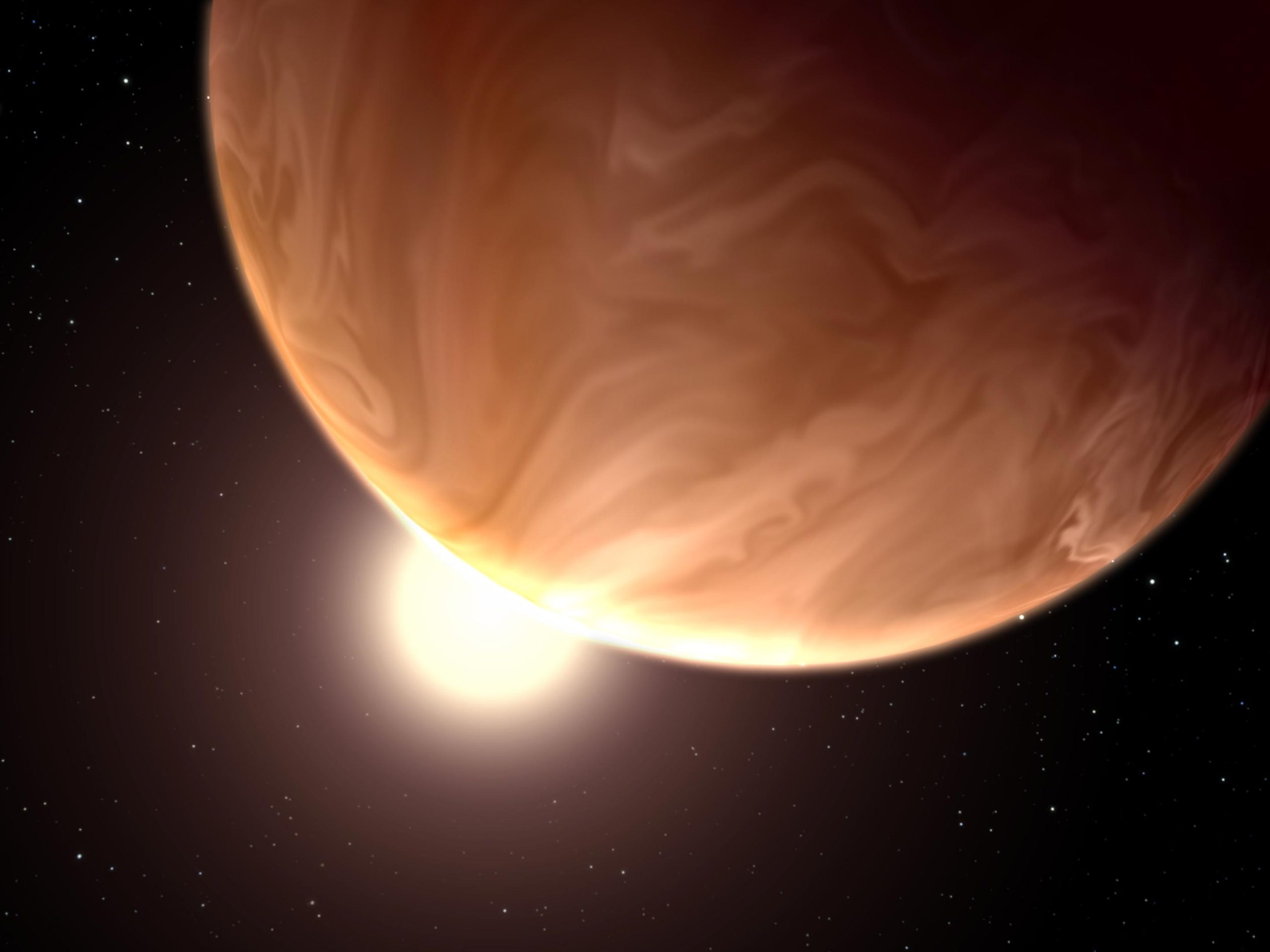
    Exoplanet GJ 1214b
    This is an illustration of the hypothetical appearance of the exoplanet GJ 1214b, which is known as a “super-Earth” type planet because it is slightly more than six Earth masses. Spectroscopic observations with NASA’s Hubble Space Telescope provide evidence of high clouds blanketing the planet. These clouds hide any information about the composition and behavior of the world’s lower atmosphere and surface. The composition of the clouds is unknown. GJ1214b is located 40 light-years from Earth, in the constellation Ophiuchus. Credit: Artwork: NASA, ESA, and G. Bacon (STScI); Science: NASA, ESA, L. Kreidberg and J. Bean (University of Chicago), and H. Knutson (California Institute of Technology)

    Using the Hubble Space Telescope, astronomers probed the atmosphere around the transiting super-Earth known as GJ1214b and concluded that unless the atmosphere has a thick top layer of clouds obscuring our view, its probable composition includes abundant water vapor.

    A “super-Earth” is an exoplanet (a planet around another star) whose mass is between about two and ten Earth masses. Planets larger than this are closer to Uranus and Neptune in size (and perhaps in other physical properties as well). The category of “super-Earth” currently refers only to the mass of the object, and not to its radius, its orbital distance from the star, its surface temperature, or its atmospheric properties, although naturally astronomers are working hard to identify super-Earths that might offer clues about the Earth in these features. Of the 576 exoplanets whose basic parameters are currently approximately known, there are 36 in the super-Earth category.

    Infrared Spectrum of the Super-Earth GJ1214b
    Infrared spectrum of the super-Earth GJ1214b. Credit: Smithsonian Astrophysical Observatory

    Four CfA astronomers, Zachory Berta, David Charbonneau, Jean-Michel Desert, and Jonathan Irwin, together with six colleagues, used the Hubble Space Telescope to probe the atmosphere around the transiting super-Earth known as GJ1214b. This exoplanet has a mass of 6.5 Earth-masses and a radius of 2.7 Earth-radii, and it orbits a small M-dwarf star (its diameter is only 21% of the Sun’s). They used the Hubble infrared spectrometer to observe the planet as it transited across the face of the star; as it did so, the planet’s atmosphere absorbed light from the star, thus subtly altering the star’s intrinsic spectrum as we observe it. The intrinsic spectrum itself was carefully measured and subtracted after the transit.

    Earlier models tried to predict what the atmosphere of this super-Earth might contain, based on ground-based transit spectra of it and on our current knowledge of the atmospheres of the planets in the solar system. For example, an atmosphere dominated by molecular hydrogen is one possibility; this is the situation in Jupiter. But measurements made in three separate transits found no evidence for this scenario — nor were they consistent with an equilibrium atmosphere composed of elements whose relative abundances are those of the average solar system. Instead, the astronomers concluded that, unless the atmosphere has a thick top layer of clouds obscuring our view, its probable composition includes abundant water vapor. Probing the atmosphere around a planet orbiting a star 42 light-years away is a remarkable achievement and an early step. Future observations of this and other transiting exoplanets will tell us more about the atmospheres of exoplanets, and lead to a better understanding of how atmospheres form, evolve, and behave under a wide range of physical conditions.

    Never miss a breakthrough: Join the SciTechDaily newsletter.
    Follow us on Google and Google News.

    Astronomy Atmosphere Exoplanet Hubble Space Telescope Popular Smithsonian Astrophysical Observatory Super-Earth Water
    Share. Facebook Twitter Pinterest LinkedIn Email Reddit

    Related Articles

    Hubble Spots Water Vapor in Small Exoplanet’s Atmosphere

    New Innovative System Evaluates the Habitability of Distant Planets

    Discovery of Laughing Gas in Space Could Mean Alien Life

    Raining Vaporized Rock: Hubble Probes Bizarre Weather Conditions on Sizzling Worlds

    How Habitable Are Planets That Orbit Red Dwarfs – The Most Common Type of Stars in the Galaxy?

    Witness the Formation of a Planet: Hubble Watches How a Giant Exoplanet Grows

    Hubble Space Telescope Sees Volcanic Activity Reforming the Atmosphere on a Rocky Exoplanet

    Hubble Finds Earth-Sized Planet That May Be on Its Second Atmosphere

    Hubble Discovers a Strange Exoplanet That Resembles the Long-Sought “Planet Nine”

    Leave A Reply Cancel Reply

    • Facebook
    • Twitter
    • Pinterest
    • YouTube

    Don't Miss a Discovery

    Subscribe for the Latest in Science & Tech!

    Trending News

    Scientists Discover Game-Changing New Way To Treat High Cholesterol

    This Small Change to Your Exercise Routine Could Be the Secret to Living Longer

    Scientists Discover 430,000-Year-Old Wooden Tools, Rewriting Human History

    AI Could Detect Early Signs of Alzheimer’s in Under a Minute – Far Before Traditional Tests

    What if Dark Matter Has Two Forms? Bold New Hypothesis Could Explain a Cosmic Mystery

    This Metal Melts in Your Hand – and Scientists Just Discovered Something Strange

    Beef vs. Chicken: Surprising Results From New Prediabetes Study

    Alzheimer’s Breakthrough: Scientists Discover Key Protein May Prevent Toxic Protein Clumps in the Brain

    Follow SciTechDaily
    • Facebook
    • Twitter
    • YouTube
    • Pinterest
    • Newsletter
    • RSS
    SciTech News
    • Biology News
    • Chemistry News
    • Earth News
    • Health News
    • Physics News
    • Science News
    • Space News
    • Technology News
    Recent Posts
    • Ancient “Spaghetti” in Dogs’ Hearts Reveals Heartworm’s Shocking Origins
    • Milk Nanoparticles Could Revolutionize Treatment for Deadly Bile Duct Cancer
    • Largest-Ever Study Finds Medicinal Cannabis Ineffective for Anxiety, Depression, PTSD
    • Scientists Reveal Why a Common Drug Causes Birth Defects and Autism
    • A Medieval Japanese Diary Just Helped Scientists Detect a Dangerous Solar Event
    Copyright © 1998 - 2026 SciTechDaily. All Rights Reserved.
    • Science News
    • About
    • Contact
    • Editorial Board
    • Privacy Policy
    • Terms of Use

    Type above and press Enter to search. Press Esc to cancel.