
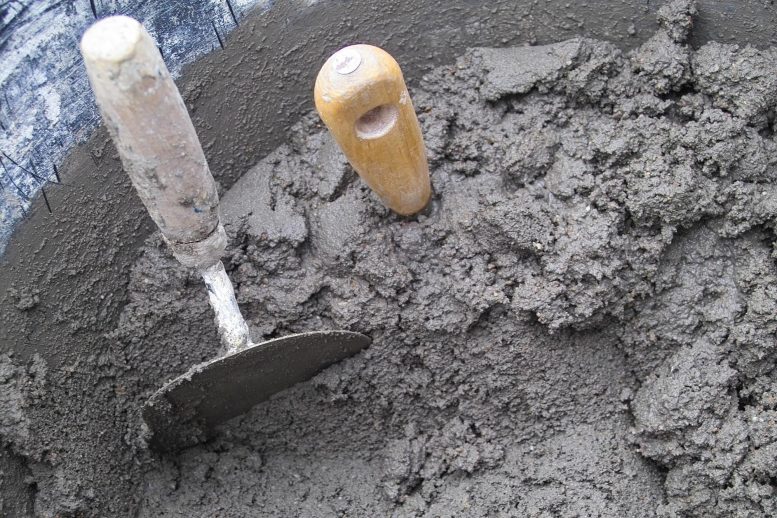
A team of engineers at Drexel University have developed a “green” version of ordinary Portland cement (OPC). By using a form of alkali-activated cement that utilizes slag, limestone, and does not require heating to produce, their cement reduces energy consumption and carbon dioxide production by 97% and decreases material cost by 40%.
Drexel University engineers have found a way to improve upon ordinary Portland cement (OPC), the glue that’s bonded much of the world’s construction since the late 1800s. In research recently published in Cement and Concrete Composites the group served up a recipe for cement that is more energy-efficient and cost-effective to produce than masonry’s most prevalent bonding compound.
Drexel’s “green” variety is a form of alkali-activated cement that utilizes an industrial byproduct, called slag, and a common mineral, limestone, and does not require heating to produce. According to Dr. Michel W. Barsoum, A.W. Grosvenor professor in Drexel’s Department of Materials Science and Engineering, this alternative production method and the ubiquity of the mix ingredients, lessens the cost of materials for Drexel’s cement by about 40 percent versus Portland cement and reduces energy consumption and carbon dioxide production by 97 percent.

“Cement consumption is rapidly rising, especially in newly industrialized countries, and it’s already responsible for 5 percent of human-made carbon dioxide. This is a unique way to limit the environmental consequences of meeting demand,” Dr. Alex Moseson, one of the lead researchers on the project, said.
While forms of alkali-activated cement have been used as far back as the 1950s and 1960s in several buildings in the former Soviet Union, much of the inspiration for this research came from the Pyramids in Egypt, as well as buildings in ancient Rome.
“Our cement is more like ancient Roman cement than like modern Portland,” Moseson said. “Although we won’t know for 2,000 years if ours has the longevity of Roman buildings, it gives us an idea of the staying power of this material.”
In contrast to ordinary Portland cement, Drexel’s cement is made of up to 68 percent unfired limestone, a plentiful, cheap, and low-carbon dioxide resource; the American Society for Testing and Materials standards for Portland cement limit the amount to 5 percent. To this base, a small amount of commercial alkali chemical is added along with the iron slag byproduct. In Portland cement the substitute for this mixture, called clinker, is produced by firing a number of ingredients in a kiln, thus requiring more energy and generating more carbon dioxide.
During Moseson’s work in India to commercialize the technology, he developed products that meet local standards, using entirely local materials and techniques. He also investigated how the availability of green cement could help make quality building materials more affordable and accessible to marginalized populations living in slums, and create jobs by jump-starting small-scale cement manufacturing in the country.
“Our results and the literature confirm that it performs as well or better than OPC,” Barsoum said. “We are very close to having the cement pass an important commercialization milestone, ASTM C1157, a standard that judges cement-like products on performance, such as strength and setting-time, regardless of composition”
The next step for the cement is getting it to the market, which the group is working toward via a start-up company called Greenstone Technologies, Inc.
Never miss a breakthrough: Join the SciTechDaily newsletter.
Follow us on Google and Google News.