
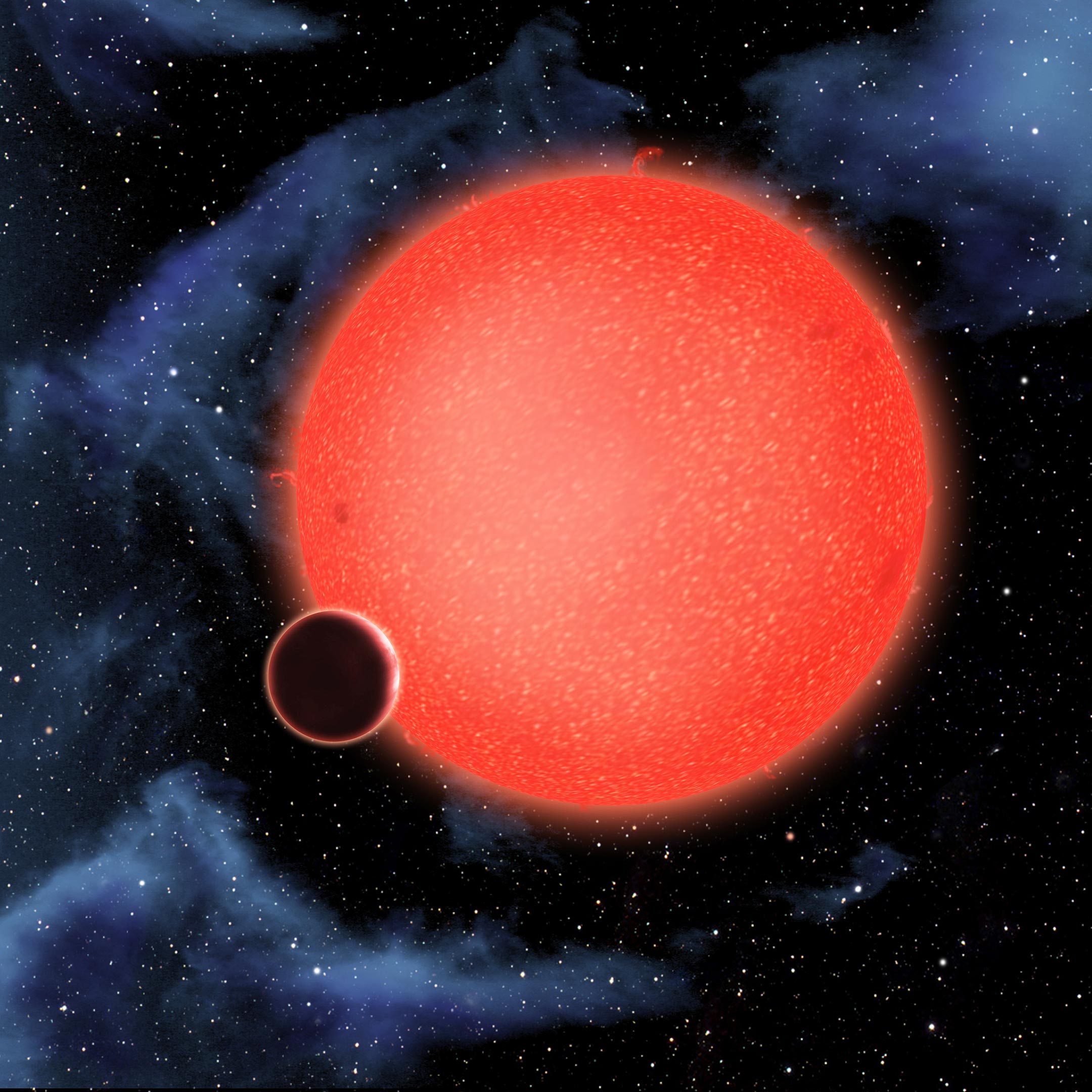
NASA’s Hubble Space Telescope helped astronomers analyze the previously discovered world GJ1214b and helped them prove that it is a waterworld enshrouded by a thick, steamy atmosphere. GJ1214b is 2.7 times Earth’s diameter, weighs almost 7 times as much, and orbits a red dwarf star every 38 hours at a distance of 1.3 million miles.
Our solar system contains three types of planets: rocky, terrestrial worlds (Mercury, Venus, Earth, and Mars), gas giants (Jupiter and Saturn), and ice giants (Uranus and Neptune). Planets orbiting distant stars come in an even wider variety, including lava worlds and “hot Jupiters.”
Observations by NASA’s Hubble Space Telescope have added a new type of planet to the mix. By analyzing the previously discovered world GJ1214b, astronomer Zachory Berta (Harvard-Smithsonian Center for Astrophysics) and colleagues proved that it is a waterworld enshrouded by a thick, steamy atmosphere.
“GJ1214b is like no planet we know of,” said Berta. “A huge fraction of its mass is made up of water.”
GJ1214b was discovered in 2009 by the ground-based MEarth (pronounced “mirth”) Project, which is led by CfA’s David Charbonneau. This super-Earth is about 2.7 times Earth’s diameter and weighs almost 7 times as much. It orbits a red dwarf star every 38 hours at a distance of 1.3 million miles (2.1 million kilometers), giving it an estimated temperature of 450 ° Fahrenheit (230 ° Celsius).
In 2010, CfA scientist Jacob Bean and colleagues reported that they had measured the atmosphere of GJ1214b, finding it likely that the atmosphere was composed mainly of water. However, their observations could also be explained by the presence of a world-wide haze in GJ1214b’s atmosphere.
Berta and his co-authors used Hubble’s WFC3 instrument to study GJ1214b when it crossed in front of its host star. During such a transit, the star’s light is filtered through the planet’s atmosphere, giving clues to the mix of gases.
“We’re using Hubble to measure the infrared color of sunset on this world,” explained Berta.
Hazes are more transparent to infrared light than to visible light, so the Hubble observations help tell the difference between a steamy and a hazy atmosphere.
They found the spectrum of GJ1214b to be featureless over a wide range of wavelengths, or colors. The atmospheric model most consistent with the Hubble data is a dense atmosphere of water vapor.
“The Hubble measurements really tip the balance in favor of a steamy atmosphere,” said Berta.
Since the planet’s mass and size are known, astronomers can calculate the density, which works out to about 2 grams per cubic centimeter. Water has a density of 1 g/cm³, while Earth’s average density is 5.5 g/cm³. This suggests that GJ1214b has much more water than Earth, and much less rock.
As a result, the internal structure of GJ1214b would be very different than our world.
“The high temperatures and high pressures would form exotic materials like ‘hot ice’ or ‘superfluid water’ — substances that are completely alien to our everyday experience,” said Berta.
Theorists expect that GJ1214b formed farther out from its star, where water ice was plentiful, and migrated inward early in the system’s history. In the process, it would have passed through the star’s habitable zone. How long it lingered there is unknown.
GJ1214b is located in the direction of the constellation Ophiuchus, and just 40 light-years from Earth. Therefore, it’s a prime candidate for study by the next-generation James Webb Space Telescope.
A paper reporting these results has been accepted for publication in The Astrophysical Journal and is available online.
Reference: “The Flat Transmission Spectrum of the Super-Earth GJ1214b From Wide Field Camera 3 on the Hubble Space Telescope” by Zachory K. Berta, David Charbonneau, Jean-Michel Désert, Eliza Miller-Ricci Kempton, Peter R. McCullough, Christopher J. Burke, Jonathan J. Fortney, Jonathan Irwin, Philip Nutzman and Derek Homeier, 13 February 2012, The Astrophysical Journal.
DOI: 10.1088/0004-637X/747/1/35
Never miss a breakthrough: Join the SciTechDaily newsletter.
Follow us on Google and Google News.